
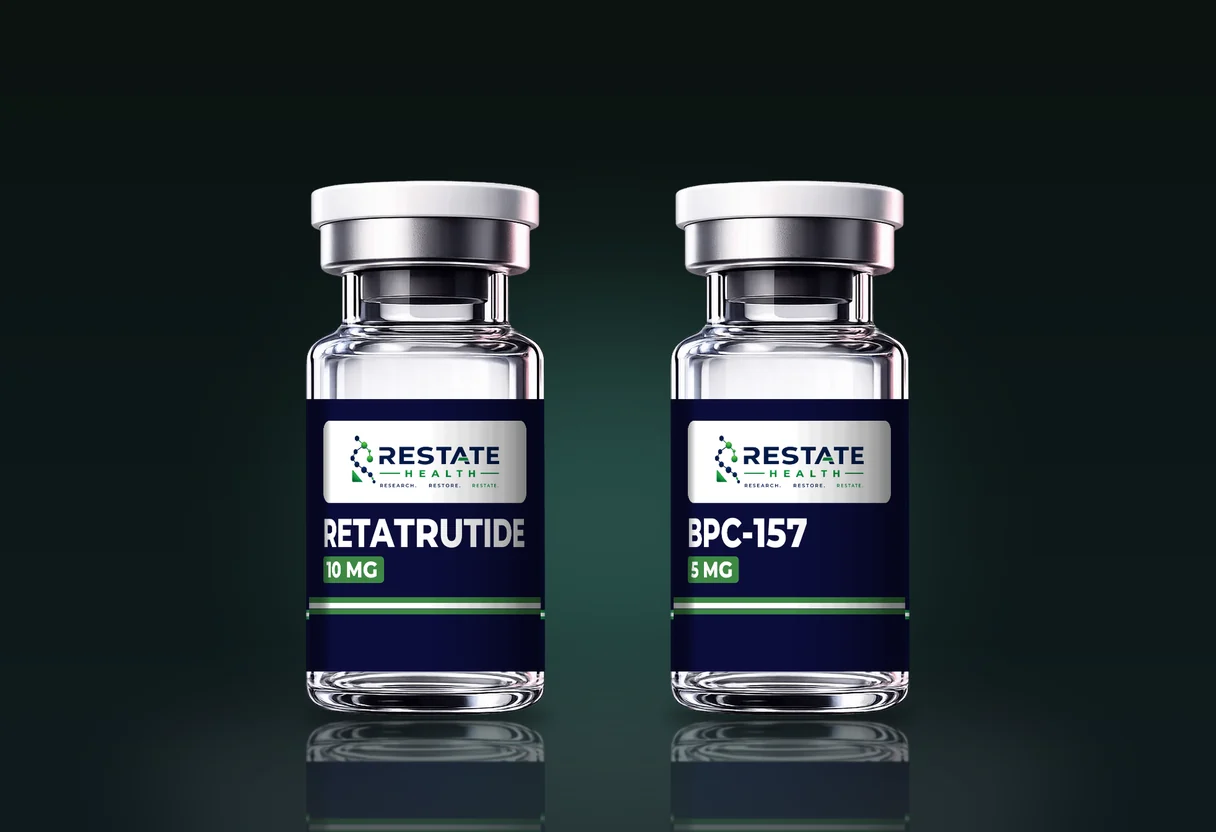
A certificate of analysis for a vial of LY3437943 or BPC-157 uses perhaps thirty technical terms in a single page, and a catalogue record and a wholesale quote add a further twenty. Most have a precise meaning fixed by a pharmacopoeia, an ICH guideline or an IUPAC recommendation, and several are routinely confused with each other.
This glossary defines them in one to three sentences each and points to the library guide that explains each one properly. Terms are grouped by subject so that the ones most often confused, purity and net content for instance, sit next to each other. Where a term has a formal source the source is in the references at the foot.
| Term | What it measures | Typical form | Where it comes from |
|---|---|---|---|
| Label strength | Mass of lyophilised solid in the vial, nominal | 10 mg | The fill, set to meet or exceed the label |
| Net peptide content | Fraction of that solid which is peptide rather than water, counterion and salt | 82% | Amino acid analysis, qNMR or nitrogen |
| HPLC purity | Share of detector response from the target peptide among peptide species the method separates | ≥99% | Reversed-phase HPLC, area percent |
The three numbers most often confused on a certificate. Each answers a different question, and multiplying the last two by the first gives the mass of target peptide in the vial.
Identity and structure
- Amino acid residue. What remains of an amino acid once it has been joined into a chain and lost a molecule of water to each bond. Residue masses, not free amino acid masses, are what sum to a peptide's molecular weight. See peptide nomenclature and sequence notation.
- Sequence. The order of residues from N-terminus to C-terminus, written in one-letter or three-letter code under the 1983 IUPAC-IUB recommendations. Two peptides with the same residues in a different order are different molecules of identical mass. See peptide nomenclature and sequence notation.
- Peptide bond. The amide linkage between the carboxyl of one residue and the amino group of the next, formed with loss of 18.015 Da of water and planar because of resonance. It is the bond that hydrolysis breaks. See peptide vs protein for why chains of it are classified as they are.
- Peptide versus protein. By convention a peptide has two to around fifty residues and a protein has more; the real distinction is whether the chain holds a stable fold. See peptide vs protein.
- Non-standard residue. A building block outside the twenty encoded amino acids, such as Aib (α-aminoisobutyric acid) in NN9535, LY3298176 and LY3437943. Its presence means the molecular weight cannot be checked from the letter code alone. See NN9535, LY3298176 and LY3437943 compared.
- Analogue. A molecule derived from a natural sequence by substituting, adding or removing residues or attaching groups. The certificate must confirm the analogue, not the parent. See GLP-1 and incretin peptides explained.
- Molecular formula. The count of each element in one molecule, written C62H98N16O22 for BPC-157. It must match between catalogue and certificate if the molecule is the same. See molecular weight for buyers.
- CAS Registry Number. A unique identifier for one substance assigned by the Chemical Abstracts Service. It is the quickest way to confirm two suppliers' products are the same molecule, or that a trivial name is being used for two different ones. See buying TB-500: confirming which molecule.
- Non-peptide catalogue item. A product listed alongside peptides that is not one, such as NAD (a coenzyme) or glutathione (a tripeptide by structure, but usually classed with small molecules). Different tests apply. See NAD is a coenzyme, not a peptide and not everything in a peptide catalogue is a peptide.
Purity and testing
- HPLC purity. The share of ultraviolet detector response from the main peak among the species a reversed-phase method separates, reported as area percent. It excludes water, salts and counterions entirely. See HPLC purity explained.
- Purity grade. A supplier's tier, usually quoted as ≥95%, ≥98% or ≥99% by HPLC. The figure is a minimum specification, and the certificate's measured value should sit at or above it. See peptide purity grades: what 95, 98 and 99 mean.
- Related impurity. A peptide species other than the target produced during synthesis or storage: deletion sequences, truncated chains, incompletely deprotected residues, oxidised or deamidated forms. These are what HPLC purity counts against. See peptide impurities explained.
- Identity by mass spectrometry. Confirmation that an observed mass is consistent with the expected molecule. An intact mass confirms the formula; a fragmentation method confirms the sequence. See mass spectrometry and peptide identity.
- Monoisotopic versus average mass. Two conventions for molecular weight. Monoisotopic uses the most abundant isotope of each element; average uses natural abundance. For a 4,800 Da peptide they differ by about three daltons, so a certificate must state which it reports. See molecular weight for buyers.
- Bacterial endotoxin. Lipopolysaccharide from Gram-negative bacteria, measured in endotoxin units (EU) per milligram or millilitre by the limulus amoebocyte lysate test or a recombinant factor C method under USP <85> and <86>. See endotoxin testing explained.
- Sterility test. A culture-based test for viable microorganisms under USP <71>. It is distinct from sterile filtration, which is a process step, and a certificate that reports one should not be read as reporting the other. See sterility testing vs sterile filtration.
- Elemental impurities. Metals such as lead, arsenic, cadmium and mercury, limited under ICH Q3D(R2). Rarely tested on research peptides and worth asking about. See heavy metals and residual solvents.
- Residual solvents. Organic solvents left from synthesis and purification, classified and limited under ICH Q3C. Acetonitrile and dimethylformamide are the ones most relevant to peptides. See heavy metals and residual solvents.
- Third-party testing. Analysis performed by a laboratory independent of the supplier. Its value depends on the laboratory's accreditation, usually to ISO/IEC 17025, and on whether the sample tested was the lot being sold. See third-party testing and ISO 17025.
- Method validation. Evidence, under ICH Q2(R2), that an analytical procedure is fit for its purpose: specific, accurate, precise and linear over its range. A purity figure from an unvalidated method is an estimate. See why peptide testing matters.
- What a certificate does not test. Anything not listed on it. Absence of a sterility or endotoxin line means the test was not done, not that the result was favourable. See what a CoA does not test for.
Content and mass
- Label strength. The nominal mass of lyophilised solid in the vial, such as 10 mg. It refers to the whole solid, not to the peptide alone. See net peptide content explained.
- Net peptide content. The fraction of the solid that is peptide, as opposed to water, counterion and salt, determined by amino acid analysis, quantitative NMR or nitrogen analysis. It is a separate figure from purity and the two multiply. See net peptide content explained.
- Amino acid analysis. The reference method for peptide content: the peptide is fully hydrolysed and the released amino acids quantified against standards. See net peptide content explained.
- Counterion. The anion paired with each positive charge on the peptide in the solid. Trifluoroacetate from HPLC purification is the default; acetate is supplied on request. The counterion is real mass that is not peptide. See TFA and acetate salt forms.
- Residual moisture. Water retained in the lyophilised solid, commonly a few percent by mass, measured by Karl Fischer titration or loss on drying. See residual moisture in lyophilised peptides.
- Molecular weight. The mass of one mole of the molecule in g/mol, numerically the same as the mass of one molecule in daltons. It is the figure that converts a mass to a number of moles. See molecular weight for buyers.
Handling and stability
- Lyophilisation. Freeze-drying: the solution is frozen and the water removed by sublimation under vacuum, leaving a dry solid that stores far better than the liquid. See lyophilisation explained.
- Reconstitution. Dissolving the lyophilised solid in a solvent to make a solution. The choice of solvent and the volume fix the concentration. See reconstitution solvents compared.
- Bacteriostatic water. Sterile water containing 0.9% benzyl alcohol as a preservative, used as a reconstitution solvent for multi-entry vials. See bacteriostatic water for peptides explained.
- Solubility. How much peptide dissolves in a given solvent, governed mainly by net charge and hydrophobic content. Highly charged peptides dissolve readily in water; lipidated and hydrophobic ones dissolve slowly. See peptide solubility explained.
- Degradation pathways. The chemical routes by which a peptide in solution loses integrity: hydrolysis of the backbone, deamidation, oxidation, racemisation and aggregation. See peptide degradation pathways.
- Shelf life. The period over which material stored as directed remains within specification, under the stability principles of ICH Q1A(R2). It differs sharply between lyophilised solid and solution. See peptide shelf life: lyophilised vs in solution.
- Cold chain. The controlled-temperature handling of material from supplier to storage, including the shipping container and its monitoring. See cold chain for peptide shipments.
- Temperature excursion. A period during which material was outside its specified storage range. What matters is how far, for how long, and whether the material was solid or in solution. See temperature excursions on arrival.
- Light sensitivity. Susceptibility of residues such as tryptophan, tyrosine and methionine to photo-oxidation, which is why amber glass and the catalogue's protect-from-light storage line exist. See light sensitivity and amber glass.
Documentation and records
- Certificate of analysis. The document reporting a lot's test results against its specification: identity, purity, appearance and whatever else was tested, with dates and the testing laboratory. See how to read a peptide CoA.
- Lot number. The identifier tying a vial to the batch it came from and to that batch's certificate. The lot on the glass must match the lot on the paper. See lot traceability and recordkeeping.
- Retest date versus expiry date. A retest date is the point at which material should be re-examined to confirm it still meets specification, under ICH Q7; an expiry date is the point after which it should not be used. Suppliers use the two inconsistently. See retest dates vs expiry dates.
- Chain of custody. The record of who held material, where, from receipt to use or disposal. See chain of custody inside a practice.
- Verifying a certificate. Checking that a certificate is genuine and refers to the lot received: contacting the testing laboratory, matching lot numbers and dates, reconciling the formula and mass. See how to verify a certificate of analysis.
- Standard operating procedure. A written, versioned procedure for a recurring task such as receiving and storing a shipment, so that it is done the same way each time and the record shows it. See writing an SOP for peptide receipt and storage.
Buying terms
- Research use only. The supply condition under which catalogue material is sold: for laboratory research, not for human or veterinary use. The phrase has a specific meaning and a supplier's obligations follow from it. See research use only explained.
- Minimum order quantity. The smallest order a supplier will accept for a product or account, which may exceed what a laboratory can consume before the material ages. See minimum order quantities explained.
- Payment terms. The agreed timing of payment, such as prepayment or net 30, and the conditions under which credit is extended to an account. See payment terms and wholesale accounts.
- Quote. A written offer stating product, strength, quantity, unit price, lead time and validity period. The lines to read are the ones that are missing. See reading a wholesale peptide quote.
- Lead time and reorder point. The time between order and receipt, and the stock level at which a reorder must be placed to avoid running out across that time. See inventory and reorder points.
- Counterfeit and mislabelled material. A vial whose contents do not match its label, whether by fraud or error. The defences are lot-matched certificates, independent testing and receiving inspection. See counterfeit and mislabelled material.
- Receiving inspection. The check performed when a shipment arrives: temperature indicator, seals, labels against the packing list, lots against certificates. See receiving and inspecting a peptide shipment.
- Supplier audit. A structured review of a supplier's documentation, testing, traceability and responsiveness before and during a buying relationship. See supplier audit checklist and comparing suppliers on documentation.