
Most lyophilised peptides in this catalogue carry the same storage line: reconstitute with bacteriostatic water. Bacteriostatic Water is therefore the one item a laboratory orders alongside almost everything else, and it is also the item least often read about. It is a pharmacopoeial article with a label, a composition and a set of conventions, and each of those has consequences for the peptide dissolved in it.
This guide covers what the article is, what the preservative does and does not do, where the 28-day figure comes from, how the three diluents a buyer meets differ, and the situations in which the preservative is the wrong choice. Reconstitution solvents compared covers choosing between water, buffer and organic co-solvents for a difficult sequence, and is not repeated here.
What the pharmacopoeial article is
Bacteriostatic Water for Injection, USP is the United States Pharmacopeia's name for sterile, nonpyrogenic water for injection to which benzyl alcohol has been added as a preservative. The Hospira label on file with the FDA, which is the product listed in this catalogue, describes it as containing 0.9% (9 mg/mL) or 1.1% (11 mg/mL) of benzyl alcohol, with a pH of 5.7 within a range of 4.5 to 7.0, stored at 20 to 25 °C. The 30 mL plastic vial is the 9 mg/mL presentation.
The label calls the container one from which repeated withdrawals may be made, which is the whole reason the preservative is there. Sterile Water for Injection, USP, the same manufacturer's unpreserved article, is supplied only in single-use containers and its label instructs that the unused portion be discarded. The preservative is what permits a second entry.
Benzyl alcohol itself is a small aromatic alcohol, C7H8O, molecular weight 108.14 g/mol (PubChem CID 244). At 9 mg/mL a 30 mL vial contains 270 mg of it, and every millilitre drawn to dissolve a peptide carries 9 mg of benzyl alcohol into the peptide vial.
What the preservative does
Bacteriostatic means growth-inhibiting. Each time a needle passes the septum there is a chance of carrying a small number of organisms into the vial; the benzyl alcohol is there to stop that inoculum multiplying between entries. That is the full extent of the claim.
- It does not sterilise. A solution that was contaminated at a level the preservative cannot hold is not made sterile by containing benzyl alcohol, and a vial handled badly is not rescued by it.
- It does not stabilise the peptide. Benzyl alcohol has no effect on deamidation, oxidation or hydrolysis, which are chemical processes rather than microbial ones. The clock on a reconstituted peptide runs at the same speed whichever diluent was used.
- It does not extend the peptide's life to 28 days. The 28-day convention, covered below, belongs to the diluent vial and says nothing about the peptide dissolved in it.
Where the 28-day convention comes from
The figure most people attach to bacteriostatic water is 28 days after first entry. The Hospira label does not state it. The label's own instruction is to use aseptic technique for single or multiple entries, mix thoroughly and use promptly, and not to store solutions made with it unless the manufacturer of the dissolved material says otherwise.
The 28 days come from USP General Chapter <797>, Pharmaceutical Compounding: Sterile Preparations, which sets the default beyond-use date for an opened multiple-use container at 28 days after initial entry unless the manufacturer specifies a different period. That is a default for the diluent vial, written for a different setting, and it is the reason some distributors print 28 days on their packaging.
For a laboratory the practical reading is this: the date of first entry goes on the diluent vial, the vial is discarded at 28 days or at the manufacturer's stated period, and the peptide dissolved in it is governed by its own stability, which is a separate question covered in peptide storage and handling.
Three diluents compared
A buyer meets three articles that look alike on a shelf. Two are pharmacopoeial products from a licensed manufacturer and one is a catalogue item made to the same composition.
| Article | Preservative | Container | After first entry | Catalogue |
|---|---|---|---|---|
| Bacteriostatic Water for Injection, USP (Hospira) | Benzyl alcohol 0.9% (9 mg/mL) | Multiple-use, 30 mL plastic vial | Date the vial; USP <797> default of 28 days unless the manufacturer states otherwise | 30 mL from $56.00 |
| Sterile Water for Injection, USP (Hospira) | None; no bacteriostat, antimicrobial agent or buffer | Single-use only | Discard the unused portion; no second entry | Not listed |
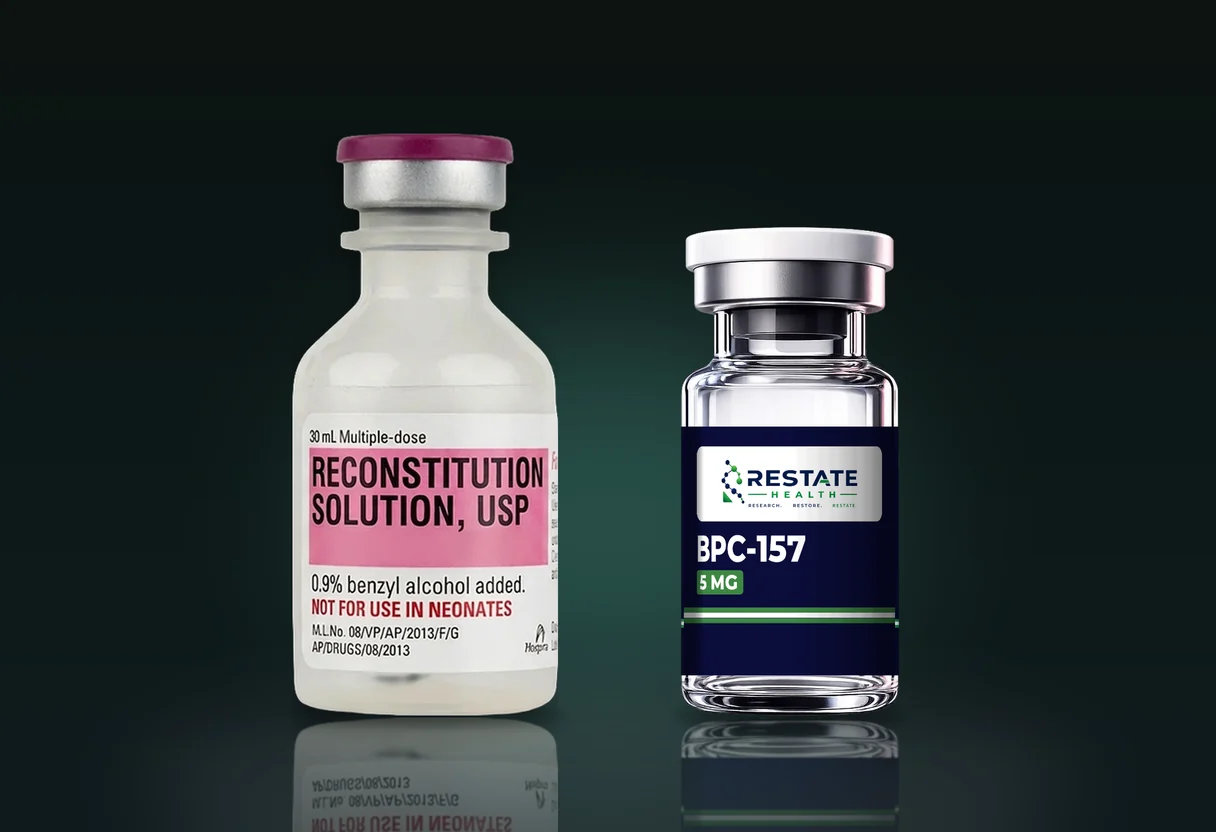
| Reconstitution Solution (Restate Health) | Benzyl alcohol 0.9% | Multiple-use, 30 mL vial | Same convention as bacteriostatic water | 30 mL from $33.60 |
From the Hospira labels on DailyMed (Bacteriostatic Water for Injection, USP, set id 87d6e9dc; Sterile Water for Injection, USP, set id 3a6422e1) and the catalogue records for the two Restate Health diluents.
The catalogue's Reconstitution Solution is described in its record as sterile reconstitution solution with 0.9% benzyl alcohol in a 30 mL vial, a diluent that contains no active peptide. It is the same composition as the pharmacopoeial article at a lower price; what differs is that one is a licensed drug product with an FDA-listed label and the other is a laboratory reagent with a certificate. A buyer who needs the label, for a quality system or an audit, buys the Hospira article. A buyer who needs the composition buys either.
When benzyl alcohol is the wrong choice
The preservative is pharmacologically active, which is why the Hospira label itself carries a warning about benzyl alcohol toxicity in neonates. In a laboratory that activity matters in three situations.
Cell culture. Benzyl alcohol is toxic to cultured cells. Chang and colleagues (2011) studied it in human retinal pigment epithelial cells, where it was the preservative in a triamcinolone acetonide suspension, and reported concentration-dependent cytotoxicity along with the mechanisms behind it. A peptide reconstituted in bacteriostatic water and then diluted into a culture well carries the preservative with it, and at low dilution factors the benzyl alcohol can be the thing the cells respond to. For cell work, reconstitute in sterile water or in the assay buffer, aliquot, and freeze.
Protein and peptide stability. Benzyl alcohol is not inert toward the molecule it is preserving. Thirumangalathu and colleagues (2006) showed that it induces aggregation of recombinant human granulocyte colony stimulating factor, with the rate depending on pH, temperature and the presence of sucrose. A sequence prone to association, which includes long acylated peptides such as LY3298176, has one more reason to aggregate when the diluent contains the preservative. The effect is molecule-specific and not every peptide shows it, which is why a certificate's solubility line, or a quick visual check for haze after reconstitution, is worth more than a general rule.
Analytical work. Benzyl alcohol absorbs in the ultraviolet and elutes as a real peak on reversed-phase HPLC. A sample prepared in bacteriostatic water carries a solvent peak that can sit near early-eluting impurities and that has to be excluded from any area-percent calculation. For purity or identity work, dissolve in the mobile phase or in water.
Storing the opened vial
- Write the date of first entry on the vial the first time the septum is pierced, not later from memory. The 28-day count runs from that date.
- Keep it at the labelled 20 to 25 °C unless a manufacturer states otherwise. Refrigeration is not required by the label and does not extend the beyond-use period.
- Count entries as well as days. Every pass through the septum is a chance of contamination and a small loss of closure integrity, and vial closures, stoppers and seals covers why a stopper has a finite number of entries in it.
- Inspect before each use. The label's instruction to check for particulate matter and discolouration applies as much to the diluent as to anything dissolved in it; haze or particles in a water vial end its life regardless of the date.
- Discard at the earlier of 28 days, the manufacturer's stated period, or any sign of contamination. The cost of a replacement vial is small against the cost of a contaminated peptide.
How much to draw
The volume drawn sets the concentration of the peptide solution, and the concentration is the number every later calculation uses. Reconstitution maths and concentration works through the arithmetic, including the correction for net peptide content; the point relevant here is that the diluent's own contribution to the vial, 9 mg of benzyl alcohol per millilitre, is fixed by the label and does not change with the peptide.
For a 30 mL vial used at one or two millilitres per reconstitution, the vial outlasts the 28-day period by a wide margin, and most of it is discarded. That is the expected pattern rather than waste to be avoided; a smaller vial entered more often would be the worse trade.
In short
Bacteriostatic water is sterile water with 9 mg/mL of benzyl alcohol, supplied in a vial built for repeated entry. The preservative holds back organisms introduced at the septum and does nothing else: it does not stabilise the peptide, it does not sterilise a contaminated solution, and the 28 days it is associated with are a USP <797> default for the diluent vial rather than a property of anything dissolved in it. Use sterile water or buffer for cell culture, for aggregation-prone sequences where haze appears, and for analytical samples.