
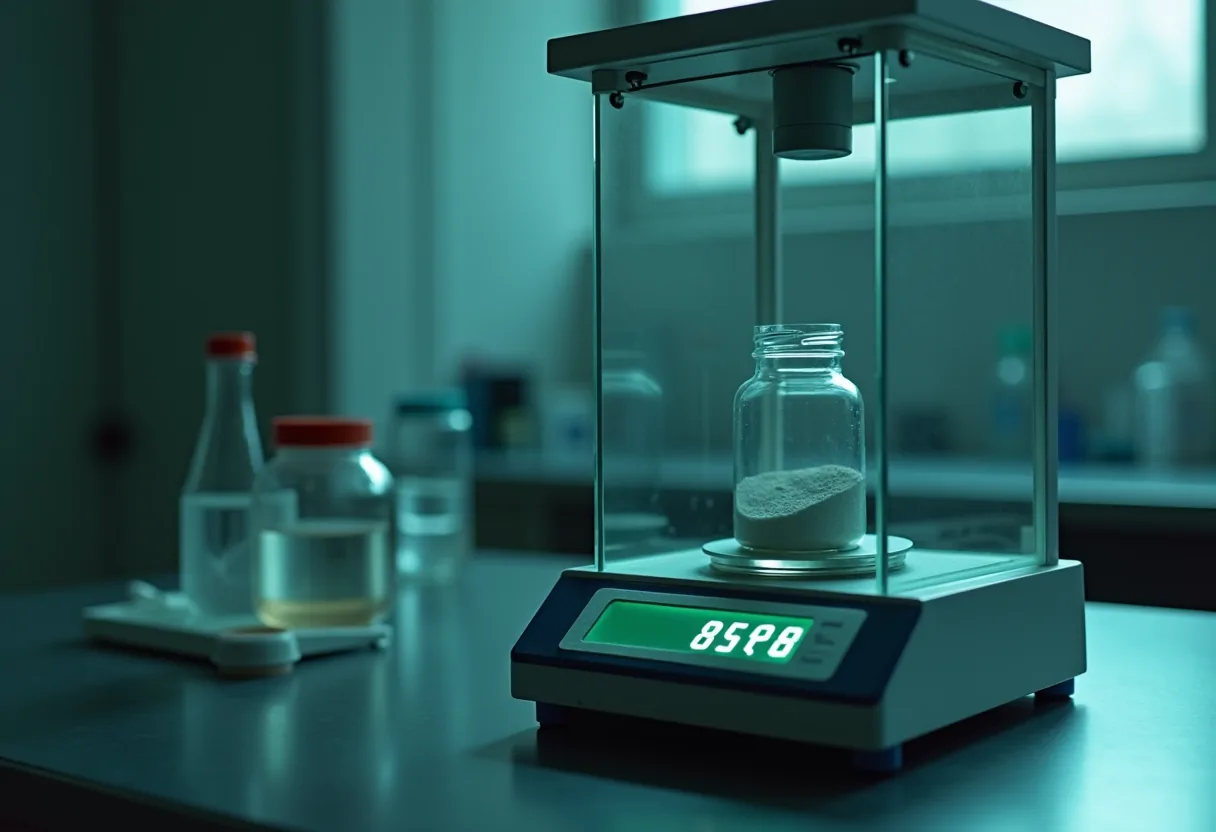
The number on a vial label almost always refers to gross weight: the mass of lyophilised solid in the container. That solid is a mixture. The peptide is the largest part of it, but water, counterions and residual salts occupy real mass, and none of them is peptide.
Net peptide content is the fraction of that solid which is actually the compound. It is a separate determination from purity, and the two are regularly confused.
What else is in the vial
- Water. Lyophilised peptide is hygroscopic and retains residual moisture even after drying, commonly a few percent by weight and sometimes more depending on the cycle and the sequence.
- Counterions. Peptides purified by reversed-phase chromatography with trifluoroacetic acid are typically isolated as TFA salts. For a basic peptide with several charged residues, that counterion burden can be substantial.
- Residual inorganic salts carried through from synthesis, cleavage or buffer exchange.
Why purity does not capture this
A chromatographic purity figure measures the main peak's share of total ultraviolet detector response. Water does not absorb in the ultraviolet. Neither do most inorganic salts. Trifluoroacetate is not retained and detected as a peptide peak.
The consequence is counter-intuitive but important: a lot can legitimately report 99% chromatographic purity while roughly a fifth of the vial's mass is not peptide at all. The two figures are not in conflict. They are answering different questions, and only one of them tells you how much compound you received.
How net content is measured
Several approaches exist and they differ in rigour.
- Amino acid analysis is the reference method. The peptide is hydrolysed completely into its constituent amino acids, which are then separated and quantified against standards. Because it measures the amino acids themselves, it is indifferent to water and counterions and gives a direct answer.
- Quantitative nuclear magnetic resonance, written qNMR, compares the integral of a peptide signal against an internal standard of known concentration. It is non-destructive and increasingly common.
- Ultraviolet absorbance at 280 nm, using the calculated extinction coefficient from tryptophan and tyrosine content, is quick but only applicable to sequences containing those residues and sensitive to aggregation.
- Elemental nitrogen analysis infers peptide content from nitrogen, which requires knowing what else in the sample contributes nitrogen.
Why this matters for comparing suppliers
Two vials labelled identically, both certified at the same purity, can contain materially different quantities of compound. A buyer comparing price per vial is comparing gross mass unless net content is stated, which makes the comparison unreliable in exactly the way that is hardest to notice.
Where net content is reported, price per milligram of actual peptide becomes calculable, and that is the figure worth comparing.
The [salt form](/blog/tfa-and-acetate-salt-forms) question
Where counterion burden is a concern, material can be supplied as a different salt. Acetate and hydrochloride are the usual alternatives to trifluoroacetate, produced by ion exchange after purification. The exchange adds a processing step and cost, and it changes the net content figure, so it should be stated on the certificate rather than assumed.
What to ask for
- Is the label weight gross or net?
- Is net peptide content determined, and by which method?
- What salt form is the material supplied as?
- Is water content determined, for example by Karl Fischer titration?
A supplier reporting gross weight is not doing anything improper, and gross labelling is the industry norm. The difference is whether they will tell you the net figure when asked.
For how this fits with everything else that happens to a vial between delivery and use, peptide storage and handling for clinics covers the full picture.