
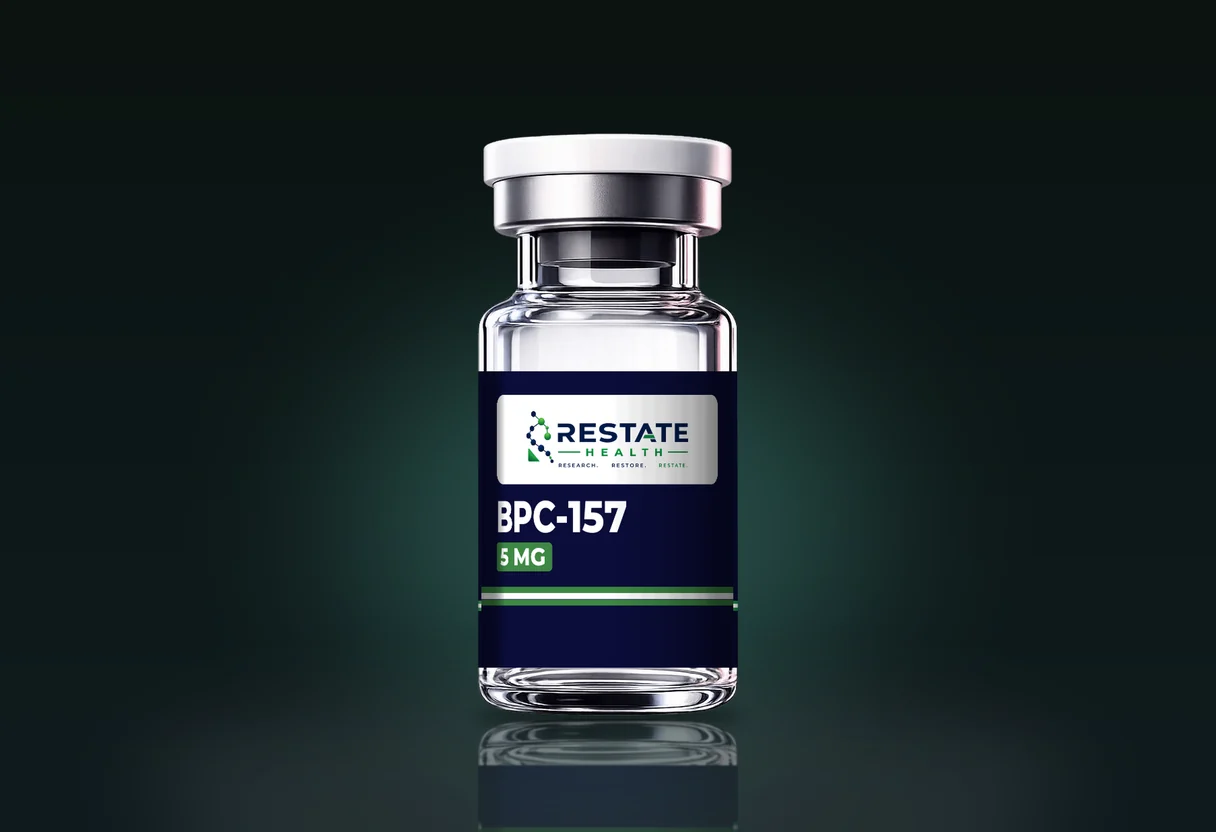
The catalogue record for BPC-157 states ≥99% by HPLC, and so does the record for LY3437943. Other suppliers quote 95% or 98% for the same molecules, and the grades read as if they were on a single scale of quality where a higher number means more peptide. They are on a scale, but it is not that one. Purity by HPLC is the share of detector response that belongs to the main peak, and that is a different quantity from the share of the vial's mass that is peptide.
This guide sets out what the percentage measures, what one percent means in a 10 mg vial, why a 99% purity figure and a 75% net content figure describe the same vial without contradiction, how the wavelength and the method move the number, and what each grade is used for.
What the percentage actually is
A reversed-phase HPLC purity method separates the peptide from its related substances on a column, passes the eluent through an ultraviolet detector, and integrates the peaks. Purity is the main peak's area divided by the total area of all peaks, times 100. Two things follow immediately. The number counts only what the method separates and detects, so anything that does not elute as a peak, or does not absorb at the detection wavelength, is not in the denominator. And it is a ratio of areas, not of masses, so it is a mass fraction only if every species responds to the detector equally per unit mass.
They do not. ICH Q3A acknowledges this directly by allowing an impurity's response factor to be corrected relative to the parent where the two differ. Kuipers and Gruppen (2007) measured the molar absorptivity of peptides at 214 nm, the wavelength most purity methods use, and showed that it depends on composition: the peptide bond contributes most, but aromatic and some other residues add to it, so a deletion sequence missing a tryptophan absorbs less per molecule than the target and is under-counted. HPLC purity explained covers the method in detail.
What one percent means in a 10 mg vial
Take the arithmetic at face value first. A 10 mg vial at 99% purity has 1% that is not the main peak. One percent of 10 mg is 0.1 mg, or 100 micrograms. That 100 micrograms is not one substance. On a typical certificate it is five to fifteen resolved peaks, each of a few hundredths of a percent to a few tenths, plus whatever the method did not resolve. At 98% the figure doubles to 200 micrograms, and at 95% it is half a milligram.
Now correct the arithmetic. The 10 mg is gross mass, the weight of lyophilised solid, not peptide. The purity applies to the peptide material only, because water, counterion and salts produce no peptide peak and are outside the denominator. Where a certificate states net peptide content, which is covered in net peptide content explained, the peptide present is gross mass × net content × purity. At 75% net content and 99% purity, a 10 mg vial holds about 7.4 mg of target peptide and about 0.07 mg of related substances; the other 2.5 mg is water, counterion and salt. Melanson and colleagues (2018) measured this on a candidate angiotensin II reference material and assigned a peptide content of about 69% by mass, with the trifluoroacetate counterion alone at nearly 25%, in a material whose chromatographic purity was far higher.
The two numbers are not in tension. They answer two different questions: how much of the peptide is the right peptide, and how much of the powder is peptide at all. A grade speaks only to the first.
How wavelength and method move the number
The same vial, run by two laboratories, can honestly return 98.6% and 99.3%. At 214 or 220 nm every peptide bond absorbs, so every peptide impurity is detected, and the purity figure is the most demanding. At 280 nm only tryptophan and tyrosine absorb, so impurities lacking those residues disappear from the denominator and the figure rises; a sequence with neither residue, which includes the BPC-157 sequence in the catalogue record, produces almost no signal at 280 nm at all. Gradient slope, column chemistry and run length decide whether a close-eluting deletion is a separate peak or a shoulder that is integrated into the main one.
This is why a purity figure without its method is an incomplete statement, and why the method line on a certificate, which reading a certificate of analysis line by line walks through, belongs next to the number. It is also why lot-to-lot consistency is judged on the same method across lots: a change in the figure between lots run differently says nothing about the material.
The grades, and what each is used for
The grades a buyer meets are conventions rather than pharmacopoeial categories. Each corresponds to a different amount of purification effort and a different laboratory purpose.
| Grade | What the certificate states | What it does not state | Typical laboratory use |
|---|---|---|---|
| >95% | Main peak at least 95% of integrated area; up to 5% related substances | Net peptide content; identity of the impurities; anything not detected at the wavelength | Screening, method development, antibody production, work where a few percent of related sequences does not change the readout |
| >98% | Main peak at least 98%; up to 2% related substances | The same, plus whether the 2% includes a co-eluting isomer | Most in-vitro and cell-based work; binding assays; the common grade for research catalogues |
| ≥99% | Main peak at least 99%; under 1% related substances | Net content; D-residue content; aggregation; positional isomers of the same mass | Quantitative assays where an impurity could carry activity; structural and biophysical work; the grade stated on the catalogue records for BPC-157 and LY3437943 |
| ≥99.5%, characterised | Purity by HPLC plus identified impurities, assigned content by mass balance or qNMR, and uncertainty | Little; this is the point of the exercise | Reference standards and calibrants, where the material is the yardstick other measurements are compared against |
Grade conventions as they appear on supplier records and certificates; the uses are laboratory purposes for research material. Figures are HPLC area percent at the certificate's stated wavelength.
The last row is a different kind of document. For a reference material the purity figure alone is not enough; what is wanted is the mass fraction of peptide, with the impurities identified and quantified so that their contribution can be subtracted. Stoppacher and colleagues (2013) at the Bureau International des Poids et Mesures did this for angiotensin I by liquid chromatography with high-resolution tandem mass spectrometry, identifying the related impurities and showing that leaving them uncorrected would bias an amino acid analysis result by about the same percentage as their mass share. Melanson and colleagues (2018) combined qNMR with amino acid analysis to the same end. That level of characterisation is what separates a reference standard from a 99% research lot, and it is not a slightly higher number; it is a different measurement.
What ≥99% on a catalogue record commits to
The record's figure is a specification: the lot will be released only if its purity by the stated method is at or above 99%. The certificate for a given lot reports the actual value, which will be 99.0% or higher, and the lot-to-lot range is itself information. A supplier whose lots land at 99.1%, 99.4% and 99.2% is running a consistent process; one whose lots land at 99.0%, 99.8% and 99.1% is running a wider one, or running different methods, and the method line settles which.
The catalogue price reflects this. BPC-157 is listed from $56.00 and LY3437943 from $95.20 at ≥99%; a 95% grade of either from another source would be cheaper per vial, and the difference buys the two or three further purification passes needed to move from 95% to 99%, each of which discards material.
When the grade matters and when it does not
Whether 95% or 99% is the right purchase depends on what the remaining percent could do in the experiment. D'Hondt and colleagues (2014) make the general point that a related impurity is not inert: a deletion sequence, an oxidised form or a diastereomer can bind the same target with different affinity, act as an antagonist, or be immunogenic in an animal model. In a concentration-response assay on a receptor, a 2% impurity with ten times the affinity of the target dominates the result. In a Western blot or a screening assay the same 2% is invisible.
The grade also matters more for a long modified peptide than for a short one. For LY3437943, 39 residues with a lipid chain, the 1% remainder at ≥99% is likely to contain positional isomers and deletions that an intact-mass test cannot distinguish from the target, and the purity figure says nothing about them. For the 15-residue BPC-157 the impurity population is smaller and simpler, and the same 1% is a less consequential unknown.
Reading the purity line
- Find the wavelength. 214 or 220 nm is the demanding condition; 280 nm is not, and for a sequence without tryptophan or tyrosine it is close to meaningless.
- Find the method: column, gradient and run time. Two lots are comparable only on the same method.
- Find the largest single impurity, not only the total. One impurity at 0.8% is a different situation from eight at 0.1%.
- Find the net content line, and if it is absent, ask. Without it the grade cannot be turned into milligrams of peptide.
- Check that the lot number on the certificate is the lot on the vial. A grade belongs to a lot, not to a product.
In short
A purity grade is the main peak's share of chromatographic area at a stated wavelength on a stated method. It says how much of the peptide is the right peptide and nothing about how much of the powder is peptide, which is why 99% purity and 75% net content describe one vial without contradiction. One percent of a 10 mg vial is 100 micrograms of several substances; whether that matters depends on what they are and what the experiment measures. A reference standard's 99.5% is not a higher grade but a different document, with the impurities identified and the content assigned by mass.