
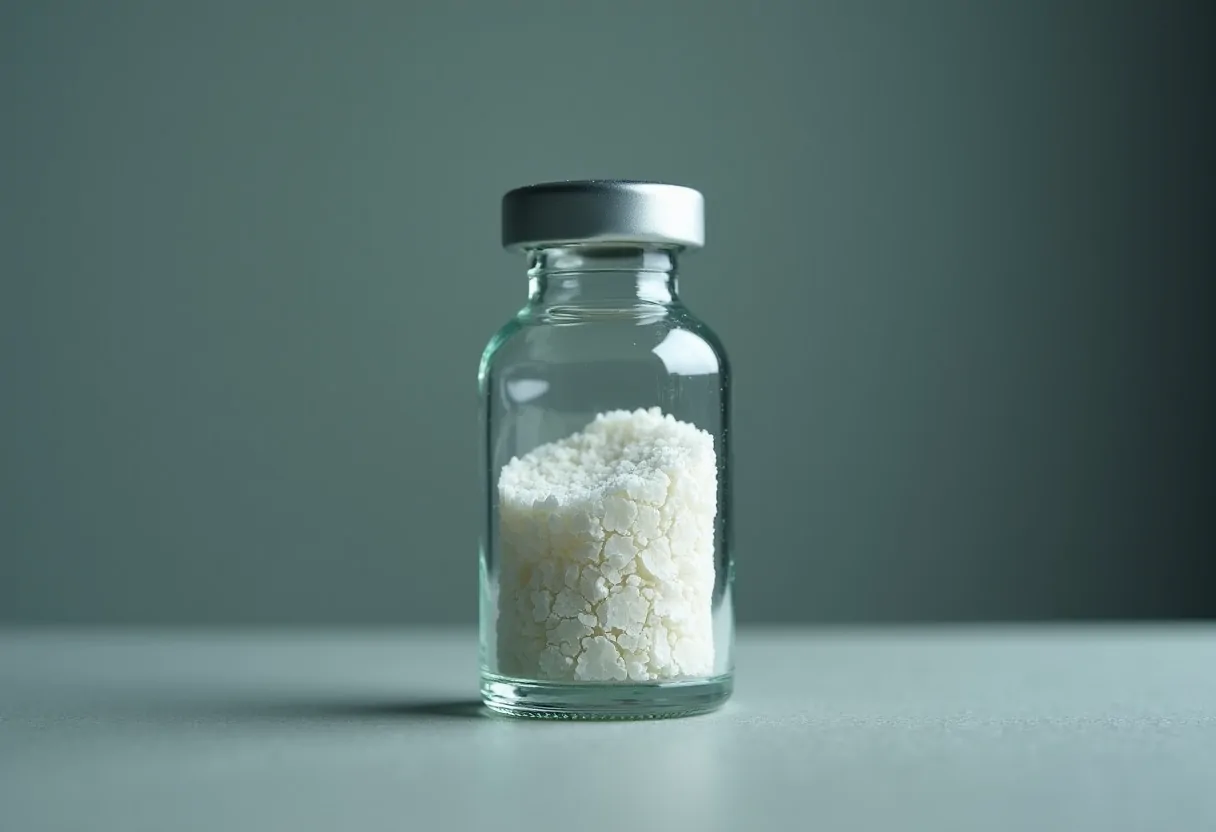
Peptides in solution degrade. Water is a reactant in hydrolysis and deamidation, a medium for oxidation, and a requirement for microbial growth. Removing it is the single most effective way to extend the usable life of the material, and lyophilisation is how that is done without cooking the molecule.
Why not simply evaporate the water
Evaporative drying concentrates the solution as it proceeds, raising solute concentration and often temperature, both of which accelerate aggregation and degradation. The liquid-to-gas transition also creates an air-water interface that can denature the molecule.
Lyophilisation avoids the liquid phase altogether. Water is frozen solid and then removed by sublimation, passing directly from ice to vapour under reduced pressure. The material never experiences a concentrating liquid phase.
The three stages of a cycle
- Freezing. The solution is cooled until it solidifies. The rate matters: fast freezing produces small ice crystals and a fine pore structure, slow freezing produces large crystals and a more open structure that sublimes faster but may be more fragile. Some cycles include an annealing hold to control crystal size deliberately.
- Primary drying. Chamber pressure is reduced and a small amount of heat is supplied through the shelf. Ice sublimes directly to vapour, which is captured on a cold condenser. This stage removes the bulk of the water and occupies most of the cycle, often many hours. Temperature must stay below the formulation's collapse temperature or the cake structure fails.
- Secondary drying. Temperature is raised to drive off water that remains bound to the solid rather than frozen as ice. This determines the final residual moisture.
Reading the cake
The dried plug in the vial carries visible information about the cycle that produced it.
- A uniform cake occupying roughly the original fill volume, with a matte surface, indicates a well-controlled cycle.
- A shrunken, glassy or partially melted-looking cake suggests collapse, meaning the product temperature exceeded the critical point during primary drying. Collapsed material often holds more residual moisture and may reconstitute more slowly.
- A cake that has detached and moves freely in the vial is cosmetic in itself, but can indicate a less controlled freeze.
- Discolouration is worth querying. Lyophilised peptide is typically white to off-white.
Why some vials look nearly empty
A few milligrams of peptide spread across the base of a vial can be almost invisible, particularly after a fast freeze that produces a thin, fine cake. This is routinely mistaken for a short-filled vial.
Where a very small quantity is filled, a bulking agent such as mannitol or trehalose may be included to give the cake physical structure. Any such excipient should appear on the certificate, since it contributes to vial mass and therefore to the gap between label weight and net peptide content.
What the dry state does and does not do
Lyophilisation suppresses the reactions that require water and halts microbial growth by removing available moisture. It does not sterilise: organisms present before drying can survive it and resume growing on reconstitution. It does not stop oxidation, which proceeds in the solid state where oxygen is present. And it does not make the material indefinitely stable, only far more stable than the same compound in solution.
Residual moisture is the variable that determines how much protection is actually achieved, which is why it is measured, commonly by Karl Fischer titration, and why an intact seal matters: a compromised stopper lets a hygroscopic cake draw moisture back out of the air.
For how this fits with everything else that happens to a vial between delivery and use, peptide storage and handling for clinics covers the full picture.