
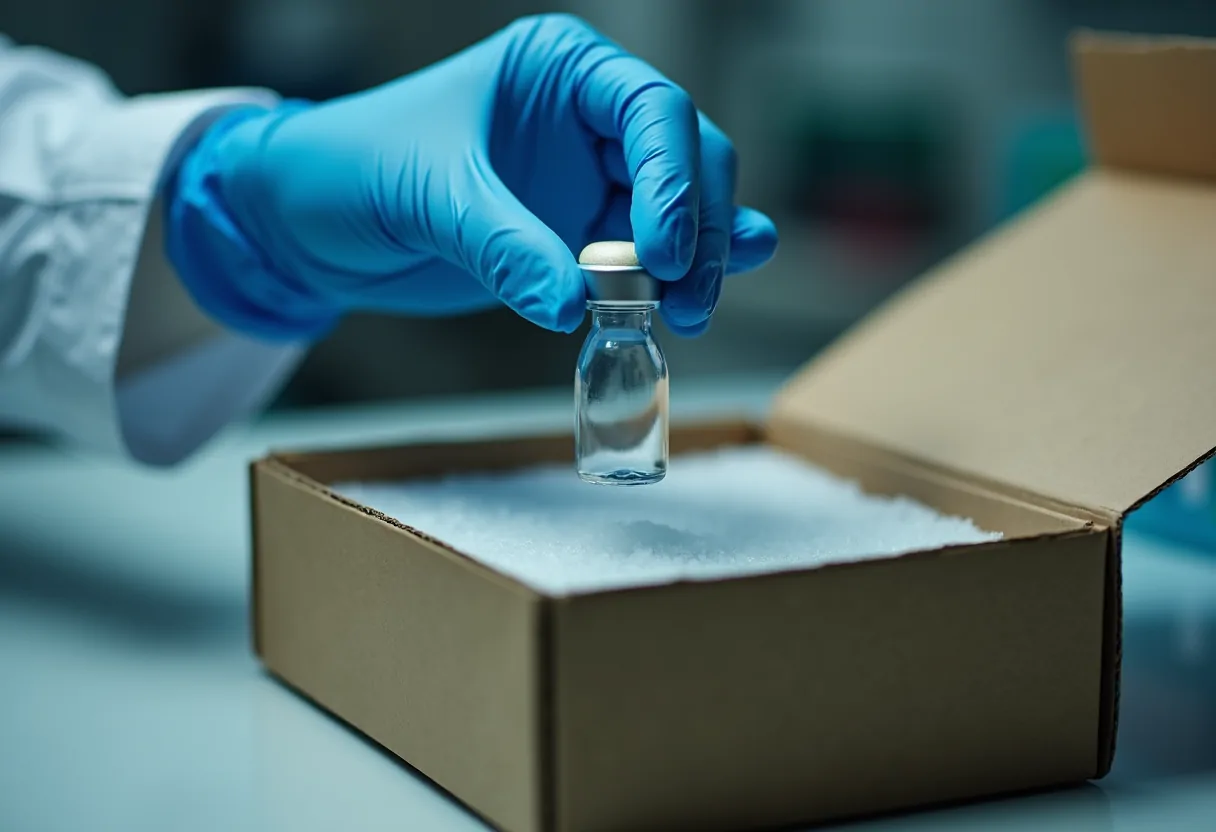
Receiving tends to be treated as a signature rather than a step. The consequence is that discrepancies surface days later, when the claim window has closed and the evidence has been thrown away with the packaging.
A structured ten minutes at the bench solves most of it. The order below is deliberate: the things that are hardest to reconstruct later come first.
One: the exterior, before anything is opened
- Crushing, puncture or water staining on the outer carton.
- Whether seals and tape are intact or have been opened and resealed.
- Whether the carton was oriented as marked, where orientation is indicated.
Photograph damage before opening. A photograph of an undamaged carton takes two seconds and is the only evidence that will satisfy a carrier claim later.
Two: the [cold chain](/blog/cold-chain-for-peptide-shipments)
Covered in detail separately, but the sequence belongs here: coolant state, indicator status, logger file if present, and the time elapsed since dispatch. Record it before unpacking warms anything further.
Three: the documentation
- Packing list present and matching the purchase order.
- A certificate of analysis for each compound received.
- The lot number on each certificate matching the lot number on the corresponding vial. This is the check most often skipped and the one that most often finds something.
A certificate for a different lot of the same compound is a common administrative error. It is also, from a documentation standpoint, no certificate at all: it describes material that is not in front of you.
Four: the vials
- Count against the packing list.
- Seals intact, caps secure, no evidence of prior entry.
- Glass sound, with no cracks or chips, particularly around the neck.
- Labels legible, attached, and matching the compound and strength ordered.
- Cake appearance. White to off-white and reasonably uniform is expected. Discolouration, a markedly collapsed cake, or obvious moisture are worth raising.
- Any vial where the cake is absent rather than merely thin.
Five: to storage, then to the record
Transfer to the specified storage condition before completing paperwork. The record can be written at a desk; the material should not wait at ambient while it is.
What to photograph
Four images cover almost every dispute that arises later, and they cost under a minute.
- The outer carton as received, damaged or not.
- The opened pack showing coolant and indicator in place.
- The vials as laid out, with labels readable.
- Any specific defect, close enough to show the detail and wide enough to show which vial it is.
Raising a discrepancy
Claim windows are short and commonly run from the delivery date rather than the date a problem is noticed. Restate Health's own refund policy asks for contact within seven days of delivery with the order number and photographs, which is a representative term rather than an unusual one.
Two practical rules follow. Do not return anything without authorisation, because an unauthorised return usually voids the claim. And raise a discrepancy as a factual record, with the order number, lot number, quantity affected and images, which converts the conversation from an assertion into a documented event.
Why the first ten minutes decide everything
Because that is the only point at which the shipment is a single identifiable unit with its packaging, its temperature history and its documentation all in one place. Once the box is unpacked and vials are distributed to storage, most questions about what arrived become unanswerable.
The protocol below is short deliberately. A procedure that takes twenty minutes will not be followed consistently, and a procedure that is not followed consistently is worse than none because it creates the appearance of a control.
Before opening the box
- Record the arrival time, and where the package sat if it was not opened immediately.
- Photograph the exterior, including any damage and any temperature indicator, before anything is disturbed.
- Note the condition of the outer packaging, since crushing or wetting is relevant to what is inside.
- Check the shipment is addressed to the entity on the account, which matters for the eligibility record as well as for logistics.
On opening
- Read any temperature indicator or logger and record the value rather than an impression of it.
- Note the state of any coolant: fully melted, partly melted and still solid are three different findings.
- Confirm the contents against the packing list before anything is moved.
- Check each vial's lot number against the certificate supplied for it.
- Inspect the vials themselves for cracked glass, lifted stoppers, discoloured contents or a collapsed cake.
What a collapsed cake does and does not mean
A cake that has slumped, shrunk from the glass or looks glassy has warmed above the temperature at which the amorphous solid softens during drying or storage. The structure is lost, which affects how quickly it dissolves and how readily it takes up water.
It does not mean the molecule has degraded. Identity and purity are separate questions answered by the certificate, which is why a collapsed cake is a finding to raise rather than a verdict to act on. Lyophilisation explained covers why the structure matters.
When to accept and when to query
Accept and document in almost all cases. Accepting while recording the condition preserves the evidence and keeps the material under your control. Refusing a delivery sends it back into transit, which rarely improves anything and destroys the record of what arrived.
Query in writing where an indicator has tripped, where a lot number does not match its certificate, or where any vial is physically compromised. Temperature excursions on arrival covers assessing the first of those.
What goes into the record
Date and time of arrival, condition of packaging, any indicator reading, lots received, certificates received, who inspected, and any discrepancy with the time it was raised. Six fields and a name.
That record is what lets a question months later be answered from a document rather than a recollection, and it is the foundation the rest of the material record sits on. Records to keep covers where it fits.
The handover that usually goes missing
Between whoever signs for the package and whoever puts it away. Those are frequently different people and the interval between them is frequently undocumented, which is exactly the period a temperature question would ask about.
Completing the receipt note at the door rather than at the shelf closes that gap, and it is the single highest-value change most practices can make to their receiving process.
Who should do the inspection
Someone who knows what the material should look like and has the authority to raise a discrepancy. Those two requirements rule out whoever happens to be at the door, which is why the receipt note and the inspection are often better treated as two steps rather than one.
The signature at the door records arrival and condition of packaging. The inspection records the contents against the documentation. Separating them is realistic, and it stops the inspection being skipped because the person signing was not equipped to do it.
Checking lot numbers properly
Read the full string rather than the last few characters, because lot numbers within a supplier's range frequently differ only in their final digits. A mismatch found at receiving is a conversation; the same mismatch found months later is an unanswerable question about material already used.
Where several lots of one compound arrive together, check each one rather than assuming the shipment is uniform. Mixed lots in a single delivery are common and are exactly the situation where a rotation rule later goes wrong.
What to do with the packaging
Keep it until the material has been accepted and put away, and keep it longer where anything was queried. Insulated packaging and coolant are evidence about transit conditions, and they are the first thing discarded and the first thing asked about.
Building the habit
A receiving procedure survives contact with a busy day only if it is short and if one person owns it. Six fields, a camera, and a named role is enough. Writing an SOP for peptide receipt and storage covers turning that into something a practice can actually follow.
A ten-minute protocol, condensed
- Record arrival time and where the package waited.
- Photograph the exterior and any indicator before opening.
- Read the indicator and the coolant state, and write the values down.
- Check contents against the packing list.
- Match every lot number on every vial to its certificate.
- Inspect the vials for cracked glass, lifted stoppers and collapsed cakes.
- Raise anything unexpected in writing before the material is put away.
- File the receipt note where the purchase records live.
Eight steps, one person, one form. The value is not in any single check but in the fact that the record exists at all when a question arrives later.
For how this fits with everything else that happens to a vial between delivery and use, peptide storage and handling for clinics covers the full picture.