
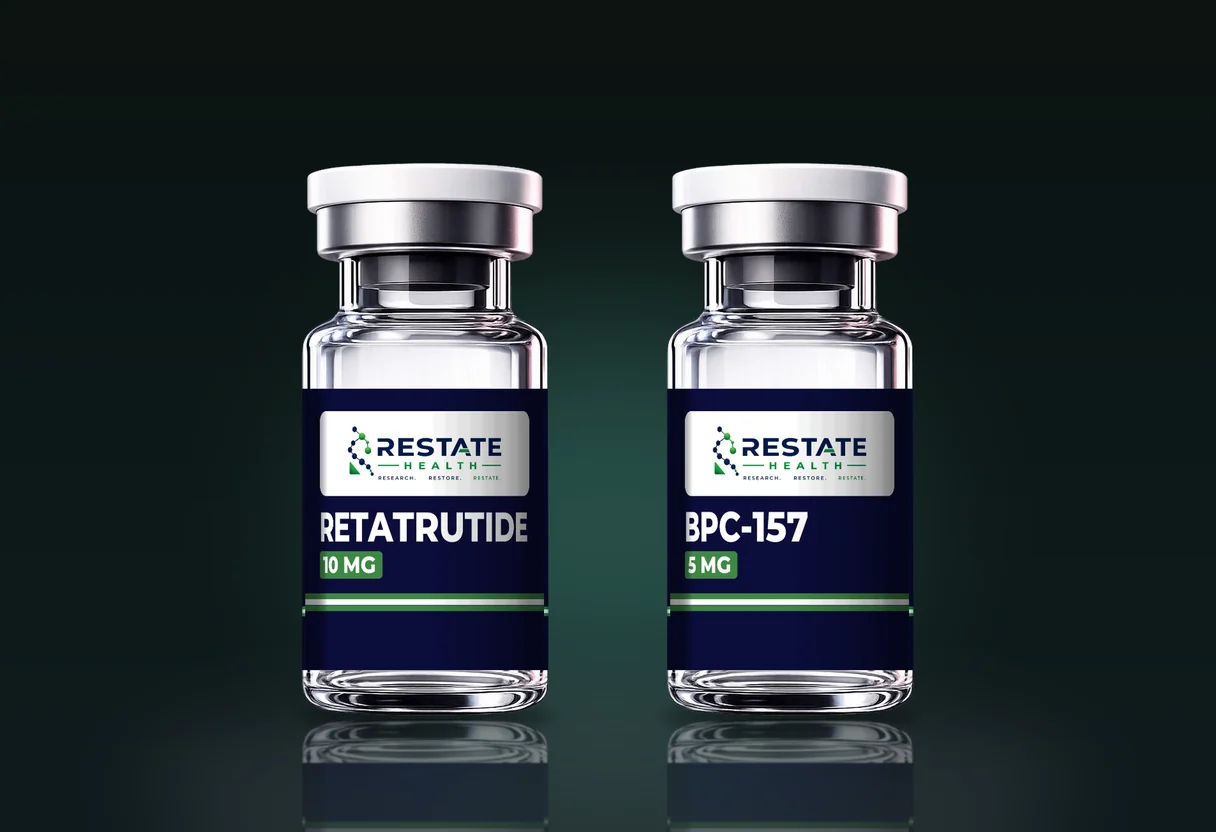
The question a buyer asks most often about a peptide is how long it lasts, and the honest answer begins with another question: in what state? A sealed vial of lyophilised LY3437943 at -20 °C, the same vial on a courier's van for three days, the same material dissolved and standing in a refrigerator, and that solution split into frozen aliquots are four different chemical situations. Each has its own dominant degradation route and its own usable window.
This guide takes the four states in turn, gives the main threat and the control for each, and sets out what the published stability literature actually supports. The catalogue's storage line for most peptides, including BPC-157, reads: store lyophilized at -20°C; protect from light and moisture; reconstitute with bacteriostatic water; refrigerate reconstituted solution at 2-8°C. That line is a compressed version of what follows.
Why no single number is honest
A shelf life is a prediction that a measured attribute, usually chromatographic purity, will stay within a limit under stated conditions. Change the conditions and the prediction changes. Water is the medium most degradation chemistry needs, so the same molecule dry and in solution can differ in stability by orders of magnitude. Temperature sets the rate of every route. And the sequence decides which routes exist at all: a peptide without methionine or tryptophan has no oxidation-prone side chains to lose, and one without asparagine has no fast deamidation site.
Manning and colleagues set this out for proteins in 1989 and updated it in 2010: the chemical routes (deamidation, oxidation, hydrolysis, isomerisation, disulfide exchange) and the physical ones (aggregation, adsorption, denaturation) each have their own dependence on water, temperature, pH and sequence. Peptide degradation pathways covers the chemistry of each route; this guide is about which one dominates in which state.
State one: sealed and lyophilised at -20 °C
This is the state a certificate's date describes. The water that most reactions need has been removed, the temperature is low, and the vial is closed against moisture and oxygen. It is the most stable state a peptide is ever in, and it is the only state a supplier can make a claim about, because it is the only one the supplier controls.
Stable is not inert. Lai and Topp (1999) reviewed solid-state chemical degradation of proteins and peptides and showed that deamidation, oxidation and other routes continue in the lyophilised solid, slowly, with rates governed by residual moisture, temperature and the mobility of the amorphous matrix. Wang (2000) covers the same ground from the formulation side: a lyophilised cake with a few percent of residual water is a very different material from one dried to under one percent.
The date on a certificate for this state is a re-test date, not an expiry. It is the point at which the material should be tested again before use, derived under ICH Q1A(R2) from stability data at the stated storage condition. Re-test dates versus expiry dates covers the distinction and what each obliges the holder to do.
State two: lyophilised at room temperature in transit
Most research peptides ship at ambient temperature, and that is not a corner cut. For a dry solid the step from -20 °C to 20 °C raises the rate of every route, but the routes that need water are still starved of it, so a few days at room temperature consumes a small fraction of the material's life rather than ending it. Wang (2000) gives the reasoning: the stability advantage of lyophilisation comes from removing water, and that advantage travels with the vial.
The two things that do matter in transit are moisture and heat beyond room temperature. A compromised stopper lets the hygroscopic cake take up water, which changes the solid from the material the certificate describes. A parcel left in a hot vehicle can reach temperatures where even solid-state routes move quickly. Temperature excursions on arrival covers how to read an indicator and decide what a recorded excursion means.
State three: reconstituted at 2-8 °C
This is where the clock speeds up, because water is now present. How fast depends almost entirely on sequence.
The best-studied small peptide is oxytocin, a nine-residue hormone with a disulfide bridge and three amide-containing side chains. Hawe and colleagues (2009) followed its degradation kinetics in aqueous solution across temperatures and identified the products; Wiśniewski and colleagues (2013) worked out the mechanisms, which run through the disulfide and the asparagine and glutamine side chains. Both groups found that pH, temperature and buffer composition changed the rates substantially, so a figure measured in one formulation does not transfer to another.
Deamidation of asparagine, the fastest chemical route in many sequences, illustrates how wide the range is. Robinson and Robinson (2001) measured deamidation rates in a large set of model pentapeptides and found that the identity of the residue following the asparagine changed the rate by more than two orders of magnitude, with asparagine-glycine the fastest.
Applied to the catalogue examples: the BPC-157 sequence in the catalogue record (Gly-Glu-Pro-Pro-Pro-Gly-Lys-Pro-Ala-Asp-Asp-Ala-Gly-Leu-Val) contains no methionine, tryptophan, cysteine or asparagine, so oxidation, disulfide exchange and asparagine deamidation are not available to it; the adjacent aspartates leave isomerisation and backbone cleavage at Asp as the routes to watch. LY3437943, a 39-residue acylated peptide, has more residues, more routes and a fatty diacid chain that favours self-association, so its solution behaviour is dominated by aggregation as much as by chemistry. The honest window for a reconstituted peptide at 2-8 °C therefore runs from days to a few weeks, and the only way to know where a given sequence falls is to test it or to find a published stability study on it.
State four: frozen aliquots
Freezing a reconstituted solution slows the chemistry but introduces its own stresses. As water freezes, solutes concentrate in the shrinking liquid phase and buffer pH can shift; ice surfaces and the air-liquid interface can unfold peptides; and each thaw repeats the whole cycle. Manning and colleagues (2010) review the freeze-concentration and interface effects that make repeated freeze-thaw the commonest avoidable cause of aggregation.
The control is to freeze once. Split the reconstituted solution into single-use aliquots, freeze them, and thaw each only when it is used. Freeze-thaw cycles and aliquoting covers container choice, volumes and labelling.
The four states side by side
| State | Main threat | Control | Evidence basis |
|---|---|---|---|
| Sealed, lyophilised, -20 °C | Slow solid-state deamidation and oxidation, driven by residual moisture | Closed vial, dry, cold, dark; re-test at the certificate date | Lai and Topp 1999; Wang 2000; ICH Q1A(R2) for the re-test period |
| Lyophilised, ambient, in transit | Moisture uptake through a compromised closure; heat beyond room temperature | Intact seal, indicator in the parcel, days not weeks | Wang 2000 on water removal; temperature-excursion guide |
| Reconstituted, 2-8 °C | Deamidation, oxidation, hydrolysis and aggregation, all sequence-dependent | Refrigerate, protect from light, use within days to weeks, inspect for haze | Hawe 2009 and Wiśniewski 2013 (oxytocin); Robinson 2001 (deamidation rates); Manning 2010 |
| Frozen aliquots | Freeze-concentration, pH shift and interface unfolding on each cycle | Single-use aliquots, freeze once, thaw once | Manning 2010; freeze-thaw guide |
Main threat, control and evidence basis by state. Evidence rows cite the sources listed at the foot of this guide; the catalogue storage line is quoted from the product records.
What a certificate's re-test date is based on
A re-test date is a statement about state one only. Under ICH Q1A(R2) it is derived from stability data on the material stored at the labelled condition, long-term and accelerated, with the attribute followed being the one most likely to change, which for a peptide is chromatographic purity and the growth of specific degradation peaks. The date is the point at which the data no longer support the claim without a new measurement.
Three things follow. The date assumes the vial stayed sealed and cold; it says nothing about the vial after first entry. It is specific to the lot tested, which is why it belongs on a lot certificate rather than a product page. And it is a re-test, so material past the date is not condemned, it is untested, and a new chromatogram can restore it. The peaks a re-test looks for are the degradation products described earlier.
What this means when ordering
Size a vial against what will be used while the reconstituted solution is still good, not against the sealed shelf life. A 60 mg vial of LY3437943 at -20 °C is a long-lived asset; the same 60 mg dissolved is a short-lived one, and the saving per milligram on the larger vial is only real if the solution is aliquoted and frozen or consumed within its window.
Record the date of reconstitution on the vial, because from that moment the certificate's date no longer describes the material, and the only date that does is the one written by hand.