
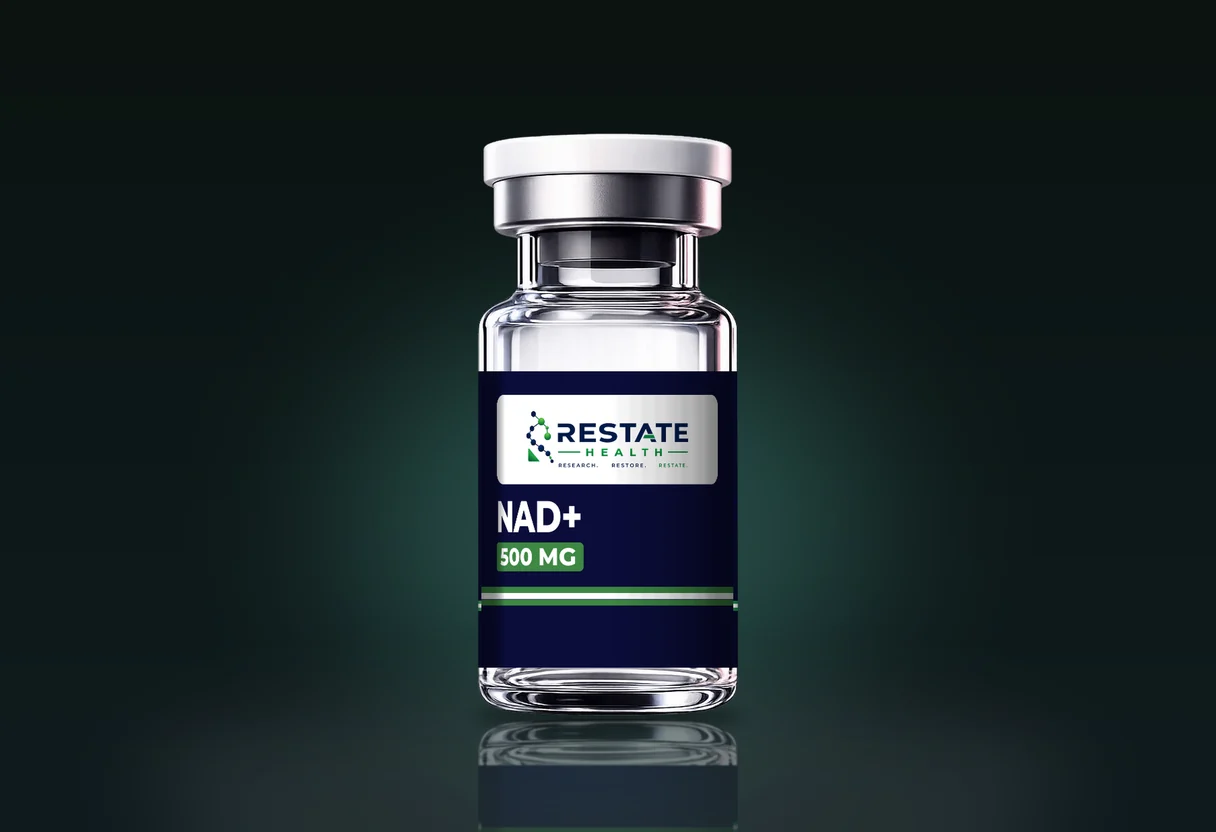
NAD+ sits in the catalogue under Research Peptides at 500 mg and 1000 mg, and its own record says what it is: the physical form line reads "Coenzyme (not a peptide), lyophilized powder". Nicotinamide adenine dinucleotide contains no amino acids and no peptide bond. It is in a peptide catalogue because buyers of peptides also buy it, not because of what it is.
This is the chemistry page. Buying NAD+: vial, spray and dissolving strips compared covers the choice between the three formats, the 500 mg NAD+ Liquid Spray and the 30-strip Melts NAD+ Dissolving Strips alongside the vial, and is not repeated here. What follows is what the molecule is, why the question "coenzyme or substrate" has the answer "both", how it degrades, and what its certificate looks like when there is no sequence to confirm.
| NAD+ | Catalog specification |
|---|---|
| Vial strengths | 500 mg, 1000 mg |
| Molecular formula | C21H27N7O14P2 |
| Molecular weight | 663.43 g/mol |
| CAS number | 53-84-9 |
From the Restate Health catalog record. Lot-specific values are on the certificate of analysis.
A dinucleotide, not a chain of residues
The catalogue record gives the formula C21H27N7O14P2, a molecular weight of 663.43 g/mol and CAS 53-84-9. PubChem CID 5892, filed under the synonym nadide, gives the same formula at 663.4.
The structure is two nucleotides joined through their phosphates. One half is adenosine monophosphate: adenine on a ribose carrying a phosphate. The other is nicotinamide mononucleotide: nicotinamide on a second ribose with its own phosphate. The two phosphates are linked to each other, so the molecule reads adenine, ribose, phosphate, phosphate, ribose, nicotinamide. There is no amide bond between amino acids anywhere in it; the only amide is the carboxamide on the nicotinamide ring.
The plus sign refers to the nicotinamide ring. The ring nitrogen is quaternary and carries a positive charge, which is what makes the ring able to accept a hydride. It does not describe the molecule's net charge, which at neutral pH is negative because the two phosphates are ionised. A buyer who sees NAD+ written as a cation on one document and as an anion on another is looking at the ring and the whole molecule respectively.
Coenzyme or substrate: both, depending on the enzyme
The 2007 review by Belenky, Bogan and Brenner in Trends in Biochemical Sciences separates the two roles cleanly, and the 2015 review by Cantó, Menzies and Auwerx in Cell Metabolism builds on the same distinction.
In the first role NAD+ is a coenzyme. Dehydrogenases transfer a hydride to the carbon at position 4 of the nicotinamide ring, converting NAD+ to NADH, and other enzymes transfer it back. The molecule cycles between the two forms and is not used up: the same pool is oxidised and reduced many times over. Glycolysis, the citric acid cycle and the electron transport chain all run on this cycling.
In the second role NAD+ is a substrate that is consumed. Imai, Armstrong, Kaeberlein and Guarente showed in 2000 that the yeast protein Sir2 is an NAD-dependent histone deacetylase, and the sirtuin family named after it cleaves the bond between nicotinamide and ribose in every reaction, releasing nicotinamide and transferring the ADP-ribose to the acetyl group. Poly(ADP-ribose) polymerases, the PARPs, break the same bond to build chains of ADP-ribose on proteins. The CD38 family of cyclases consumes it too. In each case the molecule is destroyed and has to be made again, which is why Verdin's 2015 review in Science treats synthesis and salvage as the counterpart to consumption.
| Enzyme class | What happens to NAD+ | Role | Fate of the molecule |
|---|---|---|---|
| Dehydrogenases and reductases | Hydride added to or removed from C4 of the nicotinamide ring | Coenzyme | Cycles between NAD+ and NADH; not consumed |
| Sirtuins (Sir2 family) | Bond between nicotinamide and ribose cleaved; ADP-ribose transferred | Substrate | Consumed; nicotinamide released |
| Poly(ADP-ribose) polymerases | Same bond cleaved; ADP-ribose chains built on proteins | Substrate | Consumed; nicotinamide released |
| CD38 and related cyclases | Same bond cleaved to form cyclic ADP-ribose and related products | Substrate | Consumed; nicotinamide released |
The two roles of NAD+, as set out in the reviews by Belenky, Bogan and Brenner (2007) and Cantó, Menzies and Auwerx (2015).
So the common question has a short answer. Towards a dehydrogenase, NAD+ is a coenzyme and comes back. Towards a sirtuin or a PARP, it is a substrate and does not. The published work on the molecule in cells and in mouse models is largely about the balance between those two columns, and it is that literature, not a catalogue, that speaks to what the balance does.
Why a peptide catalogue carries it
The honest reason is demand: laboratories that buy peptides also buy NAD+, and a supplier with the cold chain and the documentation for one can supply the other. The record is careful to label it a coenzyme. The reason it matters to say so is that most of the checks a buyer runs on a peptide do not apply here, and the next sections set out which do. Not everything in a peptide catalogue is a peptide covers the wider set of small molecules a catalogue carries; NAD+ is the clearest case, because glutathione at least has amide bonds between amino acids and NAD+ has none. The compounds in mitochondrial peptides are often sold alongside it, and the grouping is by topic rather than by chemistry.
How it degrades: hydrolysis, pH and light
The weak point of the molecule is the bond between the nicotinamide ring and its ribose, the same bond the sirtuins and PARPs cleave on purpose. Oppenheimer's 1994 review in Molecular and Cellular Biochemistry sets out the chemical and enzymatic mechanisms of that hydrolysis. In water the bond breaks slowly on its own, releasing nicotinamide and ADP-ribose, and faster as temperature rises.
The pH behaviour is the practical fact a buyer needs, and it was measured by Lowry, Passonneau and Rock in 1961. The oxidised form, NAD+, is stable in acid and labile in alkali; the reduced form, NADH, is the reverse, stable in alkali and destroyed by acid. A solution of NAD+ that drifts above neutral pH is therefore losing material, and a carrier for a liquid format has to hold the pH on the acid side of neutral. That is also why the oxidised and reduced forms cannot be stored in one solution at one pH without one of them degrading.
The lyophilised solid is hygroscopic. Water taken up from the air both starts the hydrolysis and changes the mass on a balance, which is why the record says to protect from moisture and why water content belongs on the certificate. The record also says to protect from light, and the 2-8°C instruction for the reconstituted solution follows from the temperature dependence above.
What a certificate for a non-peptide shows
Several lines a buyer looks for on a peptide certificate are absent for NAD+, and their absence is correct rather than a gap. There is no sequence to confirm by fragmentation, no amino acid analysis, no net peptide content and no counterion from a trifluoroacetic acid purification. What takes their place is the certificate of a small molecule.
| Line | Synthetic peptide | NAD+ |
|---|---|---|
| Identity | Observed mass against the calculated mass; sequence by fragmentation for longer chains | HPLC retention time against a reference standard, an ultraviolet spectrum, and an observed mass reconciling with 663.43 g/mol |
| Assay | Net peptide content by amino acid analysis or qNMR | HPLC assay against a reference standard, as a percentage of the labelled mass, often supported by an enzymatic assay |
| Purity | Main peak over total area by reversed-phase HPLC | Main peak over total area, with NADH, nicotinamide and ADP-ribose named as the related substances |
| Water | Karl Fischer titration | Karl Fischer titration; more important here because the solid is hygroscopic |
| Sequence | Stated and confirmed | None; the record has no sequence line |
| Counterion | TFA or acetate stated | Stated as the free acid or a salt form, which changes the mass per mole |
Certificate lines for a synthetic peptide and for NAD+, against the catalogue record values for NAD+.
Two of those lines deserve a note. The ultraviolet spectrum is a useful identity check because the adenine ring absorbs near 260 nm in both forms while only NADH has a second band near 340 nm, so the spectrum distinguishes the oxidised material the record describes from its reduced counterpart. And the related-substances line should name nicotinamide and ADP-ribose, because they are what hydrolysis produces, and a rising nicotinamide figure between the release certificate and a later test is the direct measure of how far the degradation above has run.
What the three formats have to cope with
The format guide covers the choice; this is the chemistry each format faces. The lyophilised vial keeps the molecule dry, and the hydrolysis clock starts at reconstitution. The liquid spray, recorded at 500 mg per 10 mL, is already in water, so the clock has been running since manufacture and the carrier's pH is doing the work of holding the oxidised form stable. The dissolving strips are a dry film, and the question for them is content uniformity across thirty pre-measured strips rather than hydrolysis. Each format's certificate should therefore lead with a different line: water content for the vial, pH and assay at release for the spray, and uniformity for the strips.
What this guide does not cover
Effects. The reviews cited here are about the biochemistry of the molecule in cells and in mouse models, and that literature, not a catalogue record, is where questions about what NAD+ does belong. NAD+ is supplied for laboratory research only. What a certificate can settle is that the vial holds nicotinamide adenine dinucleotide in its oxidised form, how much, how pure, how wet, and how far hydrolysis has run since release.