
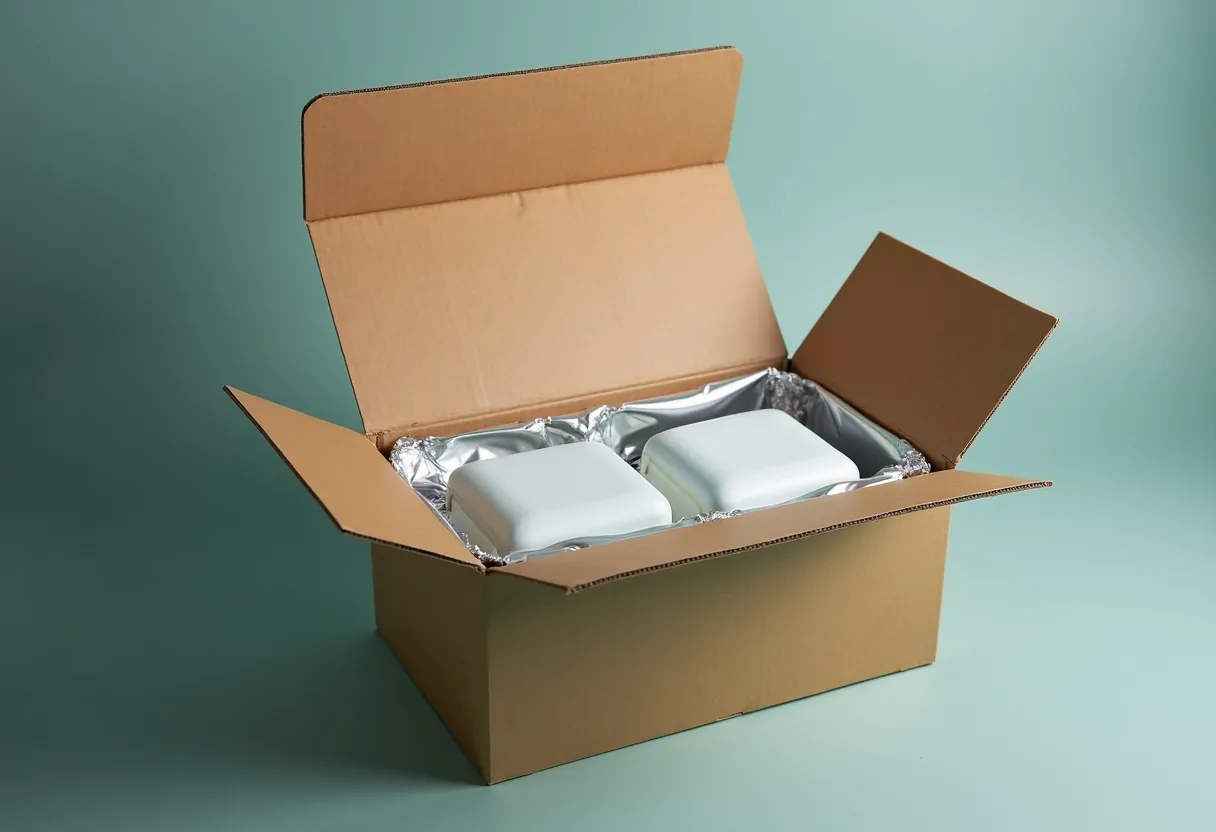
Cold chain is the weakest link in a supply chain that is otherwise well documented. Synthesis, purification and analysis all happen under controlled conditions in known facilities. Transit happens in a van.
The useful posture on arrival is neither to assume damage nor to assume integrity, but to record what arrived and assess it against what the material actually requires.
What a shipper is designed to do
An insulated shipping container is engineered to hold a temperature range for a stated duration under stated ambient conditions. That is the whole specification, and each part of it matters.
- Coolant type. Gel packs hold refrigerated ranges; dry ice holds frozen ranges and sublimates away rather than melting, which is why a dry ice shipment arriving with no dry ice left is ambiguous rather than conclusive.
- Qualified duration. A pack qualified for 48 hours gives no assurance at hour 72. Carrier delays are the usual cause of an excursion.
- Ambient profile. A pack qualified against a summer profile behaves differently from one qualified against winter. Validation is performed against specific profiles, not against the weather.
Lyophilised peptide is generally more forgiving in transit than a solution, because the degradation routes that need water are suppressed in the dry state. That is the reason material ships as powder and the reason a brief ambient excursion on a dry product is usually less serious than the same excursion on a reconstituted one.
Reading a temperature indicator
Three categories of device appear in shipments and they differ enormously in what they tell you.
- Threshold indicators change colour irreversibly once a set temperature is crossed. They answer one question: was this limit exceeded at any point. They do not record for how long or by how much.
- Time-temperature indicators integrate exposure over time, so a brief touch above the limit reads differently from a sustained one. More informative, still not a full record.
- Data loggers record temperature at intervals across the whole journey and produce a downloadable profile. This is the only device that supports a real assessment, because it shows magnitude and duration together.
A tripped threshold indicator is a prompt to investigate, not a verdict. Material whose stability data shows tolerance for short excursions may be entirely unaffected by the event that tripped it.
Assessing an excursion
The question to answer is not whether the shipment got warm but whether the exposure falls outside what the material tolerates. That requires four things, in order.
- The magnitude and duration of the excursion, from the logger if one is present.
- The storage specification for the compound, from the certificate of analysis.
- Whatever stability data the supplier holds for excursions, which is the part most buyers never ask for.
- A documented decision, whether that is accept, quarantine pending supplier assessment, or reject.
A supplier who can speak to the third point is operating a real quality system. One who answers every excursion with blanket reassurance, or blanket replacement without assessment, is operating a customer service policy.
Receiving conditions that undermine good shipping
A well-executed cold chain is routinely broken at the receiving end rather than in transit.
- A carton left at reception over a weekend has had a longer ambient exposure than the entire journey.
- Scheduling deliveries for days when someone is present to receive and transfer them is the cheapest cold chain improvement available.
- Storage immediately on receipt, rather than after the paperwork is done, keeps the exposure to minutes.
What to document
- Date and time of receipt.
- Condition of the outer carton and the insulated pack.
- State of the coolant: gel packs still cold, dry ice present or sublimated.
- Indicator status, or the logger file where one is supplied.
- Time elapsed between receipt and transfer to storage.
Those five lines take under a minute and are the difference between a documented receipt and a recollection. They also make a supplier conversation about an excursion a factual one.
For how this fits with everything else that happens to a vial between delivery and use, peptide storage and handling for clinics covers the full picture.