
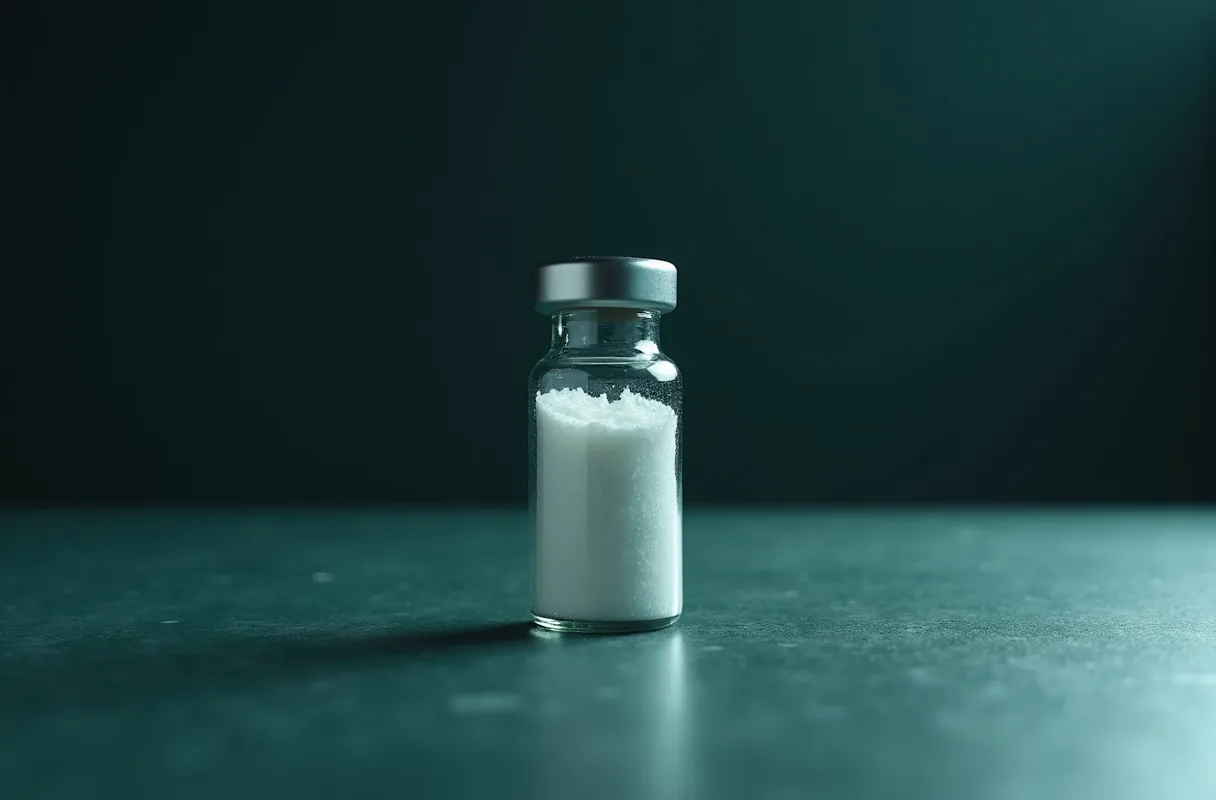
SNAP-8 is listed at 10 mg for $56.00, which places it among the least expensive vials in the catalogue. The price reflects what it is: a short, chemically straightforward sequence made at scale for a well-established research market.
This covers the molecule as a chemical object, what its one structural modification does to synthesis and to analysis, how it compares with the other peptide most often bought alongside it, and what to read on the certificate. Everything said about biological activity is reported from published work and named by model. The material is supplied for laboratory research only.
| Compound | Vial strengths | Molecular weight | Amino acids |
|---|---|---|---|
| SNAP-8 | 10 mg | 873.0 g/mol | 8 |
| GHK-Cu | 50 mg, 100 mg | ~403.93 (copper(II) complex) g/mol | 3 |
From the Restate Health catalog records. Lot-specific values are on each certificate of analysis.
An eight-residue acetylated peptide
SNAP-8 is an octapeptide — eight residues — carrying an acetyl group on its N-terminus and an amide on its C-terminus. It is catalogued in cosmetic science under the INCI name acetyl octapeptide-3, and it is structurally an elongated relative of the better-known acetyl hexapeptide, extended by two residues at one end.
Published work describes it in the context of SNARE complex assembly, the protein machinery involved in vesicle fusion. The sequence is modelled on a segment of SNAP-25, one of the proteins in that complex, which is where the name comes from. That work is in cell and tissue systems and in cosmetic science research; nothing in this guide is a claim about any effect in people.
For buying purposes the relevant facts are its length and its two end modifications, because those three things determine what the synthesis costs, how stable the material is, and how the certificate should read.
What the end-caps change
Both termini of SNAP-8 are blocked: acetylated at the N-terminus, amidated at the C-terminus. A free peptide terminus carries a charge and is a point of chemical attack; capping both ends removes two of the most common degradation routes and removes the charges that would otherwise sit there.
Three consequences follow for a buyer. The material is more stable than an uncapped sequence of the same length, which matters for shelf life. The modifications must be confirmed rather than assumed, because an uncapped or partially capped sequence is a different molecule that will pass a casual purity check. And the mass on the certificate should reflect both caps — an acetyl group adds 42 daltons and amidation shifts the C-terminus by roughly one dalton against the free acid.
That last point is the practical identity check. Mass spectrometry and peptide identity covers what the measurement proves, and reading peptide nomenclature covers how modifications are written in a sequence line so you can confirm the certificate describes the molecule you ordered.
The impurities that matter for a short modified sequence
Short sequences are easier to make cleanly than long ones, which is why an eight-residue peptide is inexpensive. The impurity profile is correspondingly simpler, but it is not empty.
Deletion sequences — chains missing one residue because a coupling step did not go to completion — are the standard synthesis impurity and are close enough in mass and chromatographic behaviour to be the ones worth looking for. Incomplete acetylation produces a species one cap short. And because the sequence is short, any residual protecting group or scavenger from cleavage is a larger proportion of the final mass than it would be in a long peptide.
Peptide impurities explained covers the categories, and peptide purity grades covers what the percentage on the front of a certificate is actually measuring. For this class of compound a purity figure without a related-substances breakdown is thin documentation.
The other vial on the same shelf
SNAP-8 is most often bought alongside GHK-Cu, which is listed at 50 mg for $47.60 and 100 mg for $72.80. The two are frequently grouped and they are chemically very different purchases.
| SNAP-8 | GHK-Cu | |
|---|---|---|
| Length | Eight residues | Three residues |
| Modifications | N-acetyl, C-amide | Copper complex |
| Catalogue strengths | 10 mg | 50 mg, 100 mg |
| Price | $56.00 | $47.60 / $72.80 |
| Appearance | White solid | Blue solid, from the copper |
| Hardest certificate line | Confirming both caps | Copper content and stoichiometry |
Two short peptides from the same shelf, compared as purchases
GHK-Cu's complication is the metal. A copper complex has to be characterised for copper content and for the ratio of copper to peptide, which is a different analysis from anything SNAP-8 needs. GHK-Cu: the copper tripeptide covers why the copper is the difficult part, and buying GHK-Cu covers reading a certificate for a complex rather than a plain peptide.
Note also the strength difference. GHK-Cu is listed at 50 mg and 100 mg against SNAP-8's 10 mg, so a per-milligram comparison between them is not a comparison of value — it is a comparison of two different scales of product. Price per milligram covers doing that arithmetic honestly.
Why short peptides are priced the way they are
At $56.00 for 10 mg, SNAP-8 is cheap by the standards of a research catalogue, and the reasons are structural rather than a reflection of quality.
Chain length is the dominant term. Each residue added to a sequence is another coupling cycle, another deprotection, another opportunity for an incomplete reaction, and another contribution to the pool of deletion sequences that purification must remove. An eight-residue chain is a routine preparation; a twenty-four residue chain is a substantially harder one, and the price difference between them is larger than the ratio of their lengths suggests. Solid-phase peptide synthesis explained for buyers covers the mechanics.
Scale is the second term. A compound with an established market is made in larger batches, and the fixed costs of method development and analytical release spread across more material. Compounds that sell steadily are cheaper per milligram than equally simple compounds that do not, independent of any difference in chemistry.
The practical implication is that a low price on a short, well-established sequence is unremarkable and should not by itself raise suspicion. A low price on a long or unusual sequence is a different matter and deserves a question about how it was achieved. What research peptides cost and why covers where the money in a vial goes.
What to check before ordering
Four lines on the certificate. The sequence, written with both modifications shown explicitly rather than implied by the product name. The observed mass, which should match the capped molecule rather than the free peptide. Purity by a named chromatographic method with stated conditions. And net peptide content, which at a $56.00 price point is a meaningful proportion of what you are paying for.
Net peptide content explains why the labelled mass and the peptide mass differ, and reading a certificate of analysis line by line covers the full document. Confirm as well that the certificate is published and verifiable rather than produced on request — how to verify a certificate of analysis covers checking it against the issuing laboratory.
Where it fits in a formulary
SNAP-8 is inexpensive enough that the usual ordering discipline is often skipped for it, and that is a small mistake with a predictable cost. A $56.00 vial that sits past its re-test date is still a vial that cannot be used in documented work, and the record-keeping burden is identical to that of a vial ten times the price.
Treat it like any other line: one lot number in the record, one certificate on file, one re-test date on the reorder list. Lot traceability and recordkeeping covers the record, and building a research peptide formulary covers deciding which compounds earn a permanent place on the shelf rather than being bought as needed.
Handling
Capped short peptides are among the more forgiving materials in a catalogue, which is not the same as being robust. Store the dry vial cold and dry; residual moisture drives hydrolysis in a lyophilised cake regardless of how the termini are protected, and residual moisture in lyophilised peptides covers the test most certificates leave out.
Once in solution, aliquot rather than cycling the whole vial. Freeze-thaw cycles and aliquoting covers the standard approach, and peptide shelf life covers the difference between the dry and dissolved states.