Nearly every research peptide on the market is built by solid-phase synthesis, the approach Bruce Merrifield introduced in the early 1960s and was awarded the Nobel Prize in Chemistry for in 1984. Knowing roughly how it works makes a certificate of analysis legible, because most of the impurities listed on one are artefacts of this process.
The central idea
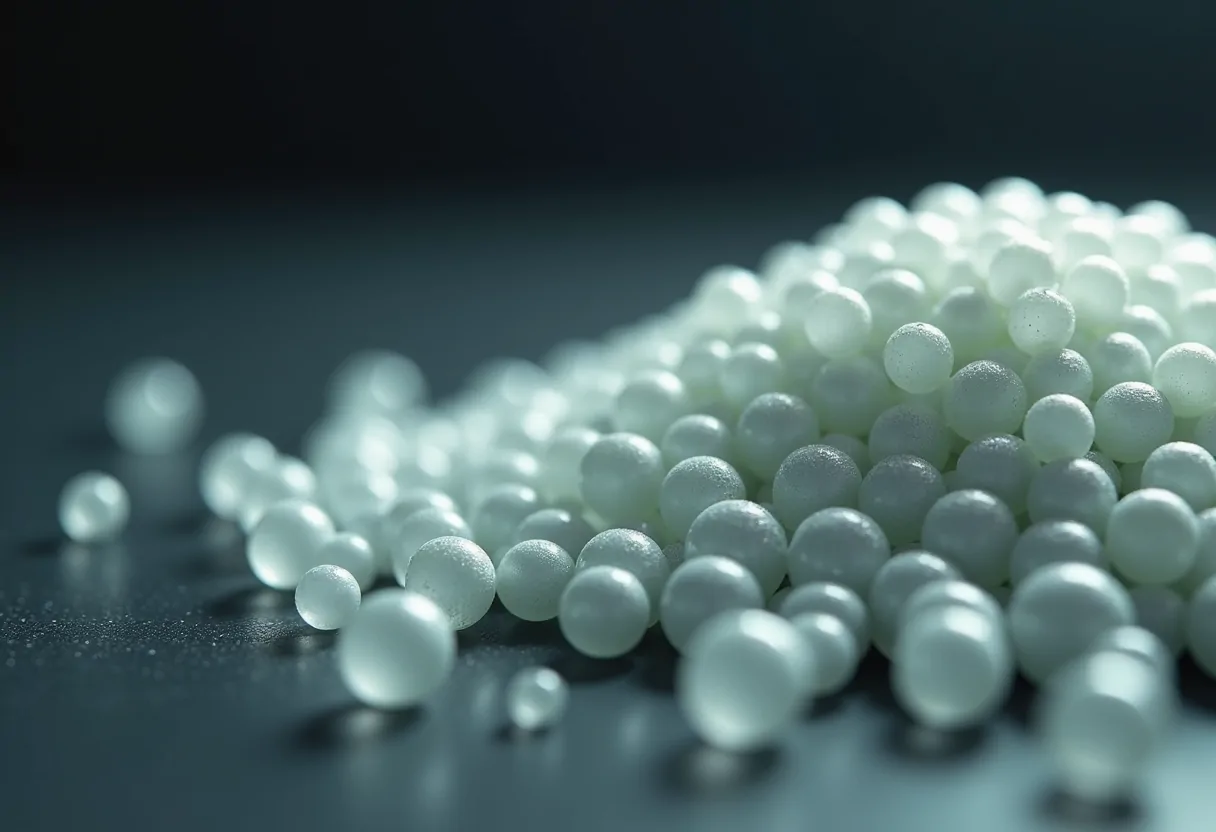
The growing chain is anchored to an insoluble polymer bead. Because the product is attached to something that can be filtered and washed, excess reagents and by-products are removed simply by rinsing the resin, rather than by purifying an intermediate at every step. That is the whole innovation, and it is what made routine synthesis of long sequences practical.
Assembly runs from the C-terminus toward the N-terminus, which is the opposite direction to biological protein synthesis.
One cycle, repeated
Each residue is added by the same four operations.
- Deprotection. The temporary protecting group on the N-terminus of the growing chain is removed, exposing a free amine.
- Washing. Reagents and by-products are rinsed away from the resin.
- Coupling. The next amino acid, itself protected and chemically activated, is introduced and forms a bond with the free amine.
- Washing again, before the cycle repeats.
A twenty-residue peptide therefore involves roughly eighty operations, each of which can be incomplete.
Fmoc and Boc
Two protecting-group strategies are named on technical documents and the distinction occasionally matters.
- Fmoc chemistry uses a base-labile group removed with piperidine, with final cleavage from the resin by trifluoroacetic acid. It is the dominant modern approach, in large part because it avoids strongly hazardous reagents.
- Boc chemistry uses an acid-labile group and requires hydrogen fluoride for final cleavage, which demands specialised equipment and handling. It remains useful for certain difficult sequences.
Fmoc's use of trifluoroacetic acid in cleavage is one of the reasons TFA appears both as a residual solvent consideration and as the counterion on the finished salt.
Why crude purity falls with length
Coupling efficiency is high but not perfect, and the losses compound multiplicatively. At 99% efficiency per step, a ten-residue peptide finishes at roughly 90% of theoretical and a fifty-residue peptide at around 60%, before purification. At 98% per step the fifty-residue case drops to roughly 36%.
This is the arithmetic behind several things a buyer observes: longer peptides cost more, carry a more complex impurity profile, and are more likely to show a crowded chromatogram before purification.
Difficult sequences
Some sequences resist assembly regardless of operator skill. Chains rich in beta-sheet-forming residues can aggregate on the resin, folding against themselves so the reactive terminus becomes sterically inaccessible. Coupling efficiency collapses at that point in the sequence.
Chemists respond with double couplings, elevated temperature, microwave assistance, modified solvent systems or pseudoproline building blocks that disrupt the folding. The practical point for a buyer is that a quoted price and lead time are not simply a function of length; a short difficult sequence can be harder than a longer straightforward one.
The impurities synthesis creates
- Deletion sequences, missing one or more residues where a coupling failed. These are the most common synthesis-related impurity and the reason capping steps exist, which terminate failed chains so they cannot continue and produce a near-identical full-length impurity.
- Truncated sequences, where the chain stopped short entirely.
- Incompletely deprotected material still carrying a side-chain protecting group, markedly more hydrophobic and late-eluting.
- Modification artefacts from the cleavage cocktail, which is why scavengers are included to intercept the reactive species that cleavage generates.
- Racemised residues, where stereochemistry has inverted at a susceptible position. Mass-identical to the parent and invisible to an intact-mass measurement.
Cleavage, purification and isolation
Cleavage releases the peptide from the resin and removes side-chain protecting groups, usually in one trifluoroacetic acid step with scavengers. The crude product is then precipitated, typically into cold ether, and purified by preparative reversed-phase chromatography, which is the same separation principle as the analytical purity assay, run at scale to collect the main peak rather than measure it.
Collected fractions are pooled and lyophilised. The salt form of the finished material is determined by this step, which is why TFA salts are the default and why an exchange to acetate or hydrochloride is an additional operation.
What this means when reading a certificate
Most certificate lines map onto a stage of this process. Purity reflects how well purification separated the synthesis impurities. Identity confirms assembly produced the intended sequence mass. Residual solvents reflect cleavage and chromatography. Net peptide content reflects lyophilisation and the counterion. Seen that way, a certificate is a summary of a manufacturing route rather than a list of unrelated numbers.
This is one part of buying wholesale. Wholesale peptides for clinics covers the whole process from evaluating a supplier to placing a first order.