
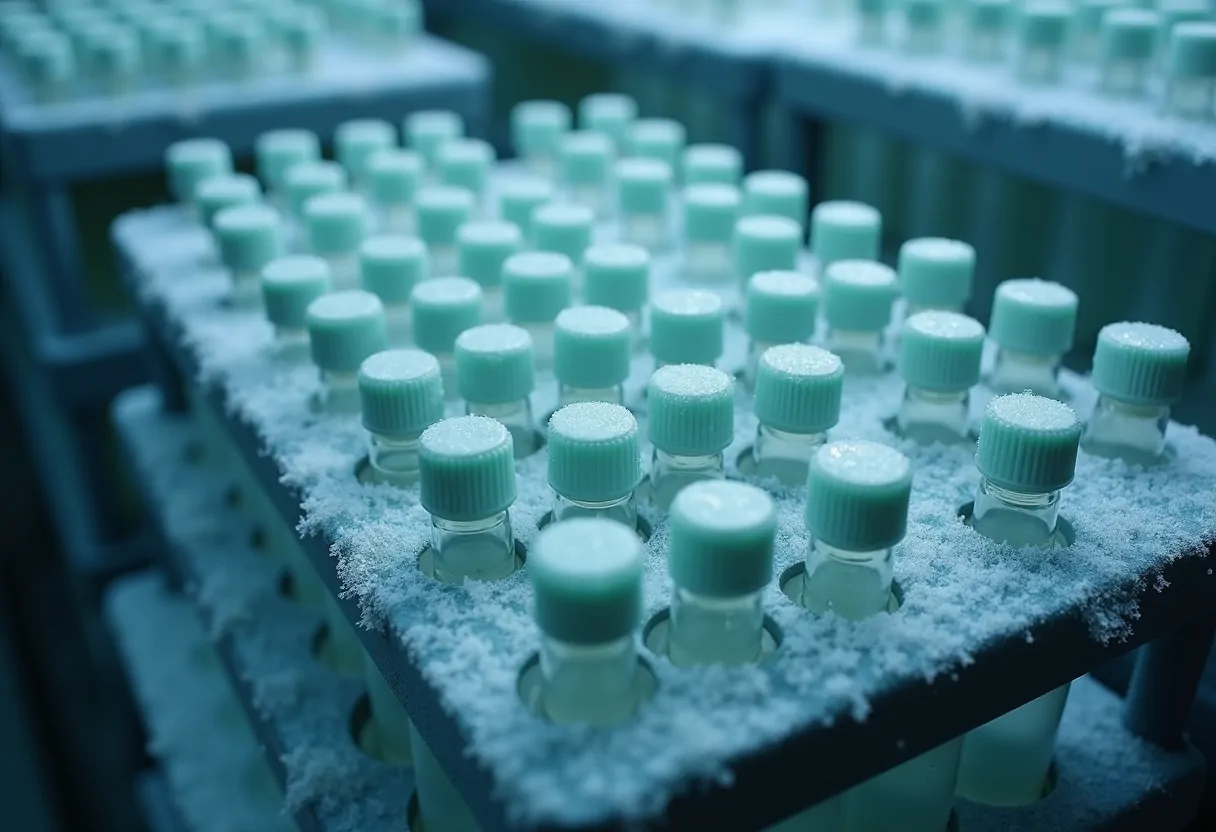
A reconstituted solution returned to the freezer and retrieved repeatedly is subjected to the same stress each time. Aliquoting into single-use portions replaces many cycles with one, and it is the highest-value handling change available for material in solution.
What actually happens during a freeze-thaw cycle
Freezing a solution is not uniform solidification. Pure water crystallises out first, which concentrates everything dissolved in the remaining liquid. A solution that was dilute can transiently reach a far higher local concentration in the shrinking unfrozen fraction.
Three consequences follow, and they compound.
- Concentration promotes aggregation, since molecules are forced into contact.
- Buffer components can crystallise at different points, shifting the pH of the remaining liquid, sometimes by more than a full unit. The peptide experiences a pH it was never formulated for.
- Growing ice crystals create extensive ice-liquid interfaces, which behave much like air-liquid interfaces in promoting unfolding and association.
Thawing reverses the process but does not reverse the damage. Aggregates formed during the cycle generally persist.
Why the count matters more than the duration
Time spent frozen at a stable temperature is comparatively benign. It is the transitions that do the work, which is why guidance is framed as a number of cycles rather than a total duration. Two cycles are usually unremarkable; repeated cycling over weeks is a different proposition, and material that has been through many is worth re-examining rather than assuming.
Aliquoting properly
- Decide the working volume first. The point is that an aliquot is used in a single session with nothing returned to storage, so the volume should match actual use rather than a round number.
- Prepare, mix gently and dispense in one pass, while the solution is homogeneous. Dispensing from a container that has already been frozen once defeats the purpose.
- Use containers suited to the temperature. Ordinary tubes can craze or fail at low temperature; screw-cap cryovials with an O-ring are intended for it.
- Leave headspace. Liquid expands on freezing and a full tube can split or unseat its cap.
- Freeze promptly rather than leaving aliquots at room temperature while the rest of the set is prepared.
Low-bind containers and adsorption
At low concentration, a meaningful fraction of peptide can adsorb onto container walls, and the loss is proportionally worse the more dilute the solution and the larger the surface-to-volume ratio. Low-binding polypropylene reduces it. For particularly adsorptive sequences a carrier protein is sometimes included, where it is compatible with the downstream work.
This is a quiet source of apparent potency loss that is easily mistaken for degradation.
Labelling that holds up
A freezer box of unlabelled tubes is unusable material. An aliquot label should carry enough to reconstruct its history without reference to anyone's memory.
- Compound and concentration.
- The source lot number, which is the link back to the certificate of analysis.
- Diluent used, since bacteriostatic and plain sterile water behave differently.
- Date prepared and the initials of whoever prepared it.
Use a cryogenic label or a solvent-resistant marker. Ordinary adhesive labels lift at low temperature and ordinary ink lifts under the alcohol used to wipe a surface down, which is how a rack of carefully prepared aliquots becomes a rack of unknowns.
That lot number is the detail most often omitted and the one that matters most, because without it an aliquot cannot be traced to the documentation that describes it.
For how this fits with everything else that happens to a vial between delivery and use, peptide storage and handling for clinics covers the full picture.