
GHK is a tripeptide: glycine, histidine, lysine. Three residues, which makes it one of the shortest compounds in any catalog. GHK-Cu is that tripeptide complexed with a copper(II) ion, and essentially everything distinctive about handling and analysing it comes from the metal rather than the peptide.
The complex
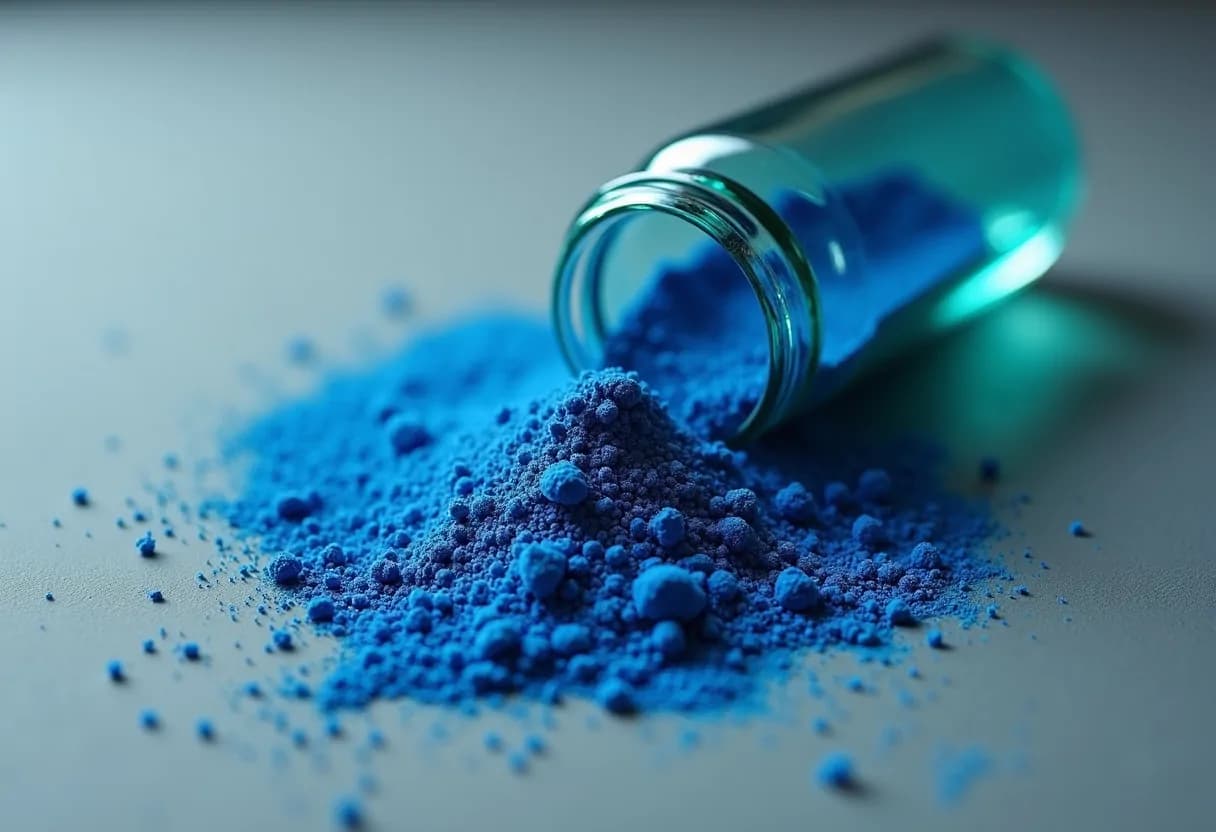
The histidine imidazole and the N-terminal amine coordinate the copper ion, forming a stable complex with a characteristic deep blue colour. That colour is diagnostic: a GHK-Cu lot that arrives off-white or pale has a problem, because the colour comes from the copper coordination itself rather than from an added dye.
It is one of the few compounds in a catalog where visual inspection on arrival carries real analytical information.
Why the copper complicates the paperwork
Copper is both the active constituent and, on every other product in the catalog, a contaminant. That creates a genuine documentation problem.
- Elemental impurity testing under USP ⟨232⟩ and ⟨233⟩ treats copper as an element to be limited. On GHK-Cu it is present by design and at a stoichiometric level, so a standard heavy-metals panel reported without comment is misleading.
- A complete certificate should therefore report copper content as a specification to be met rather than a limit not to be exceeded, and separately report the other elements as impurities.
- The ratio matters. Under-complexed material contains free peptide and free copper rather than the intended complex, and a bulk copper figure alone does not distinguish those cases.
A supplier that reports a heavy-metals panel on GHK-Cu without distinguishing the coordinated copper from impurity copper has not thought about the product.
Analytical behaviour
The complex also makes the routine assays less routine. Reversed-phase HPLC conditions can dissociate the complex, so a purity method validated on the free peptide does not necessarily describe the complexed material. Mass spectrometry shows the copper adduct with its distinctive isotope pattern, which is useful confirmation that the complex is intact rather than merely present as separate components.
In practice this means the method statement on a GHK-Cu certificate is worth reading rather than skimming.
Handling
Two practical points follow from the chemistry.
- Chelating agents compete for the copper. Buffers containing EDTA or similar will strip the metal and dissociate the complex.
- pH matters more than for most short peptides, since the coordination depends on the protonation state of the histidine and the N-terminal amine.
Stored lyophilised, cold and dark, it is stable. In solution it is more condition-sensitive than its three-residue length suggests.
Research context
GHK was first described as a fragment identified in plasma, and published work examines its role in copper transport and in extracellular-matrix remodelling, including collagen synthesis in cell culture models. Material is supplied strictly for laboratory research.
Because the copper is a constituent atom rather than an additive, the mass on a certificate will not match a sum of the three residue masses. Molecular weight covers why that arithmetic differs, and mass spectrometry and peptide identity covers what the identity line can and cannot settle for a metal complex.
Why the certificate numbers will not add up
Summing the three residue masses and adding one water gives the free tripeptide. The published figure for the copper complex is higher, because the molecule includes a copper atom and has lost hydrogens from the sites that hold it.
That arithmetic is worth doing once, because it demonstrates that the mass on the certificate describes the complex rather than the peptide. A buyer expecting the tripeptide mass and finding a larger number has not found a discrepancy, they have found the copper.
What the copper means for handling
A metal centre introduces chemistry that a plain peptide does not have, including sensitivity to chelating agents and to anything that competes for the coordination sites. Solvent choice therefore matters more here than for a simple short peptide.
Reconstitution solvents compared covers the options, and the general principle is to avoid adding anything that could strip or displace the metal unless the experiment intends it.
What a certificate can and cannot establish here
It can establish the mass of the complex, the purity of the material by the stated method, and the content. What it rarely addresses is the coordination state, which is to say whether the copper is held as intended rather than merely present.
That is an unusual gap and it follows from the test panel rather than from any failure. Identity by mass confirms composition; it does not confirm geometry. For most purchasing decisions composition is sufficient, and it is worth knowing which question has been answered.
Why solvent choice carries more weight than usual
Because anything that competes for the metal can displace it. Chelating agents are the obvious case, and several common buffer components coordinate metals to some degree. A solvent choice that would be unremarkable for a plain peptide is a real variable for a metal complex.
The conservative approach is to reconstitute in the simplest suitable solvent and to introduce buffer components only where the experiment requires them. Reconstitution solvents compared sets out the options and what each one adds.
What to confirm on the certificate
That the reported mass corresponds to the copper complex rather than the free tripeptide, and that the identity method is named. A figure matching the bare peptide on a product sold as the complex is a discrepancy worth raising before the material is used.
One closing practical point. Because the copper is integral rather than incidental, this is a compound where the appearance of the solid carries slightly more information than usual, and a visible change in colour between lots is worth a question rather than an assumption.
For where this sits among the other molecules a catalogue carries, not everything in a peptide catalog is a peptide covers how the classes differ.