
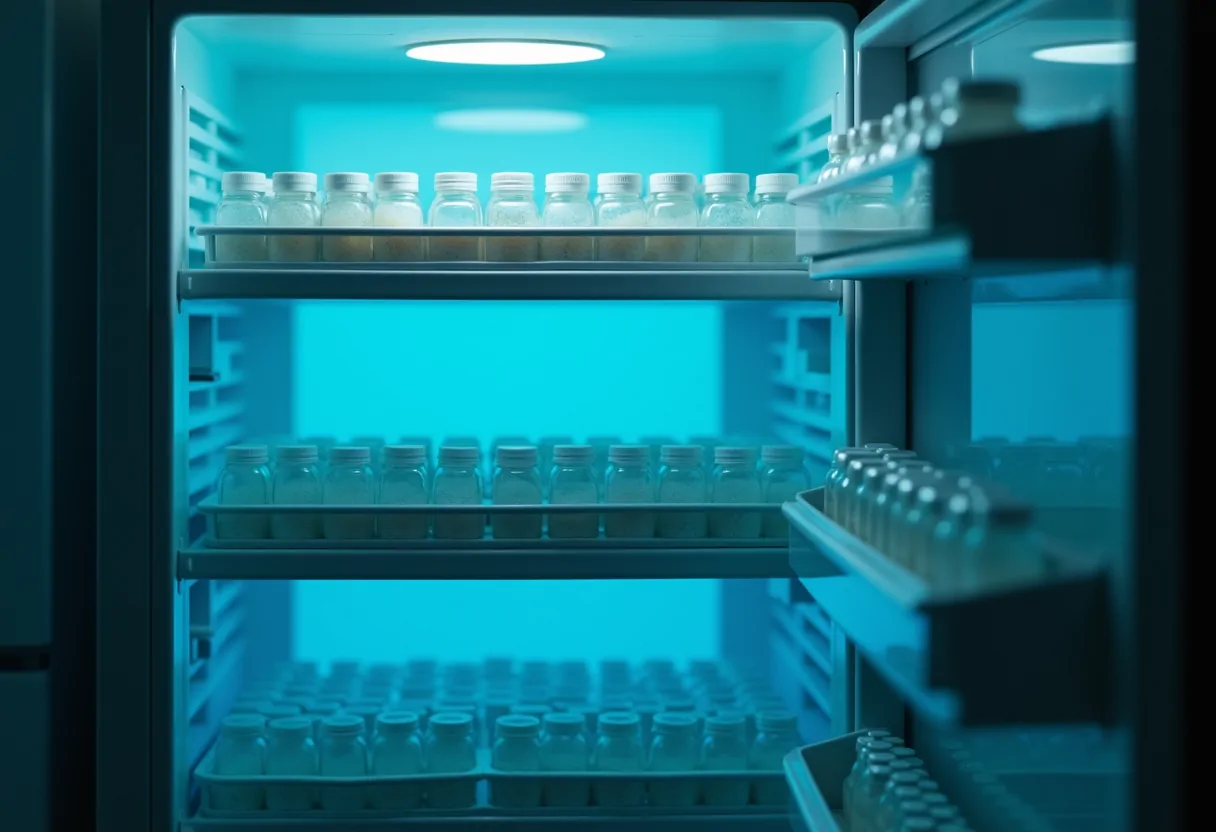
A peptide is only as good as its condition at the moment it's used. Heat, light, moisture, and time all degrade product — which means storage and handling are part of quality, not an afterthought.
This guide covers the practical steps clinics use to protect peptide integrity from the moment a shipment arrives. It is operational guidance only; it is not dosing or usage instruction, and all products are supplied for physician use only.
Protect the [cold chain](/blog/cold-chain-for-peptide-shipments) in transit
Integrity starts before the package reaches you. Reputable suppliers ship temperature-sensitive product with appropriate cold-chain packaging. On arrival, inspect the shipment promptly, confirm the contents against the packing list, and move product into proper storage without delay.
Store lyophilized vials correctly
Lyophilized (freeze-dried) peptides are generally the most stable form and are typically stored cold and protected from light and moisture. Keep vials sealed until needed, store them per the supplier's stated guidance, and avoid repeated temperature swings such as moving product in and out of cold storage.
Handle reconstituted product per stability guidance
Once reconstituted, a peptide's stability window changes and is generally shorter than the lyophilized form. Follow the supplier's stability guidance for the specific product, keep reconstituted vials cold and protected from light, and label them clearly. This article does not provide reconstitution amounts or usage protocols — refer to your supplier's documentation and your own qualified procedures.
Control light, temperature, and time
• • Keep product out of direct light and away from heat sources.
• • Minimize the time vials spend at room temperature.
• • Avoid unnecessary freeze-thaw cycles where guidance advises against them.
• • Track how long reconstituted product has been open against the supplier's stability window.
What the vial closure is doing
The stopper is not packaging. It is a barrier against water vapour, oxygen and microorganisms, and it is the half of the container that gets handled and pierced. A lyophilised cake is hygroscopic, so a compromised seal undoes what the drying achieved.
That makes entries a limit as real as time. Each one exchanges headspace for room air and carries a small risk of coring, where a fragment of stopper is punched out and the channel left behind no longer reseals. Vial closures covers what to watch for, and residual moisture covers why water is the thing being kept out.
Which compounds actually need protecting from light
Fewer than the labels suggest. Photodegradation needs a chromophore, so a sequence carrying tryptophan, tyrosine or a disulfide bond has something to damage and one without has very little. A dry cake is also far less exposed than a solution, because the chemistry needs mobility to propagate.
The practical hierarchy is a closed carton in a dark drawer first, minimal bench time second, and amber glass only where the structure warrants it. Light sensitivity sets out which structures matter, and how peptides degrade covers the routes light shares with oxidation.
Label, log, and keep the paperwork
Good documentation is part of good handling. Record lot numbers, receipt dates, and storage conditions, and keep the lot-matched COA on file so the certificate always maps to the product on your shelf. Clear labeling and a simple log make audits, recalls, and reorders far easier.
Source from a supplier that tests every batch.
Seven-layer testing, a lot-matched COA with every order, made in the USA, white-label fulfillment. Verify your NPI for instant wholesale access.
What the storage temperature is actually protecting
Cold slows every reaction in the vial, but it is not doing one job. For a lyophilised solid the dominant threat is water, because a dried cake is hygroscopic and water drives hydrolysis and lowers the temperature at which the amorphous solid softens. For a solution, mobility is already available and temperature governs how fast the chemistry runs.
That is why the same instruction means different things for the two formats. Refrigerating a sealed dry vial is largely insurance. Refrigerating a reconstituted one is the main control you have, and the clock it slows is already running.
Freeze-thaw, and why cycles matter more than time
Freezing a solution does not pause it. Ice forms as pure water, so everything dissolved is pushed into a shrinking unfrozen pocket where its concentration is many times the nominal figure on the tube. Concentration drives aggregation, so a dilute solution passes briefly through being a very concentrated one every time it freezes.
Each cycle also creates an enormous ice-water interface, and interfaces are where peptides unfold and associate. That makes the number of cycles the variable worth controlling rather than total time frozen. Sizing aliquots to a single use makes the cycle count one for every tube, which is covered in freeze-thaw cycles and aliquoting.
Temperature excursions on arrival
A warm box is a question rather than a verdict, and the first thing to establish is what was promised for that shipment. Lyophilised powder ships at ambient temperature across this industry because the dry solid tolerates it, so there may be no excursion to assess at all.
Where a temperature was promised, the decision has to be made before anything goes into storage, because once the shipment is unpacked and distributed the evidence is gone. Photograph the box before opening, read any indicator and record the value rather than the impression, and keep the packaging until the question is closed. Temperature excursions on arrival sets out the assessment.
The records that make storage defensible
Three, and they are short. A receipt note completed at the door rather than at the shelf, because the interval between the two is where a temperature question becomes unanswerable. A storage log that records movement and not only consumption, since a vial that spent an afternoon on a bench was not at a controlled temperature. And a usage log carrying the lot number, which is what ties everything back to a certificate.
None of this requires a system. The lot number running through every row is what makes the record reconstructable, and that is the whole of the discipline.
The chemistry behind the handling rules
Most storage advice is a rule without its reason, which makes it hard to apply to a compound the rule did not anticipate. These cover the mechanisms, so the rule can be derived rather than remembered.
- How peptides degrade maps each route to the residues that enable it.
- Lyophilisation explained covers why material ships as a powder and what the cake is.
- Residual moisture covers the water that stays behind and why it matters.
- Vial closures covers the barrier that keeps all of it out.
- Light sensitivity covers which structures actually need protecting.
Working with reconstituted material
- Reconstitution solvents compared covers choosing a diluent.
- Reconstitution arithmetic covers the three calculations and the unit error that costs most.
- Net peptide content covers why the label is not the number to calculate with.
- Freeze-thaw cycles and aliquoting covers protecting a vial once it is in solution.
- Retest dates and expiry dates covers what the date on a vial actually asserts.
Getting material in, and keeping track of it
Storage is only as good as what happened before the vial reached the shelf, and only as useful as the record attached to it.
- Cold chain for peptide shipments covers what each shipping intention commits to.
- Receiving and inspecting a shipment is the ten-minute protocol at the door.
- Temperature excursions on arrival covers assessing a warm box.
- Lot traceability and recordkeeping covers the field everything else hangs off.
- Chain of custody inside a practice covers the four points where custody usually breaks.
Running it as a programme
- Storage equipment and monitoring covers what to buy and what to measure.
- Writing an SOP for receipt and storage covers turning all of this into something followable.
- Labeling and identification covers keeping a vial traceable after it leaves the box.
- Inventory levels and reorder points and building a formulary cover what to hold and how much.
- Disposal and waste handling covers the last entry in the record.
- Peptide inventory planning for clinics covers planning against demand rather than guesswork.