
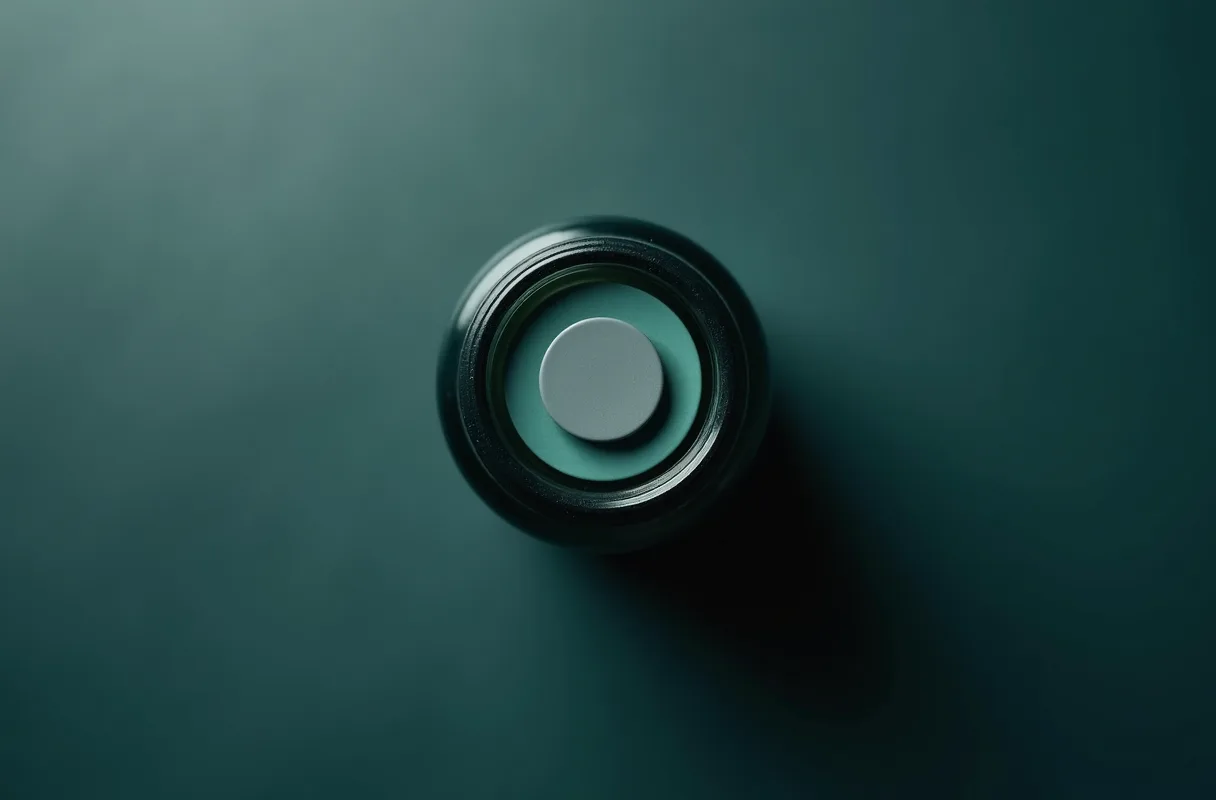
Almost everything written about peptide vials concerns what is inside them. The closure gets a sentence, usually that it is a rubber stopper, and it deserves more because it is the half of the container that is handled, pierced and relied upon, and therefore the half that fails.
Three parts, not one
Looking at a sealed vial from above you are seeing three components. An elastomeric stopper sits in the neck. An aluminium collar is crimped around the neck and over the stopper's flange, holding it in compression. A plastic cap covers the stopper's face until first use.
Removing that plastic cap does not open the vial. The crimped collar and the stopper remain, and the container is still sealed.
What the stopper is made of
For lyophilised material it is typically a butyl rubber, chosen because its permeability to water vapour is very low and because it recovers its shape after being pierced. Both properties matter: the first protects a dry cake that will take up water from anywhere it can, and the second is the reseal behaviour the whole design depends on.
Stoppers are often laminated on the product-facing surface, which reduces both extraction of rubber components into solution and adsorption of the solution's contents onto the rubber.
Colour is a formulation marker, not a grade
Grey, red and blue stoppers differ by the filler and vulcanisation chemistry the manufacturer used. The colour marks that formulation. It is not a quality ranking, and nothing can be inferred about a vial from the colour of its closure alone.
The headspace
At the end of a lyophilisation cycle the vials are under vacuum inside the chamber and the stoppers are seated there. Most processes admit an inert gas before the stoppers are fully pressed home, so a sealed vial contains a low-pressure inert atmosphere rather than a hard vacuum.
That has two consequences at the bench. The gas displaces oxygen, which matters for oxidation-prone residues covered in how peptides degrade. And because internal pressure is below atmospheric, a vial often draws solvent inward slightly on first entry.
Coring
| Cause | What happens | What prevents it |
|---|---|---|
| Shallow entry angle | The bevel shears rather than parts the rubber | Enter close to perpendicular |
| Repeated entry at one point | That spot thins and weakens | Vary the entry point slightly |
| Blunt or reused point | Tears instead of cutting | A sharp point, once per entry |
| Large gauge | Removes more material | The smallest gauge that works |
Coring punches a fragment out of the stopper. It contaminates the solution and leaves a channel that will not reseal.
Why entries are the real limit
A vial has two clocks. One is time. The other is entries, and it is the one nobody counts. Every entry exchanges some headspace gas for room air, carries whatever is on the stopper's face through the barrier, and incurs a small cumulative probability of coring.
For a dry vial the water exchange matters most, because a lyophilised cake is hygroscopic and whatever the drying cycle achieved can be undone over weeks through a compromised seal. Residual moisture covers why that matters.
The practical response is to withdraw into aliquots in one session rather than returning repeatedly, and to record the entry count alongside the reconstitution date. Freeze-thaw and aliquoting covers the aliquot side.
What a stopper is protecting against
Three things, in roughly this order of importance for a dry product. Water vapour, because the cake is hygroscopic and moisture drives most of what degrades it. Oxygen, because the headspace was deliberately filled with inert gas. And microorganisms, which matters most once the contents are a solution rather than a solid.
A closure that has been compromised fails on all three at once, which is why a cored stopper is not a cosmetic problem. The channel it leaves does not close, and it is admitting air into a container designed to exclude it.
Practical habits that cost nothing
- Wipe the stopper face and let it dry before entry rather than wiping and piercing immediately.
- Withdraw what you need in one session rather than returning to the vial repeatedly.
- Record the entry count alongside the reconstitution date, since both clocks matter and only one is usually tracked.
- Treat a solution containing a visible particle as compromised rather than filtering and continuing, because the barrier is gone as well.
What a closure cannot do
It cannot make a solution sterile. A stopper that has been pierced has been crossed, and a closure maintains a barrier rather than restoring one. If sterility is a requirement it comes from filtration, which sterility testing versus sterile filtration distinguishes.
For how this fits with everything else that happens to a vial between delivery and use, peptide storage and handling for clinics covers the full picture.