
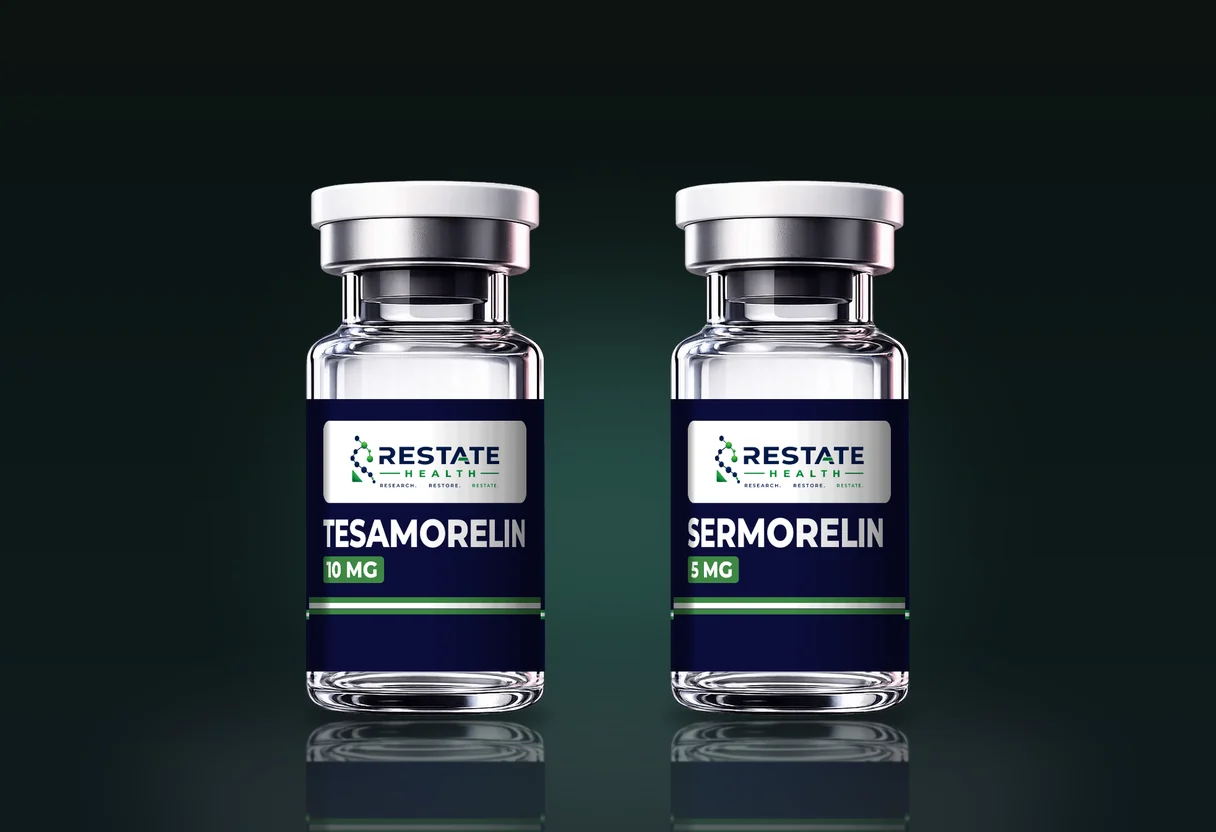
TH9507 and sermorelin are both built on human growth-hormone-releasing hormone, and they are often described together as GHRH analogues. The description is correct and it hides the two things a buyer needs to know. Sermorelin is the first 29 residues of the hormone with an amide at the end. TH9507 is all 44 residues with a trans-3-hexenoyl group attached to the N-terminal tyrosine. One is a fragment; the other is the full sequence carrying a modification.
Those two facts explain everything else that differs between them: the masses on their certificates, the strengths they are sold in, the prices, and the reason the modification exists at all. This guide works through each in turn, quoting the catalogue records for the numbers.
The parent hormone and its 29-residue fragment
Human GHRH was characterised in 1982 from pancreatic tumours that had caused acromegaly. Guillemin and colleagues in Science reported a 44-residue form; Rivier and colleagues in Nature reported a 40-residue form from a different tumour. Within two years Lance and colleagues had shown that the N-terminal 29 residues, as a C-terminal amide, carried the receptor activity of the full sequence, and GRF(1-29) amide became the standard working fragment. Sermorelin is that fragment.
The point for a buyer is that the two products are not two versions of one thing. Sermorelin is a shortened sequence; TH9507 is a lengthened and modified one relative to it. Published work on one does not transfer to the other, and neither does a certificate.
Sermorelin: GRF(1-29) amide
The catalogue record gives the sequence as Tyr-Ala-Asp-Ala-Ile-Phe-Thr-Asn-Ser-Tyr-Arg-Lys-Val-Leu-Gly-Gln-Leu-Ser-Ala-Arg-Lys-Leu-Leu-Gln-Asp-Ile-Met-Ser-Arg-NH2, with the formula C149H246N44O42S and a molecular weight of 3357.93 g/mol, CAS 86168-78-7. Twenty-nine residues, one of them a methionine at position 27, which is where the single sulfur in the formula comes from.
The sequence is unmodified apart from the C-terminal amide. That matters for stability. Position 2 is an L-alanine, so the Tyr-Ala N-terminus is the natural one, and Frohman and colleagues showed in 1989 that dipeptidyl peptidase IV in plasma removes exactly that dipeptide, leaving an inactive GHRH(3-44). The same cleavage applies to the fragment. Sermorelin is therefore the short-lived form in the literature, which is the context for every modified analogue that followed.
TH9507: the full sequence with an acyl N-terminus
The catalogue record gives TH9507 as trans-3-hexenoyl-Tyr-Ala-Asp-Ala-Ile-Phe-Thr-Asn-Ser-Tyr-Arg-Lys-Val-Leu-Gly-Gln-Leu-Ser-Ala-Arg-Lys-Leu-Leu-Gln-Asp-Ile-Met-Ser-Arg-Gln-Gln-Gly-Glu-Ser-Asn-Gln-Glu-Arg-Gly-Ala-Arg-Ala-Arg-Leu-NH2, formula C221H366N72O67S, molecular weight 5135.86 g/mol, CAS 218949-48-5. Forty-four residues. The first 29 are the sermorelin sequence, residue for residue; the remaining 15 are the rest of GHRH(1-44).
The hexenoyl group is the modification. It is a six-carbon unsaturated acyl chain joined to the N-terminal amine of the tyrosine, and its purpose is to block the dipeptidyl peptidase IV cleavage described above: the enzyme needs a free N-terminal amine to act, and an acylated one is not a substrate. The nonclinical account by Ferdinandi and colleagues (2007), published while the compound was still called TH9507, describes the analogue as a GRF stabilised against that degradation. In formula terms the acyl group adds C6H8O, about 96 g/mol, to what the bare 44-residue amide would weigh.
TH9507 exists as a licensed pharmaceutical in the United States under another name, and a published clinical literature follows from that; Grunfeld's 2011 profile in Nature Reviews Drug Discovery and the 2019 multicentre trial by Stanley and colleagues in adults living with HIV are cited below as examples of what was studied. The research material supplied here is not that product and is for research use only.
The two records side by side
| Sermorelin | RS-TESA | |
|---|---|---|
| What it is | GRF(1-29) amide | GRF(1-44) amide with trans-3-hexenoyl on the N-terminus |
| Amino acid count | 29 | 44 |
| N-terminus | Free amine (Tyr-Ala) | Acylated (hexenoyl-Tyr-Ala) |
| Methionine | One, position 27 | One, position 27 |
| Molecular formula | C149H246N44O42S | C221H366N72O67S |
| Molecular weight (average) | 3357.93 g/mol | 5135.86 g/mol |
| Monoisotopic mass (PubChem) | 3355.82 | 5132.72 |
| CAS number | 86168-78-7 | 218949-48-5 |
| Strengths | 5 mg, 10 mg | 10 mg, 20 mg |
| From | $72.80 | $151.20 (10 mg), $207.20 (20 mg) |
Figures from the two catalogue records, with PubChem's monoisotopic masses (CIDs 16137828 and 16132413) added for the certificate comparison. Prices are the listed strengths at the time of writing.
What each certificate should show
The same panel as any research peptide, in the same order: lot, dates, identity, content, purity. Reading a certificate of analysis line by line covers the general case. Three things are specific to this pair.
- The identity mass. For sermorelin it should reconcile with 3357.93 (average) or 3355.82 (monoisotopic); for TH9507 with 5135.86 or 5132.72. At 5,000 g/mol the average and monoisotopic figures are three daltons apart, so a certificate should state which basis it reports before the number is compared. A TH9507 mass about 96 lighter than expected would indicate the acyl group is missing, which is a different molecule.
- Methionine oxidation. Both sequences carry a Met at position 27, and methionine sulfoxide is sixteen daltons heavier than methionine. A satellite peak at +16 on the mass spectrum, or an early-eluting shoulder on the chromatogram, is the usual sign, and it is a purity question rather than an identity one. Peptide degradation pathways covers the route.
- Which peptide the certificate names. The first 29 residues of TH9507 are sermorelin, so a fragment-based identity method will produce many of the same fragments for both. The intact mass is what separates them, and a certificate for TH9507 that reports only fragment matches without an intact mass has not done the one measurement that distinguishes it from the shorter product.
Why length drives the price
Sermorelin is listed from $72.80 and TH9507 from $151.20, and the ratio is close to what the chemistry predicts. Both are made by solid-phase peptide synthesis, one residue at a time. Every coupling step has a yield below 100 percent, and the yields multiply: a chain of 44 couplings at 99 percent each leaves about 64 percent of the chains complete and correct, where 29 couplings at the same efficiency leave about 75 percent. The longer chain also produces more deletion sequences that are close in mass and retention to the product, so purification to the same stated purity discards more material.
TH9507 adds a further step, the N-terminal acylation, with its own yield and its own purification. Fifteen extra residues plus a modification is a reasonable account of a price roughly twice as high for the smallest strength. What research peptides cost and why sets out the general model that this pair illustrates.
Salt form and storage, read from the two sequences
Both peptides are basic, and both are normally purified with trifluoroacetic acid, so both will carry trifluoroacetate counterions unless the supplier has exchanged them for acetate. The number of counterions a molecule can carry is set by its basic sites, and the two sequences in the catalogue records allow that to be counted. Sermorelin has three arginines (positions 11, 20 and 29), two lysines (12 and 21) and a free N-terminal amine: six sites. TH9507 has six arginines (11, 20, 29, 38, 41 and 43) and two lysines (12 and 21), and its N-terminus is acylated and so carries no charge: eight sites.
At one trifluoroacetate (114.02 g/mol) per site, the counterion would be about 17 percent of the salt's mass for sermorelin and about 15 percent for TH9507. Those are upper-bound illustrations from the formula masses, not measurements of any lot; the real counterion content of a vial is whatever its certificate's net content line or a counterion assay reports. The point is that a 10 mg label on either product is a mass of powder, and a sixth of that powder may be counterion before water is counted. Net peptide content covers how the certificate reports what is actually peptide.
Both catalogue records give the same storage line: lyophilised powder, stored at minus 20 degrees Celsius, protected from light and moisture, with any reconstituted solution kept at 2 to 8 degrees Celsius. The shared instruction follows from the shared chemistry. Each sequence has a methionine to protect from oxidation, each has asparagines (position 8 in both, and position 35 in TH9507) that deamidate in solution, and both are large enough that the dry solid is far more stable than any solution of it.
The one difference is at the N-terminus. Sermorelin's free Tyr-Ala terminus is the enzyme-sensitive one in plasma, which matters in a biological matrix rather than in a vial; in a clean buffer the two behave much alike. For both, the number of entries into a reconstituted vial matters as much as the time it has been open.
Choosing a strength
Sermorelin is sold at 5 and 10 mg, TH9507 at 10 and 20 mg. The larger molecule carries fewer moles per milligram: 10 mg of TH9507 at 5135.86 g/mol is about 1.95 micromoles, where 10 mg of sermorelin at 3357.93 g/mol is about 2.98 micromoles. Where work is planned in molar terms, that is the number to size against, not the milligram figure on the label.
The usual rule applies on a first order: the smallest strength is a test of the supplier's documentation rather than a commitment, and a vial that outlasts the work was bought at full price. The certificate's content figure, not the label, is the mass to put in any calculation.
In short
Sermorelin is GRF(1-29) amide, 29 residues, 3357.93 g/mol, with the natural N-terminus that plasma dipeptidyl peptidase IV cleaves. TH9507 is GRF(1-44) amide with a hexenoyl group blocking that cleavage, 44 residues, 5135.86 g/mol. Both carry a methionine at position 27. The intact mass on the certificate tells them apart, the length accounts for the price, and the class they belong to is set out in growth hormone secretagogues explained.