
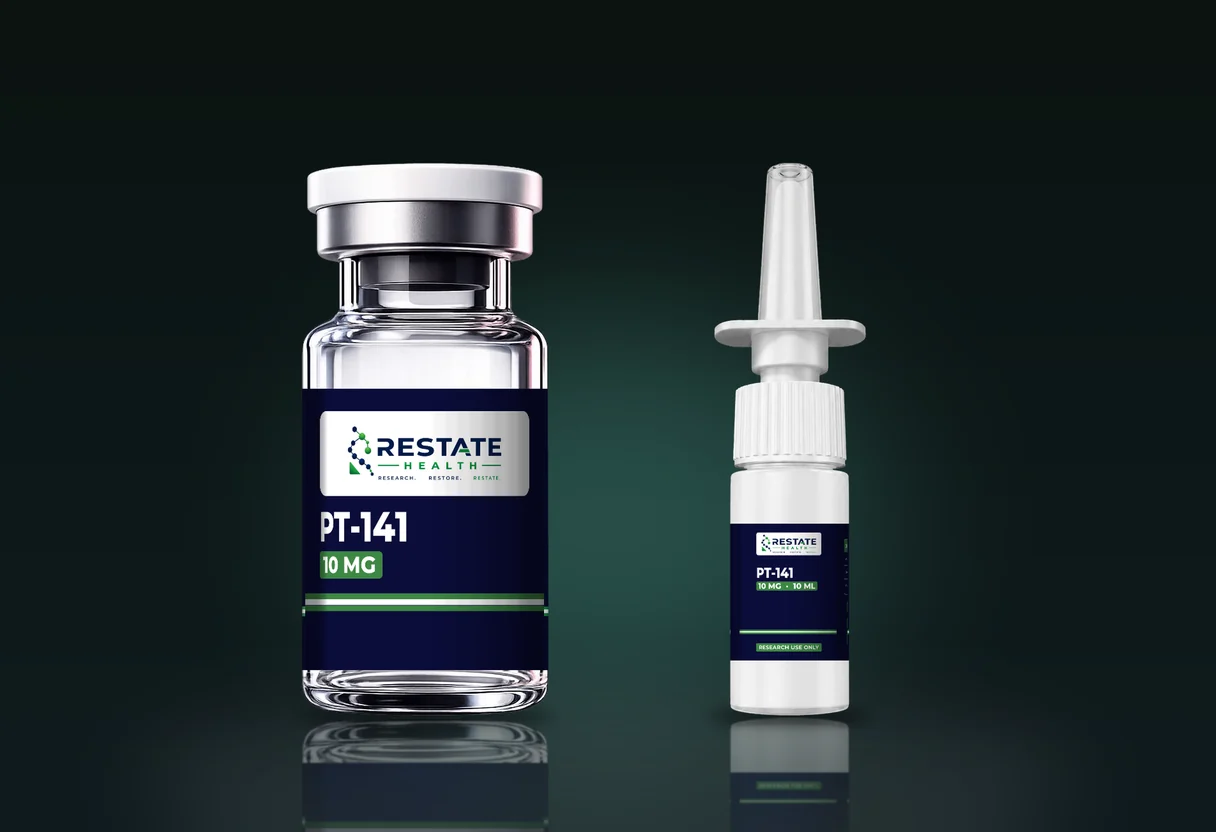
PT-141 is listed twice in this catalogue: as a 10 mg lyophilised vial and as a liquid spray carrying 10 mg in 10 mL of solution. The peptide is the same in both. The catalogue records give the same CAS number (189691-06-3), the same formula (C50H68N14O10) and the same molecular weight (1025.16 g/mol) for each, and both record the synonym bremelanotide.
What differs is everything around the peptide: whether it arrives as a dry cake or already in water, what the label states, when its storage clock starts, and what the certificate has to report to be useful. This guide sets the two presentations side by side on those points and nothing else. It does not discuss what the compound does in any system; melanocortin peptides explained covers the family and the published receptor work.
| Compound | Vial strengths | Molecular weight | Amino acids |
|---|---|---|---|
| PT-141 | 10 mg | 1025.16 g/mol | 7 |
| PT-141 Liquid Spray | 10 mg · 10 mL | 1025.16 g/mol | 7 |
From the Restate Health catalog records. Lot-specific values are on each certificate of analysis.
One heptapeptide, written out
The catalogue sequence is Ac-Nle-cyclo[Asp-His-D-Phe-Arg-Trp-Lys]-OH: a seven-residue chain acetylated at the N-terminus, closed into a ring by a lactam bond between the side chains of aspartate and lysine, and ending in a free carboxylic acid. PubChem CID 9941379, the record for bremelanotide, carries the same formula, an average mass of 1025.2 and a monoisotopic mass of 1024.52.
The ring is the design feature. Al-Obeidi and colleagues reported in 1989 that closing a lactam between an Asp side chain at position 5 and a Lys side chain at position 10 of the alpha-MSH 4-10 fragment gave a 23-membered ring with prolonged activity in frog and lizard skin bioassays; PT-141 is the free-acid relative of that scaffold. For the buyer the point is simpler. A cyclised peptide has a mass one water (18.02) below its open-chain precursor, so the identity mass on either certificate is the first thing to reconcile, and the figure is 1025.16 on an average basis whichever presentation you hold.
What a solution format changes
A solution replaces a mass with a concentration. The spray record states 10 mg in 10 mL, which is 1 mg/mL, and that concentration, not the 10 mg, is the number every later calculation uses. The metered pump is specified in the record at 0.1 mL per actuation and about 100 actuations per bottle, which is a statement about the device and belongs on the label beside the concentration.
A solution also starts its storage clock at manufacture rather than at reconstitution. Water is the medium in which hydrolysis, deamidation and oxidation run, and Manning and colleagues' 2010 review of protein and peptide stability sets out those routes and why they are suppressed in the dry state and active in solution. A bottle filled at the factory has been in solution since that day, so the manufacture date and the expiry or re-test date on a liquid product carry more weight than the same two dates on a vial. Shelf life, lyophilised versus in solution sets out the four states and what is known about each.
Third, a multi-entry bottle has to answer the preservative question, covered below. And fourth, the certificate changes shape: a purity figure for a powder is not an assay of a solution. A certificate for the spray should state the measured concentration of peptide in mg/mL, with the method, alongside identity and purity.
What a lyophilised vial changes
The vial moves the solution step to the buyer. The record states a lyophilised powder stored at -20 °C, protected from light and moisture, reconstituted with bacteriostatic water and refrigerated afterwards. Until the stopper is pierced the material is a dry cake, and Wang's 2000 review of lyophilisation describes why the dried state is the stable one: the water that most degradation routes need has been removed, which is the whole reason the format exists.
In exchange, the vial carries two numbers the solution does not. The first is net peptide content, the measured mass of peptide in the vial as distinct from the mass of powder or the label figure, which a certificate should report and which net peptide content explained covers. The second is the reconstitution volume, which the buyer chooses, so the concentration is whatever the work requires rather than the 1 mg/mL the spray fixes. The storage clock on the solution then starts at the moment of reconstitution, in the buyer's own records.
The two presentations from the catalogue records
| PT-141 vial | PT-141 Liquid Spray | |
|---|---|---|
| Strength on the label | 10 mg | 10 mg in 10 mL |
| Concentration | Set by the buyer at reconstitution | 1 mg/mL, fixed at manufacture |
| Physical form | Lyophilised powder | Atomised solution with a metered pump (0.1 mL per actuation, about 100 per bottle) |
| Storage as supplied | -20 °C, protected from light and moisture | Per the label; the solution is already in its working state |
| When the solution clock starts | At reconstitution, in the buyer's records | At manufacture, on the supplier's label |
| Certificate figure for content | Net peptide content in mg | Assay in mg/mL |
| Preservative | None in a dry cake; bacteriostatic water adds one at reconstitution | Must be stated on the label, present or absent |
| CAS, formula, molecular weight | 189691-06-3, C50H68N14O10, 1025.16 g/mol | Same |
| Price from | $72.80 | $85.26 |
Figures from the Restate Health catalogue records for PT-141 (vial) and PT-141 Liquid Spray as they stood on 21 October 2026. Mass and formula are the same in both records and in PubChem CID 9941379.
The preservative question
A bottle that will be entered many times either carries an antimicrobial preservative or it does not, and the label should say which. Benzalkonium chloride is the preservative most multi-use aqueous nasal solutions have historically carried; Marple and colleagues' 2004 review surveyed the literature on it and recorded conflicting findings, which is enough to make its presence or absence a thing a buyer wants to know rather than guess. The FDA's 2002 guidance on chemistry, manufacturing and controls documentation for nasal spray products treats preservative content as an attribute to be specified and assayed in its own right, which is the standard the certificate for a preserved solution should meet: not just the peptide figure, but the preservative figure.
A preservative-free solution is not wrong. It is simply a product with a shorter life once opened, and the label and certificate should make that trade visible. Neither answer is right for every piece of work, so the question is one to ask before ordering, and nasal sprays and liquid formats explained covers what the preservative is doing and what a liquid certificate should carry.
What each certificate should state
- Both: the lot number printed on the unit, identity by mass spectrometry reconciling with 1025.16 g/mol (average) or 1024.52 (monoisotopic) with the basis stated, and purity by HPLC with the method named.
- Vial: net peptide content in milligrams, residual moisture if tested, and the salt form if the supplier will state it.
- Spray: assay of peptide in mg/mL, the fill volume, pH, preservative identity and content if one is present, and the pump specification. The FDA's 2002 nasal spray guidance lists pump delivery, spray content uniformity and priming among the product characterisation studies, and a supplier who has run them can say so.
The spray record states that a Compound Facts panel, a lot number and a certificate of analysis ship with every unit. Read the certificate's content line first. If it reports a powder purity and no concentration, it is a certificate for the peptide before it went into solution, and the solution has not been tested as sold.
Storage and the two clocks
ICH Q1A(R2) is the stability-testing guideline supplier shelf-life claims are built on, and it is written around a product in its final container. For the vial that container holds a dry cake at -20 °C and the data are generous. For the spray it holds a solution at whatever temperature the label states, and the data have to be collected on the solution. A re-test or expiry date on a liquid product is therefore a statement about that formulation in that bottle, and a buyer is entitled to ask what it rests on.
Once the vial is reconstituted the two converge: both are now peptide in water in a stoppered container, and the controls are the same. The difference is only who started the clock and whether the date is written on the label or in the buyer's own log.
Choosing between them
- Work that needs a concentration other than 1 mg/mL, or several different concentrations, favours the vial.
- Work that benefits from a fixed, documented concentration and a metered volume per entry favours the spray.
- Material that will sit for months before use favours the vial, because the dry cake is the stable state and the clock has not started.
- The price difference ($72.80 against $85.26 for the same 10 mg) buys the formulation work, the device and the ready solution. Whether that is worth it depends on how much reconstitution and dilution the alternative saves.
In short
Same ring, same mass, same CAS. The vial gives you net content, a chosen concentration and a clock you start yourself. The spray gives you a fixed concentration, a metered pump and a clock that started at the factory, plus a preservative question the label must answer. Read the content line on each certificate in the right unit, milligrams for the vial and mg/mL for the spray, and reconcile both identity masses with 1025.16.