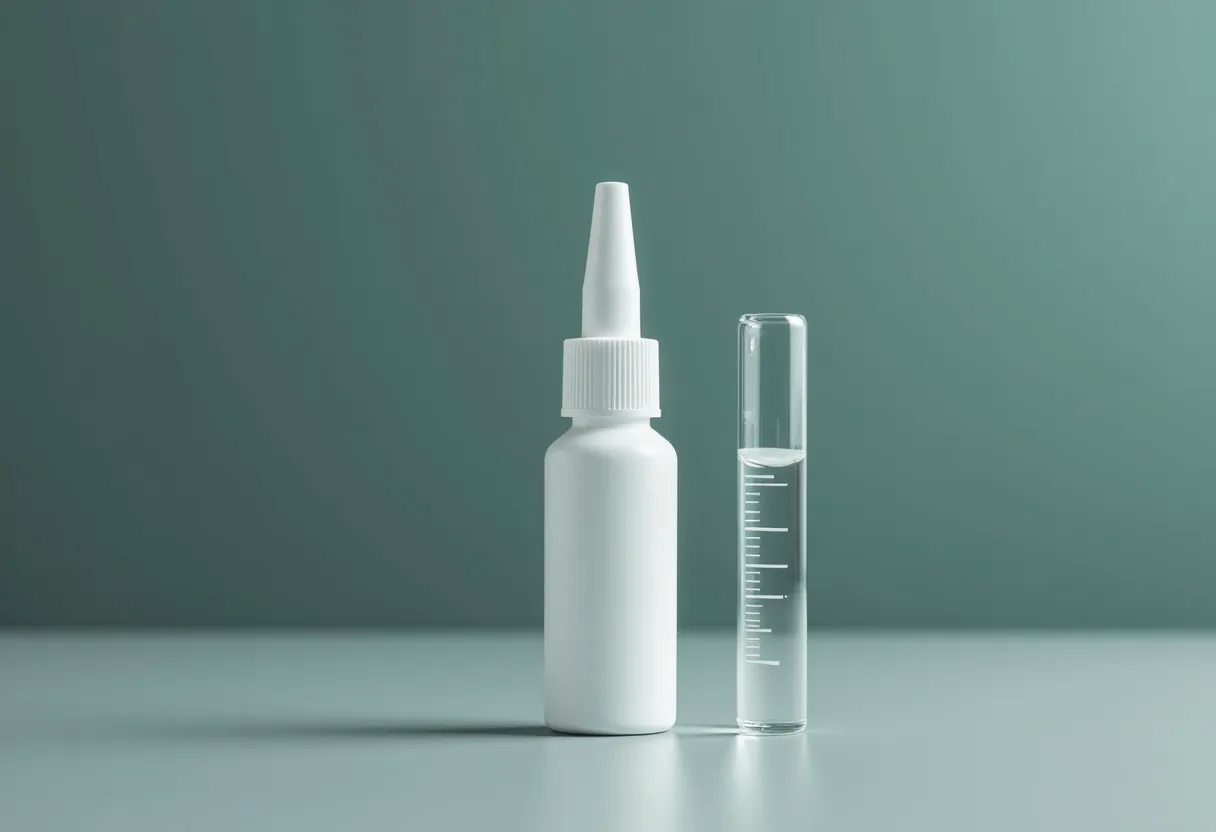
Most of a research peptide catalog is lyophilised powder. A growing minority is supplied as a ready-made solution, usually in a metered spray bottle. The format change alters almost every documentary question, and a certificate written for a powder does not transfer.
Concentration replaces mass
A powder vial is specified by mass: 10 mg in the vial, with net peptide content telling you how much of that is peptide. A solution is specified by concentration and volume, and the two figures have to appear together.
- Concentration, as mass per millilitre, is the primary specification.
- Total fill volume, which with concentration gives total peptide content.
- For a metered device, volume delivered per actuation, which is a property of the pump rather than of the solution.
A listing that states only a total mass for a spray product has omitted the figure that actually describes it.
Why shelf life is shorter
Lyophilisation exists because water is the medium in which most degradation happens. Hydrolysis, deamidation and aggregation all proceed far faster in solution than in a dry cake, which is why a lyophilised peptide stored cold has a supported period measured in years and a solution has one measured in months.
There is no reconstitution step in a liquid product, which removes one handling risk. What it removes it replaces with a continuous one: the clock has been running since the solution was made, not since the vial was opened.
That is the central trade and it should be reflected in how a liquid product is dated. A supported period should run from manufacture, and the storage condition during that period should be stated.
What the preservative is doing
A multi-use solution in a bottle that will be opened repeatedly needs protection against microbial growth, which is why preservative systems appear in these products. Benzyl alcohol is the common one, and it is the same agent that distinguishes bacteriostatic water from sterile water.
Two things follow. A preserved solution is a different formulation from an unpreserved one and should be documented as such. And the preservative is a component of the product, so it belongs on the specification rather than being unmentioned.
Container and compatibility
A solution is in prolonged contact with its container in a way a powder is not. Peptides, particularly highly cationic ones, can adsorb to container surfaces, which reduces solution concentration over time without any chemical degradation at all. The compound is not breaking down; it is sticking to the wall.
This is a real effect at low concentrations and it is why container material and any surface treatment are part of a liquid product's specification rather than packaging trivia.
What to ask for
- Concentration and total volume, both stated.
- The solvent system and any preservative, named.
- A supported period running from manufacture, with the storage condition for it.
- Whether the reported assay was run on the finished solution or on the powder before it was dissolved.
That last question is the one that separates a documented liquid product from a powder certificate with a new label. All material is supplied strictly for laboratory research.
What changes when the water is already there
Lyophilisation removes water because water is the medium almost every degradation route needs. A product supplied in solution has had that protection deliberately traded away, and everything about its handling follows from that one fact.
The reactions that a dry cake suppresses are available from the moment of manufacture. Cold storage slows them and darkness slows some of them, but the clock started before the product shipped rather than when it arrived, which is why these formats carry shorter usable lives than the equivalent powder.
What you gain in exchange
A concentration fixed at manufacture and stated on the certificate. That sounds administrative until you consider what it replaces: your own reconstitution, your own volume measurement, and the uncertainty both introduce. The number is known rather than derived.
For a short peptide used at a settled concentration, that trade is often worth making. For a compound that will sit for months, or where the concentration needed is not the one supplied, it is usually not.
Preservatives, and why they are there
A multi-use solution has to tolerate being opened repeatedly, which means something in the formulation has to limit microbial growth between uses. That component is part of the product rather than an impurity, and it belongs on the label.
It is also an experimental variable wherever the solution reaches cells, because a preservative is biologically active by design. Where a format is used in cell work, the preservative needs the same consideration as any other vehicle component.
What a certificate for a liquid format should carry
- Concentration, with the method that measured it, rather than the nominal formulation figure.
- Identity for the active compound, on the same terms as any other peptide.
- Purity, read with the understanding that solution-phase degradation has already had time to occur.
- The preservative system, where one is present.
- A date, and clarity about whether it is a retest date or an expiry.
Reading a certificate of analysis line by line covers the general fields. The liquid-specific point is that concentration replaces fill mass as the number that matters.
Metered delivery adds its own specification
A spray delivers a volume per actuation, and that volume has a tolerance like any other manufacturing parameter. Delivered dose uniformity, measured across actuations and across the life of the container, is the property that distinguishes a well-made metered product from a solution in a bottle with a pump on it.
Where that figure is not available, the honest position is that you know the concentration and not the delivered amount, which are different things.
Storage, and the first twenty-four hours
Refrigerate on arrival rather than later in the day. The material travelled at ambient temperature and has already spent part of its budget, and the interval between delivery and storage is the one most often undocumented.
Keep it closed and keep it dark. A solution has mobility that a cake does not, so light and oxygen both reach the molecule more easily, which is covered in light sensitivity and how peptides degrade.
Which format suits which work
Take the powder when material will sit for months, when the concentration you need is not the one supplied, or when the longest usable life matters. Take the solution when the stated concentration is the one you want, the material will be used soon, and removing a reconstitution step removes a source of error.
Neither is better. They are different trades, and the right one depends on how quickly the material will actually be consumed, which is a question your usage records answer rather than a supplier.
What to record for a liquid format
The lot, the stated concentration, the date of first opening, and the number of times the container has been accessed. The last two matter more here than for a sealed powder, because both clocks run faster once a solution is in use.
For where this sits among the other molecules a catalogue carries, not everything in a peptide catalog is a peptide covers how the classes differ.