
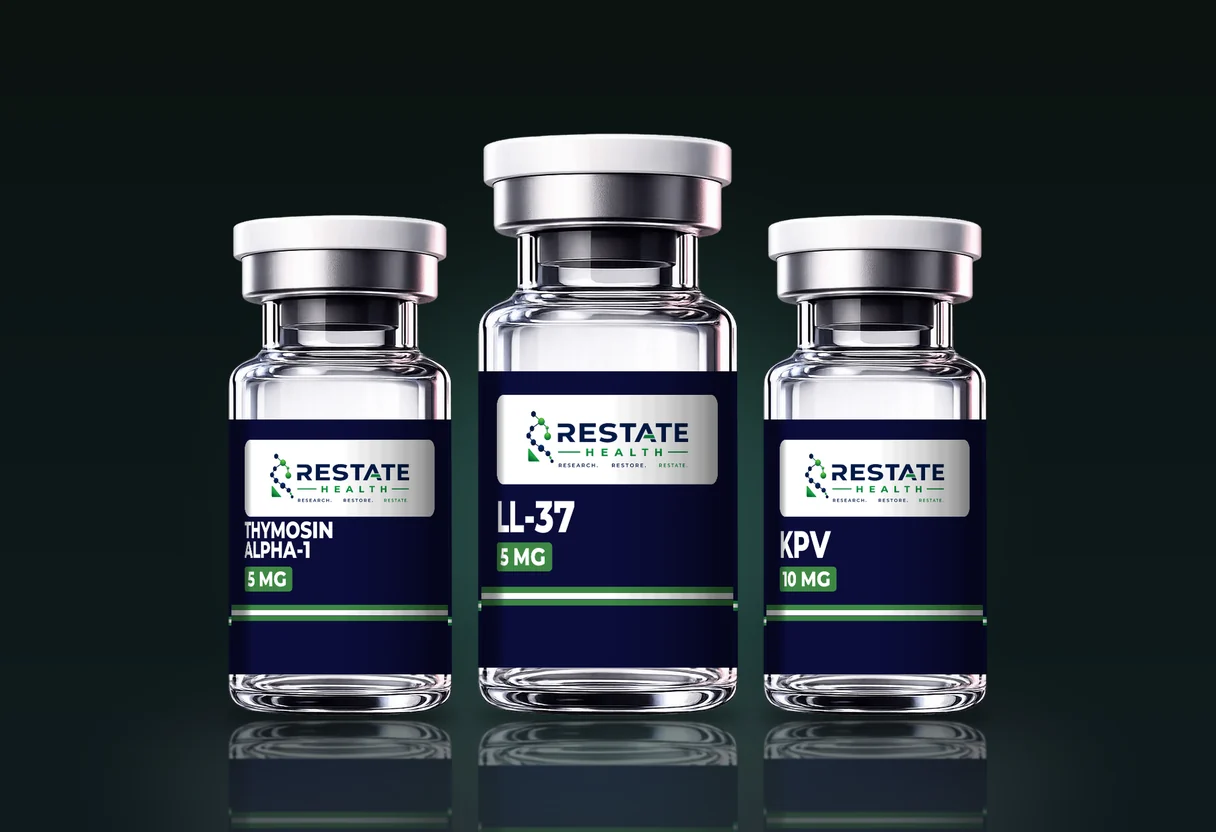
Thymosin Alpha-1, LL-37 and KPV sit together in this catalogue because the published work on each concerns signalling within the immune system. That is where the resemblance ends. One is a 28-residue acidic peptide first isolated from calf thymus, one is a 37-residue cationic fragment cut from a neutrophil protein, and one is a three-residue fragment of a pituitary hormone. They are made the same way and documented the same way, and almost nothing else about them is the same.
This is the class guide. It explains what "immune-signalling" does and does not cover, sets the three compounds side by side on origin, size, charge and handling, and says what each certificate must show. Each compound has its own guide with the detail, and this one points to them rather than repeating them.
| Compound | Vial strengths | Molecular weight | Amino acids |
|---|---|---|---|
| Thymosin Alpha-1 | 5 mg, 10 mg | 3108.30 g/mol | 28 |
| LL-37 | 5 mg, 10 mg | 4493.33 g/mol | 37 |
| KPV | 10 mg | 342.43 g/mol | 3 |
From the Restate Health catalog records. Lot-specific values are on each certificate of analysis.
What the class label covers
"Immune-signalling" is a catalogue heading, not a chemical class. It gathers peptides whose published literature concerns the regulation of immune cells or the innate response, whatever the molecule's origin or mechanism. The literature itself uses narrower terms. Zasloff's 2002 review in Nature describes antimicrobial peptides of multicellular organisms as a broad family of mostly cationic, amphipathic molecules that act at microbial membranes, and that description fits LL-37 and not the other two. Thymosin alpha-1 is described in the 1977 isolation paper as one of several polypeptides in thymosin fraction 5 that may participate in the regulation, differentiation and function of thymus-dependent lymphocytes. KPV is the C-terminal tripeptide of alpha-melanocyte-stimulating hormone, and its literature belongs to the melanocortin field.
So the class is defined by the question the papers ask rather than by anything the molecules share. For a buyer the useful consequence is that nothing learned about one transfers to the others: not the handling, not the certificate reading, and not the published findings, each of which is reported in its own models.
Three origins
- Thymic. Goldstein and colleagues (1977) determined the sequence of a 28-residue, heat-stable, highly acidic polypeptide isolated from calf thymus and named it thymosin alpha-1. The catalogue sequence carries an N-terminal acetyl group. Thymosin alpha-1 explained covers the path from thymosin fraction 5 to a defined sequence and what the acetyl group does to the mass.
- Cathelicidin fragment. Agerberth and colleagues (1995) cloned a human cathelin-like precursor from bone marrow and predicted a 39-residue cysteine-free peptide they named FALL-39; the mature 37-residue form, LL-37, was later shown by Sørensen and colleagues (2001) to be released from the precursor hCAP-18 by proteinase 3 after exocytosis from neutrophils. The catalogue synonym hCAP-18(134-170) records exactly that. LL-37 explained covers the sequence, the helix and the charge.
- Melanocortin fragment. Hiltz and Lipton (1989) tested the C-terminal tripeptide of alpha-MSH, lysine-proline-valine, in a mouse model of induced ear swelling and reported that it inhibited the swelling. The catalogue synonym α-MSH(11-13) names the positions. KPV explained covers why a 342 Da mass is weak evidence of identity on its own.
The three compared
| Thymosin Alpha-1 | LL-37 | KPV | |
|---|---|---|---|
| Origin | Thymic polypeptide (thymosin fraction 5) | C-terminal fragment of the cathelicidin hCAP-18 | C-terminal tripeptide of alpha-MSH |
| Residues | 28 | 37 | 3 |
| Termini | N-terminal acetyl; free C-terminus | Free | Free |
| Molecular formula | C129H215N33O55 | C205H340N60O53 | C16H30N4O4 |
| Molecular weight | 3108.30 g/mol | 4493.33 g/mol | 342.43 g/mol |
| Basic residues (K, R) | 4 lysines | 6 lysines, 5 arginines | 1 lysine |
| Acidic residues (D, E) | 9 | 5 | 0 |
| Approximate net charge, neutral pH | About -6 (acetylated N-terminus leaves no positive terminus) | About +6 | About +1 |
| CAS number | 62304-98-7 | 154947-66-7 | 67727-97-3 |
| Catalogue strengths | 5 mg, 10 mg | 5 mg, 10 mg | 10 mg |
| Catalogue synonyms | Thymalfasin; Tα1 | Cathelicidin antimicrobial peptide; hCAP-18(134-170) | α-MSH(11-13); Lys-Pro-Val |
Origin, size, formula, mass, CAS number and strengths from the catalogue records. Net charge at neutral pH is this guide's count of basic against acidic side chains and termini from the recorded sequence, and is approximate.
The charge row is the one that organises everything below it. Thymosin alpha-1 carries nine acidic side chains against four lysines, and its acetylated N-terminus contributes no positive charge, so it is strongly negative in neutral solution. LL-37 carries eleven basic residues against five acidic ones and is strongly positive. KPV has one lysine and nothing acidic. Two of the three are at opposite ends of the charge scale and the third is a very small molecule, and those three facts predict the handling and the certificate questions.
What the charge does to handling
A strongly cationic peptide binds to negatively charged surfaces, which in a laboratory means glass, some plastics and anything with a phosphate or carboxylate on it. At the low concentrations typical of research work, that adsorption is a measurable loss. LL-37 is the compound in this trio where the choice of container and the order of adding solvent to powder matter, and where salt in the diluent changes its behaviour, because the amphipathic helix Agerberth and colleagues predicted for residues 13 to 34 forms in a salt-containing medium and the peptide associates once it does. The LL-37 guide covers the solvent choice in detail.
A strongly anionic peptide has the opposite surface behaviour and a different counterion story. Peptides purified by reversed-phase chromatography are typically isolated as trifluoroacetate salts, and the counterion load scales with the number of basic sites, so thymosin alpha-1 with four lysines carries less TFA per molecule than LL-37 with eleven basic residues. What thymosin alpha-1 may carry instead is a cation on its acidic groups, which is why its salt form is worth asking about. The net peptide content guide covers how either kind of counterion enters the content figure.
KPV's handling problem is size. On a 342 Da tripeptide, residual water and a single TFA counterion are a large fraction of the mass of solid in the vial, so the gap between labelled mass and peptide content is proportionally the widest of the three. The storage conditions in the catalogue records for thymosin alpha-1 and KPV are the same: lyophilised at -20 °C, protected from light and moisture, with reconstituted solution refrigerated at 2-8 °C. The LL-37 record does not carry a storage line, and the certificate or the supplier's handling note is the place to find it.
What each certificate must show
| Compound | The line to read first | Why it matters here |
|---|---|---|
| Thymosin Alpha-1 | Identity mass reconciling with 3108.30 g/mol, with the mass basis stated | The acetyl group adds 42 Da; a mass that reconciles with the unacetylated 28-mer is a different molecule |
| LL-37 | Identity by a method that reads sequence, and the purity method's conditions | A 37-residue cationic peptide has many near-mass impurities; a single intact mass is weak evidence and column conditions change the purity figure |
| KPV | Net peptide content and salt form, alongside identity | At 342 Da a mass alone is consistent with other tripeptides of the same composition, and the counterion fraction is the largest of the three |
| All three | Lot number on the certificate, matching the vial | A certificate for the product line rather than the lot documents a different vial |
The certificate line that matters most for each compound, and why. The common requirements (lot number matching the vial, dates, purity method stated) apply to all three.
The thymosin alpha-1 row is worth underlining because the catalogue formula C129H215N33O55 already includes the acetyl group. A supplier quoting a mass about 42 Da lower has either omitted the modification from the calculation or is supplying a different peptide, and the certificate should settle which. The individual guides give the arithmetic for each.
What the literature describes, in which models
Stated briefly, because the compound guides carry the detail and the sources. For thymosin alpha-1, the 1977 isolation paper reports a sequence and in vitro activity in assays of thymus-dependent lymphocytes. For LL-37, the 1995 paper reports that the synthetic peptide was active against Escherichia coli and Bacillus megaterium in a defined culture medium, and the 2001 paper reports the processing step in material exocytosed from human neutrophils; Dürr and colleagues (2006) review the structural and in vitro literature on the peptide. For KPV, the 1989 paper reports inhibition of induced ear swelling in mice, and Kannengiesser and colleagues (2008) report work in two mouse models of intestinal inflammation. All of these are laboratory models. None of it is a statement about any product in this catalogue, which is supplied for research use only.
What to ask before ordering any of the three
- For thymosin alpha-1: whether the identity mass on the certificate was calculated with the N-terminal acetyl group included, and which salt form the lot is supplied as.
- For LL-37: which identity method was used, whether the purity chromatogram's column and gradient are stated, and whether the supplier has a handling note on diluent and container, since the catalogue record carries no storage line for this compound.
- For KPV: whether net peptide content is reported and by what method, and which counterion the lot carries.
- For all three: that the certificate names the lot you will receive rather than the product line, and that the two dates on it run forwards.
The answers are a documentation test as much as a chemistry one. A supplier who can answer the acetyl question for thymosin alpha-1 has calculated the mass themselves; one who can name the counterion on a KPV lot has read their own certificate. Those are the suppliers whose other answers can be trusted, and the comparison is worth making before price is discussed.
Why a class guide, then
Because the grouping is where buyers encounter the three, and the grouping invites exactly the wrong inference: that compounds studied for related questions can be bought, stored and documented in the same way. They cannot. The thymic peptide needs an acetyl-aware identity check and a question about its cation; the cathelicidin fragment needs a sequence-reading identity method and attention to containers and salt; the tripeptide needs a content figure and a salt form before its mass means anything.
Read the three compound guides for the detail. Read this one to remember that the label on the shelf is the only thing they share.