
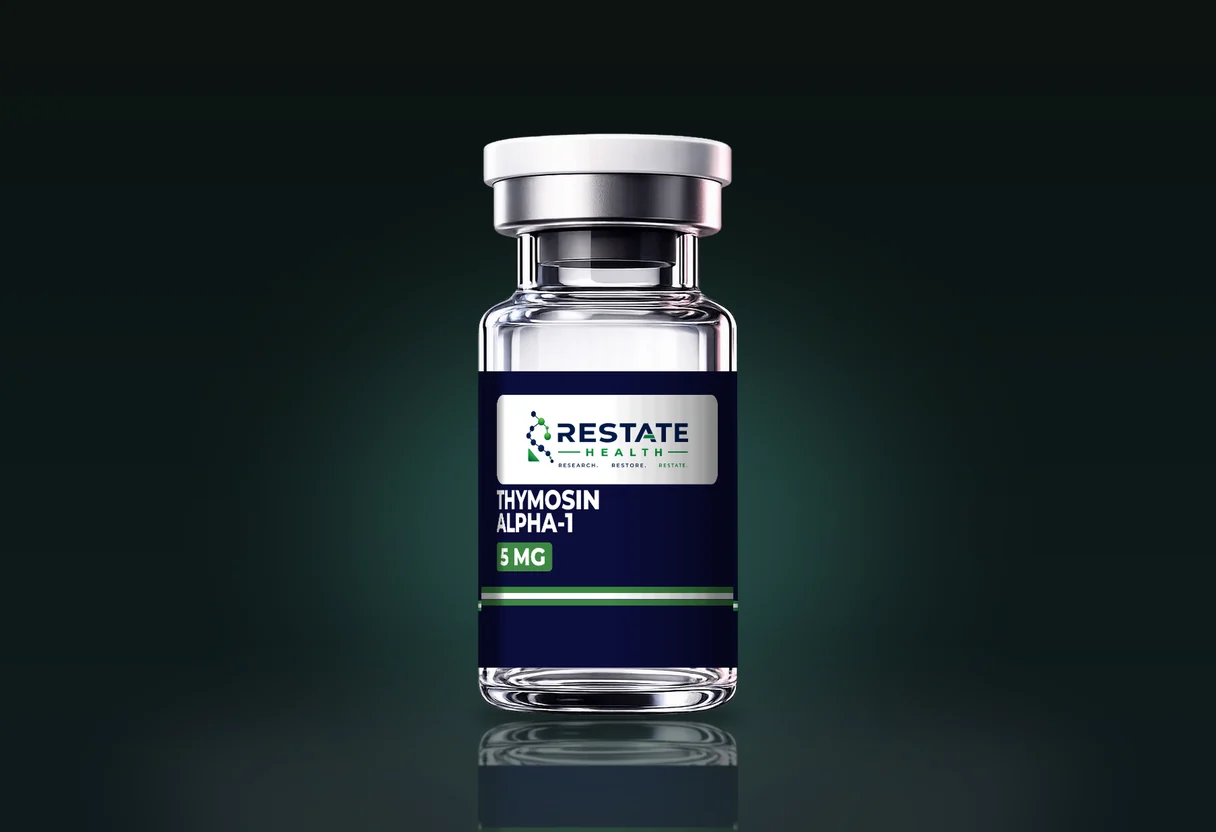
Thymosin Alpha-1 is one of the few peptides in a research catalogue whose history runs back to a named fraction of calf thymus. It is a 28-residue peptide with an acetyl group on its N-terminal serine, and the catalogue lists it in 5 mg and 10 mg vials under the synonyms thymalfasin and Tα1.
This guide covers where the sequence came from, what the acetyl group does to the mass a certificate reports, what the immune-signalling literature describes and in which models, and the three certificate lines that carry the most weight for a 28-mer. The material is supplied strictly for laboratory research.
| Thymosin Alpha-1 | Catalog specification |
|---|---|
| Vial strengths | 5 mg, 10 mg |
| Sequence | Ac-Ser-Asp-Ala-Ala-Val-Asp-Thr-Ser-Ser-Glu-Ile-Thr-Thr-Lys-Asp-Leu-Lys-Glu-Lys-Lys-Glu-Val-Val-Glu-Glu-Ala-Glu-Asn |
| Molecular formula | C129H215N33O55 |
| Molecular weight | 3108.30 g/mol |
| Amino acid count | 28 |
| CAS number | 62304-98-7 |
From the Restate Health catalog record. Lot-specific values are on the certificate of analysis.
From thymosin fraction 5 to a sequence
In the 1970s Goldstein and colleagues were working with a partially purified preparation of calf thymus they called thymosin fraction 5. In 1977 they reported the isolation of one component of it, named thymosin alpha1, together with its sequence analysis (Goldstein and colleagues, PNAS 1977). Two years later Low and Goldstein published the full amino acid sequence analysis of thymosin alpha1 alongside a second fraction-5 peptide, polypeptide beta1 (J Biol Chem 1979).
The peptide is 28 residues long. Written out in the catalogue record it runs Ac-Ser-Asp-Ala-Ala-Val-Asp-Thr-Ser-Ser-Glu-Ile-Thr-Thr-Lys-Asp-Leu-Lys-Glu-Lys-Lys-Glu-Val-Val-Glu-Glu-Ala-Glu-Asn. The Ac at the front is an acetyl group on the amino terminus. It is part of the natural molecule rather than a protecting group left over from synthesis, and the synthetic peptide in a vial carries it for that reason.
Fraction 5 was a mixture. Thymosin alpha1 is the component with a defined sequence, which is why it, rather than the fraction, is what a catalogue can supply and a certificate can describe.
Where it comes from in the cell
Thymosin alpha1 turned out not to be a gene product in its own right. In 1984 Haritos, Goodall and Horecker isolated a larger acidic protein from rat thymus, prothymosin alpha, and showed that it was the major form in which thymosin alpha1 immunoreactivity occurred: the 28-residue sequence is the N-terminal portion of the precursor (PNAS 1984).
How the fragment is produced was examined later. Sarandeses and colleagues reported in 2003 that prothymosin alpha is cleaved to thymosin alpha1 and a slightly longer form, thymosin alpha11, by a lysosomal asparaginyl endopeptidase (J Biol Chem 2003). The cleavage falls after the asparagine that ends the 28-residue sequence, which is why the catalogue sequence ends in Asn.
For a buyer this matters in one way. The synthetic peptide in a vial is the 28-residue acetylated fragment, identical in sequence to the natural fragment. It is not prothymosin alpha, and a certificate for it should show a mass near 3108 rather than the mass of the much larger precursor.
What the acetyl group does to the mass
Acetylation replaces one hydrogen on the N-terminal amine with an acetyl group. The net change to the molecule is the addition of C2H2O, which is 42.04 Da on the average-mass scale and 42.01 Da on the monoisotopic scale. The catalogue formula, C129H215N33O55, and the molecular weight, 3108.30 g/mol, already include it. PubChem holds the same formula for the compound at CID 16130571, with a monoisotopic mass of 3106.50.
Put the other way round: a peptide of the same 28 residues with a free amino terminus would have the formula C127H213N33O54 and an average mass of 3066.26 g/mol. That is the des-acetyl impurity, and it is the first thing to look for in a mass spectrum of this compound, because a synthesis that skipped or under-ran the final acetylation step produces exactly it.
| Form | Formula | Average mass (g/mol) | Monoisotopic mass (Da) | On a certificate |
|---|---|---|---|---|
| Thymosin alpha-1, N-acetyl, as supplied | C129H215N33O55 | 3108.30 | 3106.50 | The main peak, reconciling with the catalogue molecular weight |
| Des-acetyl 28-mer, an impurity | C127H213N33O54 | 3066.26 | 3064.49 | A peak 42 Da below the main peak, if present |
| Difference | C2H2O | 42.04 | 42.01 | The acetyl group itself |
The acetylated row is the catalogue record and PubChem CID 16130571. The des-acetyl rows are arithmetic, the same formula less C2H2O, and are not catalogue records.
The acetyl group has a second analytical consequence. Edman degradation, the classical chemical method for reading a sequence from the N-terminus, needs a free alpha-amino group to start, and an acetylated peptide blocks it. So a sequence-level identity check for this compound comes from tandem mass spectrometry, where the N-terminal fragment ions carry the extra 42 Da, rather than from Edman chemistry. Mass spectrometry and peptide identity covers what a fragment ladder establishes that an intact mass does not.
What the literature describes, and in which models
The published work on thymosin alpha1 is largely about immune signalling, and the catalogue about line summarises it as a thymus-derived peptide studied extensively for its immunomodulatory role in T-cell maturation and immune-response regulation. The sources below say where those observations were made.
- The 1977 isolation paper reports the peptide as immunologically active in the laboratory assays of the period, which is what the word in its title refers to.
- Romani and colleagues reported in 2004 that thymosin alpha 1 activates dendritic cells through toll-like receptor signalling, working with dendritic cells in culture and in mice; the title frames the result as antifungal Th1 resistance in those mice (Blood 2004).
- The same group's 2007 review describes the peptide as an endogenous regulator of inflammation, immunity and tolerance, drawing together cell and mouse work (Ann N Y Acad Sci 2007).
- Garaci's 2007 historical overview traces the compound from fraction 5 onward and is the shortest route into the older literature (Ann N Y Acad Sci 2007).
None of that is on a certificate, and none of it can be. A certificate speaks to what is in the vial. What the peptide does in a given assay is a matter for the literature and for the buyer's own work.
Reading a certificate for a 28-mer
Three lines carry most of the weight for this compound, and they are the same three that how to read a peptide COA walks through for any peptide.
- Identity by mass. The observed mass should reconcile with 3108.30 g/mol if the certificate reports an average mass, or with 3106.50 if it reports a monoisotopic value. The two differ by about 1.8 Da at this size, so the certificate should say which basis it uses before the number is compared.
- Purity by HPLC. The catalogue lists the compound at ≥99% by HPLC. A 28-residue peptide with nine acidic residues behaves well on reversed-phase columns, and the des-acetyl form, if present, is a separate peak close to the main one, because the acetyl group changes hydrophobicity only slightly. HPLC purity covers what the percentage is a share of.
- Endotoxin. Thymosin alpha1 is studied in immune-cell assays, and bacterial endotoxin is itself a strong stimulus in those assays. A lot without an endotoxin result is a lot whose immune-assay results cannot be attributed to the peptide alone. Endotoxin testing covers the test and its units.
Counterions on an acidic peptide
Trifluoroacetate and acetate counterions pair with basic sites on a peptide: the side chains of lysine, arginine and histidine, and a free N-terminal amine. Counting along the catalogue sequence, thymosin alpha1 has four lysines and no arginine or histidine, and its N-terminus is acetylated, so it has four basic sites rather than five. The nine acidic side chains, four aspartates and five glutamates, do not carry trifluoroacetate.
The consequence is that the counterion share of the solid is smaller for this peptide than for a strongly basic one of similar size. Four trifluoroacetates on a 3108.30 g/mol peptide add 456 Da, about 13% of the salt mass; four acetates add 240 Da, about 7%. Water retained in the lyophilised cake is a separate quantity again. The net peptide content line, where a certificate carries one, is what converts the labelled milligrams into milligrams of peptide.
Handling, from the catalogue record
The record lists the compound as a lyophilised powder, stored at -20°C and protected from light and moisture, with reconstitution in bacteriostatic water and the reconstituted solution refrigerated at 2-8°C. The solubility line is the general one: soluble in bacteriostatic water, with the product COA to be consulted for specific solvent recommendations.
An acidic peptide of this kind dissolves readily at neutral pH, because the glutamate and aspartate side chains are charged there. Asparagine and aspartate residues are the sites where deamidation and isomerisation occur over time in solution, and the sequence has one asparagine and four aspartates, so holding time in solution is the variable to control once a vial is opened.
Not the same thymosin as TB-500
The name thymosin was attached to several peptides of fraction 5, and the catalogue carries two of them. Thymosin alpha1 is this 28-mer. Thymosin beta-4 is a different and unrelated sequence, and the product sold as TB-500 is, in the catalogue record, a 7-residue fragment of it at 889.02 g/mol. Shared naming is history, not chemistry; the two share no sequence and no mass, and a certificate for one says nothing about the other. TB-500 and thymosin beta-4 covers the beta side.
What a buyer can settle, and what remains open
- Which molecule is in the vial: the acetylated 28-mer, by a mass reconciling with the catalogue figure and, better, by a fragment pattern that includes the acetyl group.
- How pure it is, and whether the des-acetyl form appears as a separate peak.
- How much of it there is, by a net content figure rather than the label.
- Whether the lot is low in endotoxin, which matters more for this compound than for most because of where it is studied.
What a buyer cannot settle from documentation is anything about effect, and a supplier who offers to is offering something no certificate contains. The catalogue supplies the peptide, its lot and its documentation. The rest of the question belongs to the literature cited below.