
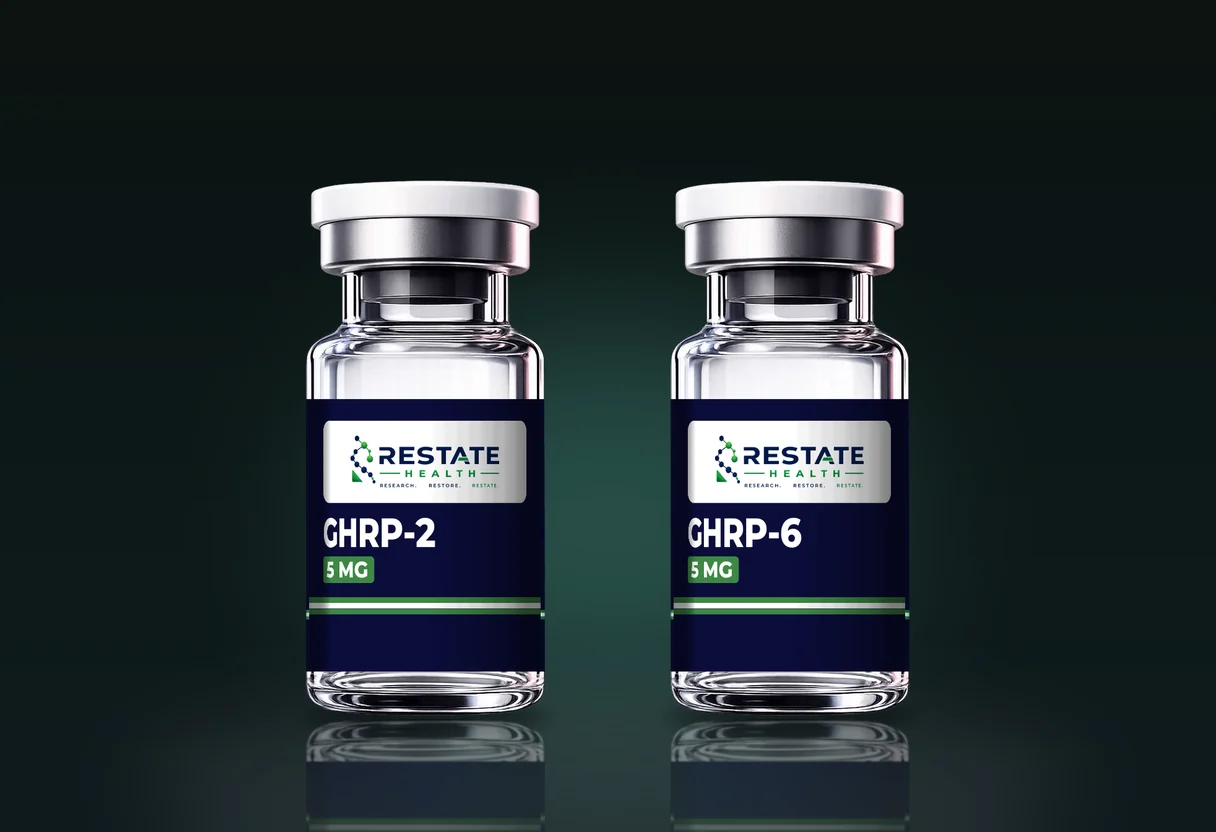
GHRP-2 and GHRP-6 are the two oldest members of a small family of synthetic growth-hormone-releasing peptides. Each is six residues long, each ends in a lysine amide, and each contains amino acids of the D-configuration, the mirror image of the form found in natural proteins. The catalogue records give the sequences as D-Ala-D-2-Nal-Ala-Trp-D-Phe-Lys-NH2 for GHRP-2 and His-D-Trp-Ala-Trp-D-Phe-Lys-NH2 for GHRP-6.
The D-residues are the analytical point of this guide. A D-amino acid has exactly the same formula and mass as its L-form, so an intact mass cannot see it, and neither can the fragment ladder from a tandem mass spectrometry run. Confirming that the D-positions in a vial are in fact D requires a chiral method, and most certificates do not include one. What that means for a buyer, and what the two sequences do and do not share, follows.
| Compound | Vial strengths | Molecular weight | Amino acids |
|---|---|---|---|
| GHRP-2 | 5 mg, 10 mg | 817.92 g/mol | 6 |
| GHRP-6 | 5 mg, 10 mg | 873.01 g/mol | 6 |
From the Restate Health catalog records. Lot-specific values are on each certificate of analysis.
Where the hexapeptides came from
The family did not begin with a hormone. In 1981 Momany and colleagues reported in Endocrinology a series of short peptides, designed from an enkephalin starting point, that released growth hormone from pituitary cells in vitro. In 1984 Bowers and colleagues, in the same journal, described a new synthetic hexapeptide with activity both in vitro and in vivo; that peptide, His-D-Trp-Ala-Trp-D-Phe-Lys-NH2, is GHRP-6. The companion paper by Momany and colleagues in the same issue reports the conformational energy work behind the design.
A 1989 paper by Cheng and colleagues, also in Endocrinology, studied the same hexapeptide alongside growth-hormone-releasing factor in rat primary pituitary cell culture and reported that the two acted through different second-messenger routes. That observation is the origin of the practice of studying a GHRP together with a GHRH analogue, which the catalogue record for GHRP-2 alludes to and which buying growth hormone axis blends covers from the purchasing side.
The receptor was found twelve years later
The hexapeptides worked before anyone knew what they bound. In 1996 Howard and colleagues reported in Science the cloning of a receptor in pituitary and hypothalamus that functioned in growth hormone release and bound the synthetic secretagogues; it became the growth hormone secretagogue receptor. The natural ligand was found three years after that, when Kojima and colleagues reported ghrelin in Nature in 1999, an acylated peptide from the stomach. GHRP-2 and GHRP-6 are therefore synthetic compounds whose receptor and whose natural ligand were both discovered after them, which is the reverse of the usual order.
Growth hormone secretagogues explained sets out how the GHRPs relate to the GHRH analogues and to ipamorelin, the later hexapeptide in the same family.
The two sequences, position by position
| Position | GHRP-2 | GHRP-6 | Same? |
|---|---|---|---|
| 1 | D-Ala | His | No |
| 2 | D-2-Nal | D-Trp | No (both D, different side chains) |
| 3 | Ala | Ala | Yes |
| 4 | Trp | Trp | Yes |
| 5 | D-Phe | D-Phe | Yes |
| 6 | Lys-NH2 | Lys-NH2 | Yes |
| D-residues | Three (1, 2, 5) | Two (2, 5) | |
| Molecular formula | C45H55N9O6 | C46H56N12O6 | |
| Molecular weight | 817.92 g/mol | 873.01 g/mol | |
| CAS number | 158861-67-7 | 87616-84-0 | |
| Synonyms as recorded | Pralmorelin; KP-102 | Growth-hormone releasing peptide-6 |
Sequences from the two catalogue records. 2-Nal is 3-(2-naphthyl)alanine, a non-coded residue. D marks a D-configured residue.
The last four positions are identical. The difference is confined to positions 1 and 2, and it accounts for the formula gap. Replacing D-Ala with His adds C3H2N2; replacing D-2-Nal with D-Trp changes C13H11NO to C11H10N2O. The net change is one carbon, one hydrogen and three nitrogens, which is exactly the difference between C45H55N9O6 and C46H56N12O6, and the masses in the records differ by 55.09 g/mol accordingly. PubChem's records for pralmorelin (CID 6918245) and GHRP-6 (CID 4345065) carry the same two formulas.
Why the D-amino acids are there
Proteases recognise L-residues. Placing a D-residue at a position the enzyme would cleave makes that bond a poor substrate, and the 1981 and 1984 design papers used D-residues at the aromatic positions for that reason, alongside their effect on the conformation the peptide adopts. The pattern of a D-aromatic residue at position 2 and D-Phe at position 5 is shared across the family. GHRP-2 goes further and makes position 1 a D-alanine as well, and replaces the D-tryptophan with the larger non-coded D-2-naphthylalanine.
For nomenclature the point is that the D prefix is part of the sequence, not a decoration. His-Trp-Ala-Trp-Phe-Lys-NH2 with all residues in the L-form is a different compound from GHRP-6 with the same formula and the same mass. How the prefix is written and read is a nomenclature question, and the certificate should carry the sequence with the prefixes in place.
What a certificate can and cannot see
The three methods on a typical certificate each answer a different question, and none of them answers the chirality one.
| Method | Can show | Cannot show |
|---|---|---|
| Intact mass (ESI or MALDI) | The formula is consistent with C45H55N9O6 or C46H56N12O6 | Which residues are D; a fully L-form isomer has the identical mass |
| Tandem MS (fragment ladder) | The residue order and side-chain identities, including 2-Nal | Which residues are D; fragments of enantiomers weigh the same |
| Reversed-phase HPLC purity | The share of detector response in the main peak | Chirality directly; a diastereomer may or may not resolve from the product |
| Marfey's derivatisation after hydrolysis | The D or L configuration of each amino acid present | Position (the hydrolysate has lost the sequence) |
| Chiral-phase chromatography of the intact peptide | Separation of the product from its diastereomers | Nothing further without a reference standard |
What each method can establish for a hexapeptide containing D-residues. Mass equivalence of enantiomers is plain chemistry; the chiral methods are those described in the reviews by Bhushan and Brückner (2004) and Bai and colleagues (2009).
The mechanism of the blind spot is simple. A D-residue and its L-form are enantiomers: the same atoms, the same bonds, opposite handedness. A mass spectrometer weighs molecules and fragments, and weight is indifferent to handedness. Mass spectrometry and peptide identity covers the strengths of the method; this is its principal limit for peptides designed around D-residues.
Chromatography is partial. Two diastereomers, say GHRP-6 and the version with an L-Trp at position 2, are not mirror images of each other and often separate on an ordinary reversed-phase column, so a clean HPLC purity figure is some evidence against a wrong-handed residue. Often is not always, and a certificate that reports a single peak has not proven that a diastereomer would have shown up as a second one. The methods that settle it are the chiral ones in the table: hydrolyse and derivatise with Marfey's reagent to read the D/L ratio of each amino acid, or run the intact peptide on a chiral stationary phase.
Where a wrong-handed residue would come from
Not usually from the wrong building block. A synthesis that uses Fmoc-D-Phe produces D-Phe at position 5. The realistic route is racemisation during coupling: the activated amino acid can lose its stereochemistry before it is joined, and some residues are more prone than others. Solid-phase peptide synthesis explained covers racemised residues as a class of impurity. For a hexapeptide with two or three D-positions and three or four L-positions, racemisation at any of them produces a diastereomer of identical mass.
The 2-naphthylalanine in GHRP-2 is a different case and a reassuring one. It is a non-coded residue with its own mass, so an intact mass or a fragment ladder does confirm it is present where the sequence says. What the mass does not confirm is that it is the D-form.
What else the two sequences tell a buyer
Two further points can be read straight off the sequences in the records, and neither needs a source beyond the formula. The first is the counterion. Both peptides end in a lysine amide and both have a free N-terminal amine, so both have at least two basic sites. GHRP-6 adds a histidine at position 1, giving three. Purified with trifluoroacetic acid, as most research peptides are, GHRP-2 would carry up to two trifluoroacetates (228 g/mol against a peptide of 817.92) and GHRP-6 up to three (342 g/mol against 873.01). As upper-bound arithmetic those are 22 percent and 28 percent of the salt by mass, which is a large share for a label that reads 10 mg. The certificate's net content line, where one is given, reports the real figure for the lot.
The second is oxidation. Each sequence carries a tryptophan at position 4, and GHRP-6 carries a second, the D-tryptophan at position 2. The indole ring of tryptophan is one of the side chains most susceptible to oxidation, and its oxidation products are heavier by 4, 16 or 32 daltons depending on the route. Neither sequence contains a methionine or a cysteine, so the tryptophans are the only oxidation-prone residues present, and a +16 satellite on a mass spectrum, if one appears, is coming from them. Light accelerates the process, which is why the usual instruction for tryptophan-containing peptides is amber glass or a dark box and storage as the dry solid.
Buying notes
- Both are supplied at 5 mg and 10 mg, both from $56. The identical pricing reflects identical length and comparable synthesis; the 2-Nal building block in GHRP-2 is the only unusual input.
- Ask whether the identity method is an intact mass or a fragment method, and whether any chiral analysis is available for the lot. Most suppliers will answer no to the last question. The useful outcome is knowing that, rather than assuming the certificate covers it.
- A certificate that reports a mass consistent with the formula and a single main peak has established what it can. Record it as that, not as confirmation of the D-residues.
- The two share a C-terminal Lys-NH2 and a free N-terminal amine (His in GHRP-6, D-Ala in GHRP-2), so both are basic peptides and both will carry trifluoroacetate if purified with TFA. The arithmetic above gives the scale of what that means for the mass of powder in the vial.
In short
GHRP-6 is His-D-Trp-Ala-Trp-D-Phe-Lys-NH2 at 873.01 g/mol; GHRP-2 is D-Ala-D-2-Nal-Ala-Trp-D-Phe-Lys-NH2 at 817.92 g/mol. They differ at positions 1 and 2 and share the last four. Both were designed in the early 1980s and their receptor was cloned in 1996. The D-residues that make them what they are have the same mass as their L-forms, so the certificate's mass and fragment data confirm the sequence but not its handedness, and only a chiral method does.