
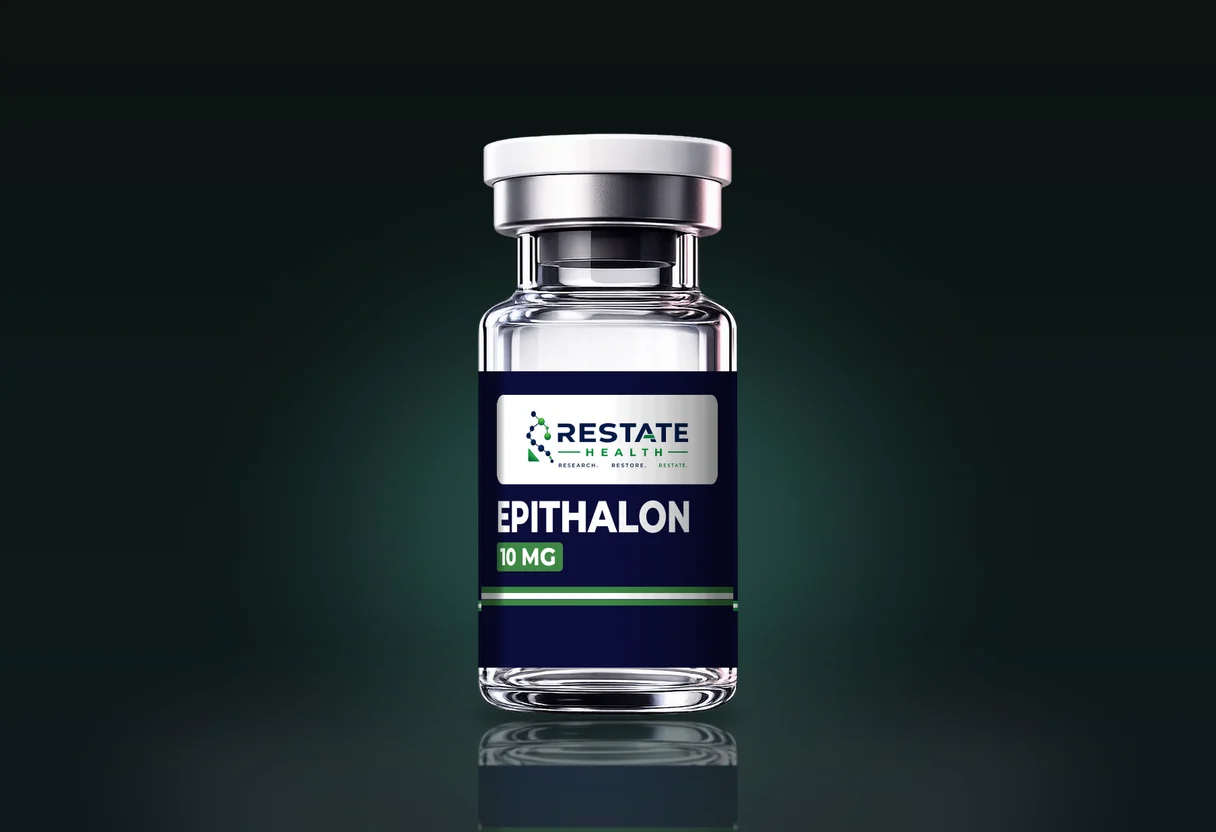
Epithalon is a synthetic tetrapeptide, Ala-Glu-Asp-Gly, with a molecular weight of 390.35 g/mol in the catalogue record. It is supplied at 10 mg and 50 mg and listed from $47.60. It belongs to the group of short synthetic peptides developed at the St Petersburg Institute of Bioregulation and Gerontology, and bioregulator peptides explained covers that class; this guide does not repeat it.
What this guide covers is the buying side. A molecule this small behaves differently on a certificate of analysis from a 3,000 g/mol peptide, in three ways that matter: an intact mass is much weaker evidence of identity, the counterion makes up an unusually large share of the powder, and the chromatography that produces the purity figure is harder to run well. Each follows from the size, and each has a question a buyer can ask.
| Epithalon | Catalog specification |
|---|---|
| Vial strengths | 10 mg, 50 mg |
| Sequence | H-Ala-Glu-Asp-Gly-OH |
| Molecular formula | C14H22N4O9 |
| Molecular weight | 390.35 g/mol |
| Amino acid count | 4 |
| CAS number | 307297-39-8 |
From the Restate Health catalog record. Lot-specific values are on the certificate of analysis.
One molecule, three names
The catalogue record lists the synonyms Epitalon and AEDG. All three names refer to the same tetrapeptide. Khavinson's group, which developed it, has published under both spellings; the 2003 paper on telomerase activity uses Epithalon and the 2025 review by Araj and colleagues uses Epitalon. AEDG is the one-letter sequence, and PubChem's record (CID 219042) carries the name Epitalon with the formula C14H22N4O9 and a molecular weight of 390.35, matching the catalogue record exactly. The spelling on a certificate is not a reason for concern; the formula and mass are what to match.
The sequence and what it implies
The record gives the sequence as H-Ala-Glu-Asp-Gly-OH, with CAS 307297-39-8. The H and OH mark a free N-terminal amine and a free C-terminal carboxylic acid, so neither end is capped. Glutamate and aspartate each carry a side-chain carboxylic acid as well. That gives the molecule three acidic groups and one basic one, which makes it strongly acidic and very water-soluble, and it makes it behave on a reversed-phase column like a small polar organic acid rather than like a typical peptide.
One further feature is worth knowing for storage. The Asp-Gly pair at positions 3 and 4 is the sequence most prone to the succinimide rearrangement that converts aspartate to isoaspartate, because glycine's lack of a side chain leaves the aspartate's own carboxyl free to attack the backbone. The product has the same formula and mass as the original, so it does not show up as a mass shift, only as a second chromatographic peak. Peptide degradation pathways covers the mechanism.
What the published work describes
The literature is largely from one group and its collaborators. The 2003 paper by Khavinson and colleagues in the Bulletin of Experimental Biology and Medicine reports telomerase activity and telomere length in cultured human somatic cells exposed to the peptide. Anisimov and colleagues (2003) studied it in female SHR mice, measuring markers of ageing, life span and tumour incidence; Rosenfeld and colleagues (2002) studied chromosome aberrations in senescence-accelerated mice. Khavinson's 2021 systematic review in Molecules collects the group's work on short peptides and gene expression, and the 2025 review by Araj and colleagues in the International Journal of Molecular Sciences is the most recent independent overview.
All of this is cited below as what was studied and in what model. None of it is a property of the vial, and a certificate speaks only to what is in the vial.
What a certificate can show for a 390 g/mol peptide
The usual panel applies: lot, dates, identity, content, purity. The general reading order is the same as for any research peptide. The size of this molecule changes the weight each line carries.
| Certificate line | What it establishes for Epithalon | What it does not |
|---|---|---|
| Intact mass | A formula consistent with C14H22N4O9 (390.35 average, 390.14 monoisotopic) | Which of the 24 orderings of A, E, D and G it is; all share the formula. Nor that it is a peptide at all, since many small organic molecules sit near 390 |
| Tandem MS (fragment ladder) | The order Ala-Glu-Asp-Gly, from the b and y fragments | The Asp versus isoAsp question, which is mass-silent |
| Amino acid analysis | That the hydrolysate contains Ala, Glu, Asp and Gly in a 1:1:1:1 ratio, and the net peptide content | The order of the residues |
| Reversed-phase HPLC purity | The share of detector response in the main peak, at the stated method | Much, if the peak elutes near the solvent front where polar impurities also sit |
| Water content (Karl Fischer) | The fraction of the powder that is water | Anything about the peptide itself |
The identity and purity lines read for a tetrapeptide specifically. Masses from the catalogue record and PubChem CID 219042; the isomer point is plain chemistry.
The first row is the important one. For a 4,000 g/mol peptide an intact mass is strong evidence of identity because very few other molecules share it. At 390 g/mol the opposite holds. The four residues can be arranged in 24 orders with the same formula, and a great many non-peptide compounds have a nominal mass near 390. A certificate that reports only an intact mass has shown that the formula is plausible, not that the vial contains Ala-Glu-Asp-Gly. The sequence-level method, a fragment ladder or sequencing, is what carries the identity claim here, and mass spectrometry and peptide identity covers the difference between the two.
The purity row needs care too. A small, highly acidic peptide elutes early on a reversed-phase column, often close to the solvent front, and the solvent front is where salts and polar impurities also appear. A purity figure of 99 percent or more, which the catalogue record states for this product, is meaningful only alongside the method: the column, the gradient and the wavelength. HPLC purity explained covers why the method statement is part of the number.
Salt form: a large share of a small powder
Peptides purified with trifluoroacetic acid are usually isolated as TFA salts, with one trifluoroacetate for each basic site. Epithalon has one basic site, the N-terminal amine, so the salt carries one trifluoroacetate (114.02 g/mol) per molecule of peptide (390.35 g/mol). That is 22.6 percent of the salt's mass. An acetate salt (59.04 g/mol as acetate) would be 13.1 percent. For a 3,000 g/mol peptide with the same single counterion the TFA share would be under four percent. The arithmetic below is for illustration; the actual counterion content of a lot is what a certificate's net content line or a counterion assay reports.
| Peptide mass | As TFA salt, counterion share | As acetate salt, counterion share |
|---|---|---|
| 390.35 g/mol (Epithalon) | 22.6% | 13.1% |
| 1,000 g/mol | 10.2% | 5.6% |
| 3,000 g/mol | 3.7% | 1.9% |
| 5,000 g/mol | 2.2% | 1.2% |
Counterion share of the solid for one counterion per molecule, calculated from the formula masses (plain arithmetic, not a measurement of any lot). Water and other salts would reduce the peptide share further.
The consequence for a buyer is that a 10 mg vial of Epithalon as a TFA salt contains, before water is counted, around 7.7 mg of peptide, where the same label on a 3,000 g/mol peptide would hold about 9.6 mg. The difference is not a quality defect; it is the chemistry of a small molecule carrying a counterion of fixed size. TFA and acetate salt forms covers why the two forms exist and when the choice matters, and net peptide content explained covers how the certificate reports what is actually peptide. For this compound more than most, the net content line is the number to use.
Choosing between 10 mg and 50 mg
At 390.35 g/mol, 10 mg of peptide is about 25.6 micromoles and 50 mg about 128 micromoles, before the salt and water corrections above. Those are large molar quantities by the standards of the catalogue: 10 mg of a 3,000 g/mol peptide is about 3.3 micromoles. Work planned in molar terms will find the 10 mg vial goes a long way.
- A first order from any supplier should be 10 mg. It is a test of whether the certificate arrives, names the lot, reports a sequence-level identity method and states the method behind the purity figure. None of that needs 50 mg.
- Repeat orders at steady consumption favour 50 mg if the material will be used within its usable window. The per-milligram saving is real only if nothing is discarded.
- The two strengths are the same lot chemistry in different fills. Each vial still needs its own lot-matched certificate, and a 50 mg vial concentrates more value behind one document.
The quantity to hold is best derived from a quarter of measured consumption rather than from the price list, and for a compound this small the molar arithmetic above usually shows that the smaller vial covers more work than the label suggests.
What to record once it arrives
- The lot number read in full from the vial, with the strength beside it, since 10 mg and 50 mg vials of the same lot are otherwise indistinguishable in a record.
- The salt form and the net peptide content figure. For a tetrapeptide the gap between label mass and peptide mass is large enough that any later calculation made from the label is wrong by about a fifth.
- The identity method named on the certificate, in a word: intact mass, fragment ladder or sequencing. A later reader needs to know which claim the document actually makes.
- The certificate itself, saved with your own records rather than linked to the supplier's archive, which can change.
Questions to ask before ordering
- Is identity on the certificate established by a fragment method or sequencing, or only by an intact mass? For a 390 g/mol compound the distinction is the whole identity claim.
- Which salt form is supplied, and is net peptide content stated? The counterion is a fifth of a TFA-salt powder here.
- What method produced the purity figure? Column, gradient, wavelength. Early-eluting peptides need the method to be stated for the number to mean anything.
- Does the certificate name the lot I will receive? The lot number is the field every other record hangs off, and a certificate for the product line rather than the lot documents a vial someone else received.
In short
Epithalon, Epitalon and AEDG are one tetrapeptide, Ala-Glu-Asp-Gly, 390.35 g/mol, CAS 307297-39-8. Its size means an intact mass is weak evidence of identity and a sequence-level method is the real check; it means a TFA counterion is more than a fifth of the powder; and it means the purity method must be stated. Order 10 mg first, read the net content line rather than the label, and treat the published work as what was studied, in cells and in mice.