
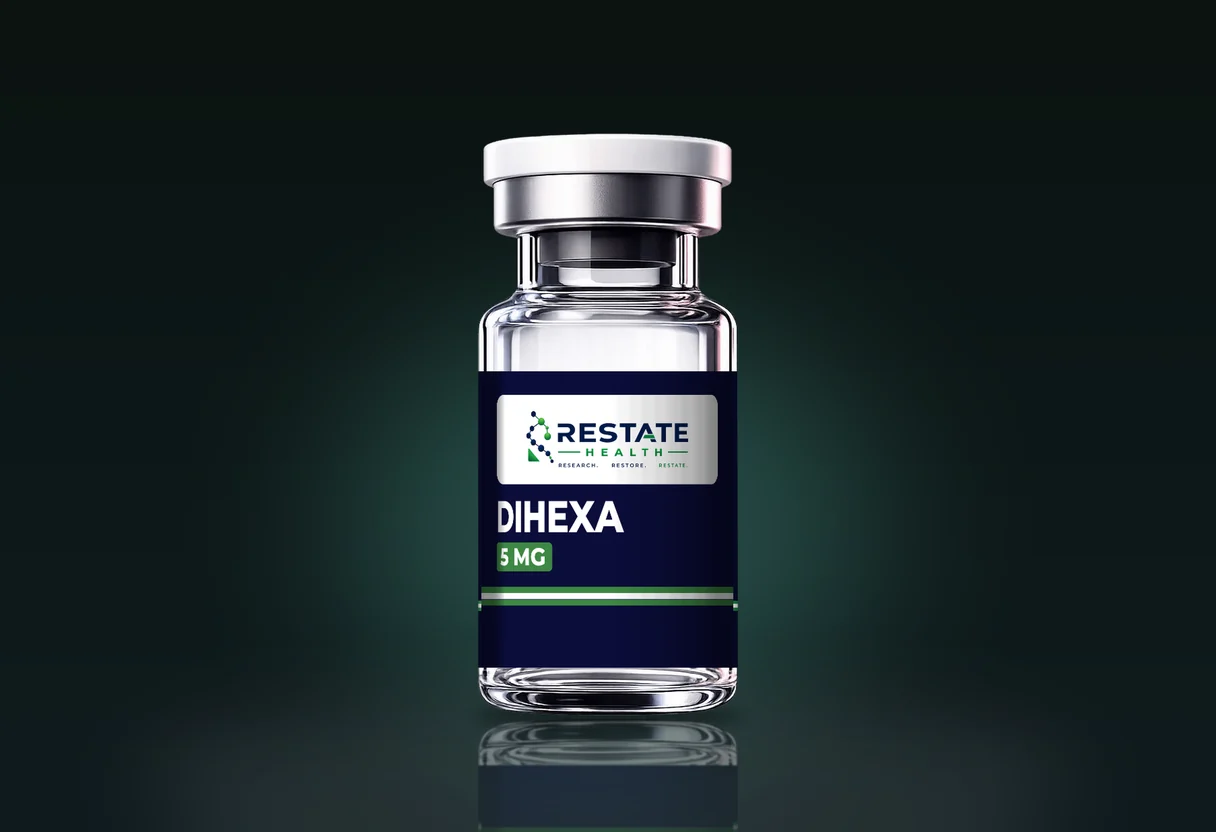
Dihexa is the smallest compound in this part of the catalogue and only just a peptide. Its core is two amino acids, tyrosine and isoleucine. The N-terminus carries a hexanoyl group, a six-carbon fatty acid, in place of a free amine, and the C-terminus is extended by 6-aminohexanoic acid finished as an amide. The full name, N-hexanoic-Tyr-Ile-(6)-aminohexanoic amide, says all of that. Dihexa is listed in the catalogue at 5 mg, at $140.
That structure makes Dihexa behave unlike almost everything else on a peptide price list. It has no charged group at ordinary pH, it is lipophilic, and it is small enough that the usual peptide certificate needs adjusting. This guide covers where the molecule comes from, what each piece of the structure does, the consequences for solubility, for analysis and for net content, and why the question of whether it is a peptide at all is a fair one.
The published work on Dihexa is rodent and cell work, and it is described as such here. The material is supplied for laboratory research only.
Where Dihexa comes from
Dihexa is the end point of a programme at Washington State University that started with angiotensin IV, the hexapeptide Val-Tyr-Ile-His-Pro-Phe. Benoist and colleagues reported in 2011, in the Journal of Pharmacology and Experimental Therapeutics, that C-terminally truncated analogues of norleucine-1 angiotensin IV were active in cultured hippocampal neurons and in rats. Kawas and colleagues in 2012 described the analogues as modifiers of the hepatocyte growth factor and Met receptor system. The 2013 paper by McCoy and colleagues in the same journal then reports a series of metabolically stabilised analogues designed to survive in circulation, and Dihexa is the compound that series produced.
The 2013 paper reports its work in rats, including animals with scopolamine-induced deficits and aged animals, in a water maze task, alongside stability measurements in plasma and in vitro work. Benoist and colleagues in 2014 reported that the effects of the angiotensin IV-derived peptides in their cell and rodent models depended on activation of the hepatocyte growth factor and c-Met system. That is the extent of the model work described in this guide; none of it is in people.
The structure, piece by piece
| Component | Position | Nature | Consequence |
|---|---|---|---|
| Hexanoyl group | N-terminal cap | Six-carbon acyl chain | No free amine, so no positive charge and no aminopeptidase site; adds lipophilicity |
| Tyrosine | Residue 1 | Aromatic, phenol side chain | Only ionisable group (phenol, weakly acidic); UV chromophore near 275 nm |
| Isoleucine | Residue 2 | Branched aliphatic | Hydrophobic; branched at the beta carbon |
| 6-aminohexanoic amide | C-terminal extension | Flexible five-carbon linker ending in a primary amide | No free acid, so no negative charge; blocks carboxypeptidases |
The four components of N-hexanoic-Tyr-Ile-(6)-aminohexanoic amide and what each contributes, following the structure described by McCoy and colleagues (2013) and recorded in PubChem CID 129010512.
Put together, the molecule has no basic amine and no free carboxylic acid. The only group that can ionise is the tyrosine phenol, and it does so only well above neutral pH. At the pH of water or buffer, Dihexa is a neutral, lipophilic molecule with a single hydroxyl and several amide bonds. Nothing about it wants to be in water.
Peptide or small molecule?
Two amino acid residues is the minimum that makes a peptide bond, and Dihexa has one true peptide bond, between tyrosine and isoleucine. The other amide bonds join the caps. By formula and mass, PubChem records the compound as C27H44N4O5 at 504.7 g/mol, which is in small-molecule territory: the mass boundary in Lipinski and colleagues' 2001 analysis of orally absorbed compounds is 500 Da, and Dihexa sits essentially on it.
The practical reason to care is that the handling habits a laboratory has built for peptides, aqueous reconstitution, concern about counterions, concern about proteolysis, mostly do not transfer. Not everything in a peptide catalogue is a peptide covers the broader question of which catalogue entries are peptides, which are small molecules and which are something else. Dihexa belongs on the border, and it is better handled as a lipophilic small molecule that happens to contain a dipeptide.
What the structure does to solubility
Peptide solubility is largely a matter of charge. A chain with several arginines or glutamates dissolves readily in water because those groups ionise. Dihexa has nothing of the kind: a fatty acyl cap, two hydrophobic side chains, a hydrocarbon linker and a single phenol. Its aqueous solubility is correspondingly low, and the usual approach for molecules of this type is an organic co-solvent first, with water or buffer added afterwards. Peptide solubility explained sets out the general method of choosing a solvent from the sequence; for Dihexa, the sequence says the water-first route is the wrong one.
Two consequences follow. The certificate's solvent recommendation is worth reading before the vial is opened, since a failed aqueous reconstitution can leave material on the glass that is hard to recover. And any stock made in an organic solvent needs to be compatible with whatever it is being added to, which is a matter for the method rather than for the compound.
What the certificate should show, and the two reference figures for mass
A small molecule gives a clean intact mass, and that is the single most useful line on a Dihexa certificate. The reference figures, however, disagree. The catalogue record carries the formula C25H33N3O4 and a molecular weight of 439.55 g/mol, with CAS number 1401708-83-5. PubChem's entry under that CAS number, CID 129010512, records C27H44N4O5 at 504.7 g/mol, and the four building blocks of the named structure sum to the PubChem formula.
| Step | Formula | Running total |
|---|---|---|
| Hexanoic acid | C6H12O2 | C6H12O2 |
| + Tyrosine | C9H11NO3 | C15H23NO5 |
| + Isoleucine | C6H13NO2 | C21H36N2O7 |
| + 6-aminohexanoic acid | C6H13NO2 | C27H49N3O9 |
| Three condensations | -3 H2O | C27H43N3O6 |
| Terminal amide (OH to NH2) | -O +NH | C27H44N4O5 |
Building-block arithmetic for N-hexanoic-Tyr-Ile-(6)-aminohexanoic amide. Each condensation removes one water; converting the terminal acid to a primary amide exchanges OH for NH2. PubChem CID 129010512 records C27H44N4O5 and 504.7 g/mol.
A certificate whose observed mass reconciles with 504.7 g/mol is reporting the named structure. One that reconciles with 439.55 g/mol is reporting a different molecule, and the supplier should be asked which structure the lot is before any comparison between quotes is made. In either case the number is small enough that a 1 Da difference, for example between the amide and the corresponding free acid, is readily seen on any routine instrument, which is not true of a 5000 Da peptide.
HPLC is informative here for a different reason than usual. The tyrosine phenol absorbs near 275 nm as well as at the 214 nm used for peptide bonds, so a purity trace can be run at either wavelength and the two should agree. The main impurities to expect are incomplete molecules: a missing hexanoyl cap at 98 Da lighter, a missing 6-aminohexanoic amide at 112 Da lighter, or a free acid in place of the terminal amide at about 1 Da heavier. All are resolvable on a molecule this size. HPLC purity explained covers how to read the trace.
Net content and the format in the record
For a lyophilised peptide, net peptide content is about counterion and water: a basic peptide is isolated as a trifluoroacetate salt and a gravimetric 5 mg contains less than 5 mg of peptide. Dihexa has no basic group, so it does not form a trifluoroacetate salt and the counterion question largely disappears. What remains is residual solvent and water, and whatever else is in the unit.
That last point matters because the catalogue record lists the physical form as capsules, 5 mg per capsule, rather than a lyophilised vial. A capsule contains a fill, and the certificate for that format should state the assay of Dihexa per unit and identify any excipient, since the gravimetric content of a capsule is not the content of the compound. The record also carries no sequence line, amino acid count or storage line, so the certificate is the only document that will describe the lot. The format is a statement about how the material is supplied, not about use; the material is for laboratory research only.
What to establish before ordering
- Which formula and mass the supplier's certificate reconciles with, 439.55 or 504.7 g/mol, since the catalogue record and PubChem disagree.
- The recommended solvent, before any attempt at aqueous reconstitution.
- The HPLC wavelength and purity figure, and whether a second wavelength was run.
- For the capsule format, the assay per unit and the identity of any excipient.
- Storage conditions, since the record carries none and the certificate or the supplier must supply them.