
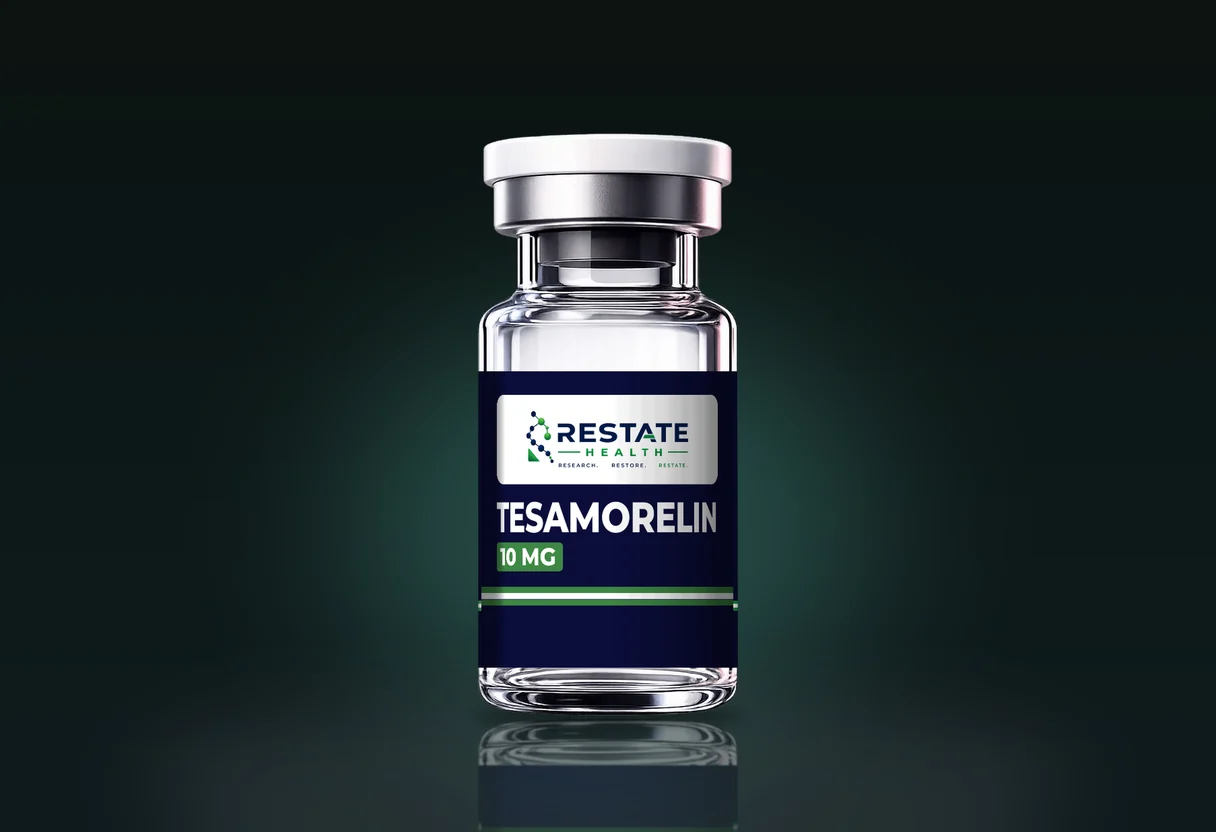
TH9507 is the full 44-residue growth-hormone-releasing hormone sequence with a six-carbon acyl group on its N-terminus. It is supplied at 10 mg and 20 mg, and it also appears in the catalogue as half of the TH9507 / Ipamorelin blend. It costs roughly twice what sermorelin costs at the smallest strength, and the reason is arithmetic rather than scarcity.
This guide covers the structure and the numbers a certificate must reconcile with, why the price sits where it does, how to choose between 10 mg and 20 mg, and when the blend is a sensible alternative to the single vial. TH9507 and sermorelin compared covers the two-way comparison and is not repeated here.
Forty-four residues and a hexenoyl group
The catalogue record gives the sequence as trans-3-hexenoyl-Tyr-Ala-Asp-Ala-Ile-Phe-Thr-Asn-Ser-Tyr-Arg-Lys-Val-Leu-Gly-Gln-Leu-Ser-Ala-Arg-Lys-Leu-Leu-Gln-Asp-Ile-Met-Ser-Arg-Gln-Gln-Gly-Glu-Ser-Asn-Gln-Glu-Arg-Gly-Ala-Arg-Ala-Arg-Leu-NH2, with the formula C221H366N72O67S, a molecular weight of 5135.86 g/mol and CAS number 218949-48-5. The 44 residues are the human GHRH sequence that Guillemin and colleagues reported in 1982; the first 29 of them are sermorelin, residue for residue.
The hexenoyl group is the modification. Frohman and colleagues showed in 1989, in plasma in vitro, that dipeptidyl peptidase IV cleaves the Tyr-Ala dipeptide from the free N-terminus of GHRH. An acylated N-terminal amine is not a substrate for that enzyme. The nonclinical account by Ferdinandi and colleagues in 2007, published while the compound was designated TH9507, describes it as a stabilised analogue on that basis.
A licensed pharmaceutical containing this molecule exists in the United States under another name, and Grunfeld's 2011 profile in Nature Reviews Drug Discovery summarises the development history. The research material supplied here is not that product, is not interchangeable with it and is for laboratory research only.
Why it costs what it costs
Synthetic peptides are made by solid-phase synthesis, one residue at a time, and every coupling has a yield below 100 percent. The yields multiply. At 99 percent per step, 44 couplings leave about 64 percent of chains complete and correct; 29 couplings leave about 75 percent; 5 couplings leave about 95 percent. The longer chain also generates more deletion sequences that sit close to the product in mass and retention time, so purification to the same stated purity discards more material. The N-terminal acylation is a further step with its own yield.
Those three facts, more couplings, harder purification and an extra step, are the whole explanation. What research peptides cost and why sets out the general case; TH9507 is the clearest example of it in this part of the catalogue.
Choosing between 10 mg and 20 mg
The two strengths, the blend, and sermorelin for scale, at the listed prices at the time of writing.
| Item | Strength | Listed price | Price per nominal mg |
|---|---|---|---|
| RS-TESA | 10 mg | $151.20 | $15.12 |
| RS-TESA | 20 mg | $207.20 | $10.36 |
| TH9507 / Ipamorelin blend | 10 mg / 5 mg | $198.80 | $13.25 |
| TH9507 / Ipamorelin blend | 10 mg / 2 mg | $280.00 | $23.33 |
| Sermorelin, for scale | 5 mg | $72.80 | $14.56 |
| Sermorelin, for scale | 10 mg | $154.00 | $15.40 |
Strengths and prices from the Restate Health catalogue records, October 2026. Per-milligram figures divide the listed price by nominal label mass; blend rows use the total nominal mass of both peptides.
The 20 mg vial is substantially cheaper per milligram, $10.36 against $15.12, a saving of about 31 percent. That is real only if the vial is finished before the material ages. A 20 mg vial of a 5135.86 g/mol peptide is about 3.9 micromoles; whether a single piece of work consumes that inside the usable window of a reconstituted solution is the sizing question, and the answer comes from measured consumption rather than from the price list.
The usual pattern holds. A first order from a new supplier is a documentation test and the 10 mg vial does that job. Steady consumption that empties a 20 mg vial inside its window justifies the larger one. Occasional work favours the smaller vial even at the higher unit price, because a vial half discarded was bought at full price.
What the certificate shows
Lot against vial, dates forwards, then identity, purity and content, with reading a certificate of analysis line by line as the general method. Three points are specific to this molecule.
- The mass basis. The catalogue figure of 5135.86 g/mol is an average mass. PubChem gives a monoisotopic mass of 5132.72 for the same formula under CID 16137828. At this size the two conventions are about three daltons apart, so the certificate must state which basis its observed mass is on before any comparison is made. A three-dalton discrepancy on a certificate for this compound is far more often a basis mismatch than a wrong molecule.
- The acyl group. A trans-3-hexenoyl group on the N-terminal amine adds C6H8O, about 96.1 daltons, relative to the free peptide. An intact mass that reconciles with 5135.86 is therefore consistent with the acylated molecule, and a mass about 96 daltons lower would indicate the unmodified 44-residue peptide. What an intact mass cannot show is that the group is on the N-terminal amine rather than on a lysine side chain, since both placements have the same formula. A fragmentation method that reads the N-terminal residues settles it.
- Purity near the main peak. The sequence contains seven glutamine and asparagine residues, and deamidation of either adds about one dalton and produces a peak close to the product on reversed-phase HPLC. A purity figure of 99 percent or higher by HPLC, the catalogue specification, should come with a method capable of resolving those neighbours, and a certificate that names column, gradient and detection wavelength is worth more than one that gives the percentage alone.
Content is the last line and the one to use. The label says 10 mg or 20 mg; the certificate reports the measured mass of peptide, and that is the figure to divide the price by and to carry into any calculation.
The blend with ipamorelin as an alternative
The catalogue lists the TH9507 / Ipamorelin blend at 10 mg / 5 mg for $198.80 and 10 mg / 2 mg for $280. The first of those is exactly the sum of the two singles at the same strengths: TH9507 10 mg at $151.20 plus ipamorelin 5 mg at $47.60 comes to $198.80. There is no price saving in that blend over the pair of singles; what it offers is one vial, one lot and one certificate in place of two of each.
That is a convenience with a cost. One lot now covers two molecules, so the certificate has to establish two identities and two contents, the mass ratio is fixed by the supplier, and a question about either component is a question about the vial. The ipamorelin half is the pentapeptide that Raun and colleagues described in 1998, 711.85 g/mol in the catalogue record, so the two components differ in mass by a factor of about seven and the 10 mg / 5 mg nominal ratio is roughly 1:3.6 by molecules.
The blend suits work where that fixed pairing is wanted and the two components are consumed together. Where the components are consumed at different rates, or where TH9507 alone is the subject, the single vial is the simpler purchase and the 20 mg strength is the cheaper one per milligram.
Storage, before and after reconstitution
The catalogue record specifies the lyophilised powder at -20 °C, protected from light and moisture, with the reconstituted solution at 2 to 8 °C. Two features of the sequence are worth knowing. The methionine at position 27 can oxidise in solution to the sulfoxide, 16 daltons heavier, which appears as a separate early peak on HPLC. The seven glutamine and asparagine residues are the deamidation sites already mentioned. Neither is a comment on the lot; both are reasons to use a reconstituted vial inside a bounded window rather than to hold it.
A 20 mg vial concentrates more value behind one stopper, so the number of entries into it matters as much as elapsed time once it is in solution.
What to check on arrival
- Lot number on every vial against the certificate supplied for it, in full.
- The strength on each vial against the packing list; 10 mg and 20 mg vials look the same.
- The identity mass basis on the certificate, average or monoisotopic, noted in your own record so that a later reader does not raise a three-dalton alarm.
- The cake: intact and white is expected, and a collapsed or glassy cake is worth recording.
- The certificate downloaded and stored with your records.
In short
TH9507 is the full 44-residue GHRH sequence with a trans-3-hexenoyl N-terminus, 5135.86 g/mol in the catalogue record. It costs what it does because 44 couplings and an acylation step leave less correct product to purify. The 20 mg vial is about 31 percent cheaper per milligram than the 10 mg vial and is the right choice where consumption is measured and steady. The certificate should state its mass basis, reconcile with the acylated mass, and name an HPLC method able to resolve deamidation neighbours. The blend with ipamorelin at 10 mg / 5 mg costs the same as the two singles and trades two certificates for one.