
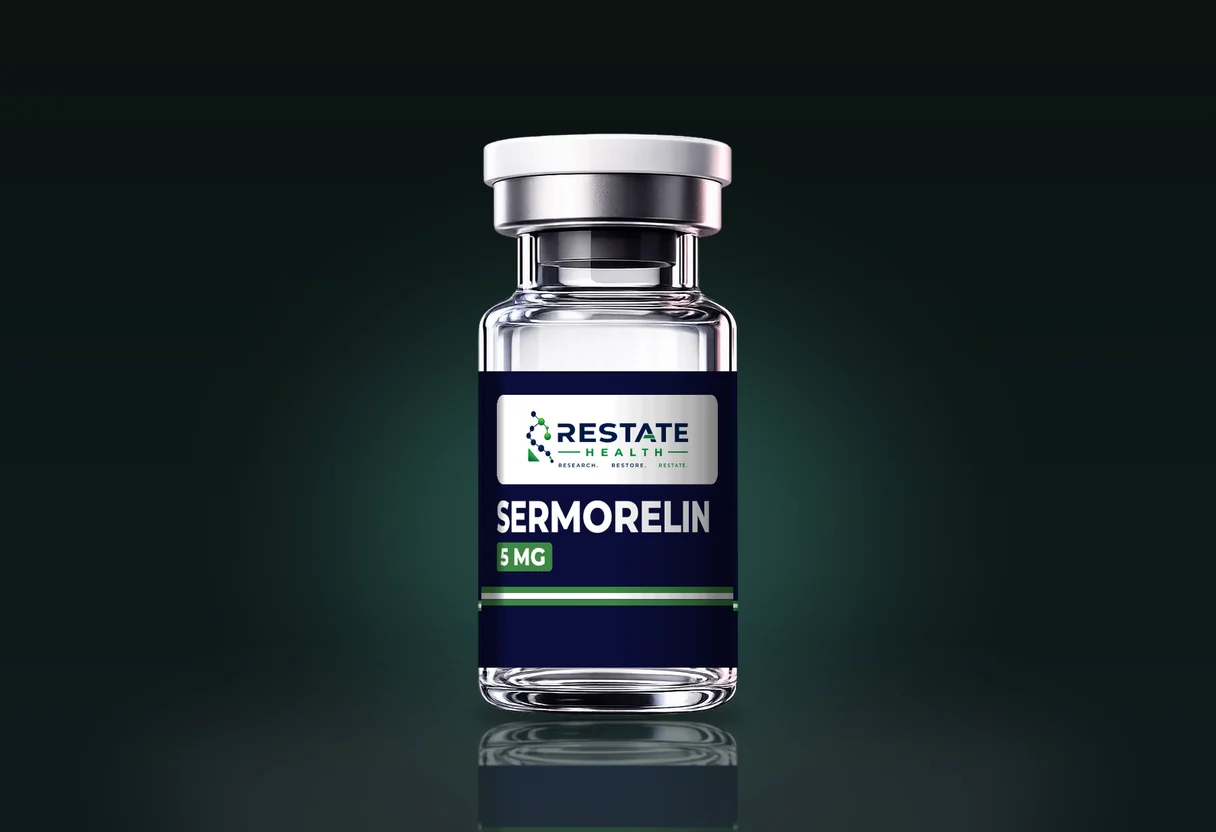
Sermorelin is one of the simpler purchases in the growth-hormone-axis part of the catalogue. It is a single unmodified sequence, it is supplied in two strengths, and the certificate for it is short. The difficulty is not the molecule but its neighbours: two other catalogue items share most of its sequence, and a certificate has to show which of the three is in the vial.
This guide covers the sequence and the numbers a certificate should reconcile with, the two strengths and what they cost per milligram, and the two things that genuinely vary between suppliers of what looks like the same product. TH9507 and sermorelin compared covers the chemistry of the comparison in more depth and is not repeated here.
| Sermorelin | Catalog specification |
|---|---|
| Vial strengths | 5 mg, 10 mg |
| Sequence | Tyr-Ala-Asp-Ala-Ile-Phe-Thr-Asn-Ser-Tyr-Arg-Lys-Val-Leu-Gly-Gln-Leu-Ser-Ala-Arg-Lys-Leu-Leu-Gln-Asp-Ile-Met-Ser-Arg-NH2 (GRF 1-29 NH2) |
| Molecular formula | C149H246N44O42S |
| Molecular weight | 3357.93 g/mol |
| Amino acid count | 29 |
| CAS number | 86168-78-7 |
From the Restate Health catalog record. Lot-specific values are on the certificate of analysis.
What sermorelin is, structurally
Human growth-hormone-releasing hormone was characterised in 1982 from pancreatic tumours that had caused acromegaly: Guillemin and colleagues reported a 44-residue form in Science, and Rivier and colleagues a 40-residue form in Nature. In 1984 Lance and colleagues showed that the first 29 residues, carried as a C-terminal amide, retained the receptor activity of the full sequence. That fragment is GRF(1-29) amide, and sermorelin is its generic name.
The catalogue record gives the sequence as Tyr-Ala-Asp-Ala-Ile-Phe-Thr-Asn-Ser-Tyr-Arg-Lys-Val-Leu-Gly-Gln-Leu-Ser-Ala-Arg-Lys-Leu-Leu-Gln-Asp-Ile-Met-Ser-Arg-NH2, with the formula C149H246N44O42S, a molecular weight of 3357.93 g/mol and CAS number 86168-78-7. Twenty-nine residues, all of them standard L-amino acids, with one methionine at position 27 that accounts for the single sulfur in the formula, and an amide rather than a free acid at the C-terminus.
That lack of modification is the point to hold on to. The two neighbours in the catalogue are modified versions of the same stretch of sequence, and growth hormone secretagogues explained sets out where each sits in the class.
The two strengths and what they cost
The catalogue lists sermorelin at 5 mg and 10 mg. The prices on the product record at the time of writing are in the table, with the per-milligram figure worked out from the label mass.
| Strength | Listed price | Price per nominal mg |
|---|---|---|
| 5 mg | $72.80 | $14.56 |
| 10 mg | $154.00 | $15.40 |
Strengths and prices from the Restate Health catalogue record for sermorelin, October 2026. Per-milligram figures are the listed price divided by the nominal label mass, not by certificate content.
The table shows something worth noticing before any sizing decision: at these listed prices the 10 mg vial is not cheaper per milligram than the 5 mg vial. The usual argument for a larger vial, that the per-milligram saving pays for holding more material, does not apply here. What the 10 mg vial buys is fewer vials to receive, log and store for the same quantity, and one lot where two 5 mg vials might come from two.
Size against what a single piece of work consumes. A first order from a new supplier is a test of documentation rather than a purchase of material, and the smaller vial does that job. A steady, measured consumption that finishes a 10 mg vial before the material ages justifies the larger one on handling grounds alone.
What the certificate must show
The same panel as any research peptide, read in the same order: lot number against the vial, the two dates running forwards, then identity, content and purity. Three lines carry the weight for this compound.
- Identity. An observed mass that reconciles with the catalogue figure of 3357.93 g/mol. That is an average mass; PubChem gives a monoisotopic mass of 3355.82 for the same formula under CID 16132413, so the two sit about two daltons apart and the certificate should say which basis its observed value is on.
- Purity. The catalogue specification is 99 percent or higher by HPLC, so the chromatogram percentage on a lot-matched certificate should meet that figure, with the method and column stated.
- Content. The measured mass of peptide in the vial, which is the number every later calculation uses and which is rarely identical to the label mass.
Identity needs one more comment. The catalogue record for CJC-1295 (no DAC), also called Mod GRF(1-29), gives a molecular weight of 3367.93 g/mol, ten daltons above sermorelin, for a 29-residue sequence that differs from it at a handful of positions including a D-alanine at position 2. An intact mass separates the two cleanly, since ten daltons is far outside the error of any mass spectrometer a testing laboratory would use. What an intact mass cannot do is distinguish a D-residue from its L-form, because the two have identical formula and mass; that is a question for chiral analysis, and it only matters where a certificate claims a stereochemistry.
A method that fragments the peptide and reads a ladder of residues establishes more than an intact mass alone, and for a 29-residue sequence with one methionine that ladder is straightforward to interpret. A certificate that names the method is worth more than one that reports a number.
Why the N-terminus matters to a buyer
In 1989 Frohman and colleagues showed, in plasma in vitro, that dipeptidyl peptidase IV removes the Tyr-Ala dipeptide from the N-terminus of human GHRH, leaving an inactive GHRH(3-44). The same cleavage applies to the 1-29 fragment, because the cut depends on the first two residues and nothing else.
Sermorelin is the unmodified form, so it carries the natural Tyr-Ala N-terminus that this enzyme acts on. The two catalogue neighbours are the two ways the literature has blocked that cut: Mod GRF(1-29) substitutes a D-alanine at position 2, and TH9507 carries a trans-3-hexenoyl group on the N-terminal tyrosine. For a buyer this is the clearest way to understand why three closely related items exist in one catalogue, and why a certificate for one is not a certificate for another.
None of this says anything about what the material does, and this guide makes no such claim. It explains why the identity line on a sermorelin certificate has to be read against the neighbours rather than on its own.
Two things that vary between suppliers
Two suppliers quoting the same purity for the same sequence may still be supplying different vials, and both differences are usually invisible on the certificate.
- The salt form. A synthetic peptide leaves purification as a salt, most often trifluoroacetate or acetate, and the counter-ion contributes to the mass of powder without contributing any peptide. TFA and acetate salt forms covers why this matters for cell work. It is rarely printed on the certificate and it is always answerable by email.
- The net peptide content. The label says 5 mg or 10 mg. The vial contains that much powder, or a fill set against it, and the powder is peptide plus counter-ion plus residual water. The certificate's measured content figure is the quantity of peptide. Net peptide content explained covers how the figure is obtained and why it is the one to use.
Ask both questions before a first order. The answers settle whether two quotes are for the same thing, and how quickly and precisely they arrive says a good deal about the supplier.
Storage, before and after reconstitution
The catalogue record specifies storage of the lyophilised powder at -20 °C, protected from light and moisture, with the reconstituted solution refrigerated at 2 to 8 °C. As a sealed dry solid this material is comparatively robust. The clock that matters starts at reconstitution.
The one residue to keep in mind is the methionine at position 27. Methionine side chains oxidise to the sulfoxide, which adds 16 daltons and appears as a separate, slightly earlier peak on reversed-phase HPLC. A certificate issued at release will not show it; a vial in solution for weeks may. That is a reason to use the material in a bounded window rather than a comment on the lot.
What to check on arrival
- The lot number on every vial against the certificate supplied for it, reading the full string.
- That the strength on each vial matches the packing list, since 5 mg and 10 mg vials of this compound look the same.
- The cake: an intact white lyophilised cake is expected, and a collapsed or glassy one is a finding worth recording even though it says nothing about identity or purity.
- The certificate itself, downloaded and stored with your own records rather than linked to the supplier's archive.
A short pre-order checklist
Five questions in one email. Can you send the certificate for a lot I would receive. Which laboratory issued it. Is the identity mass stated as an average or a monoisotopic value. Which salt form is supplied. What is the measured content of the current lot.
The answers settle the purchase. Whether they arrive from someone who can see the document, and how long they take, settles the supplier.
In short
Sermorelin is GRF(1-29) amide, 29 standard residues with one methionine, 3357.93 g/mol in the catalogue record. It is supplied at 5 mg for $72.80 and 10 mg for $154, and at those prices the larger vial is not cheaper per milligram. The certificate has to reconcile with that mass and, by doing so, separate the compound from Mod GRF(1-29) ten daltons away. Salt form and net content are the two things to ask about, because neither is on the label.