
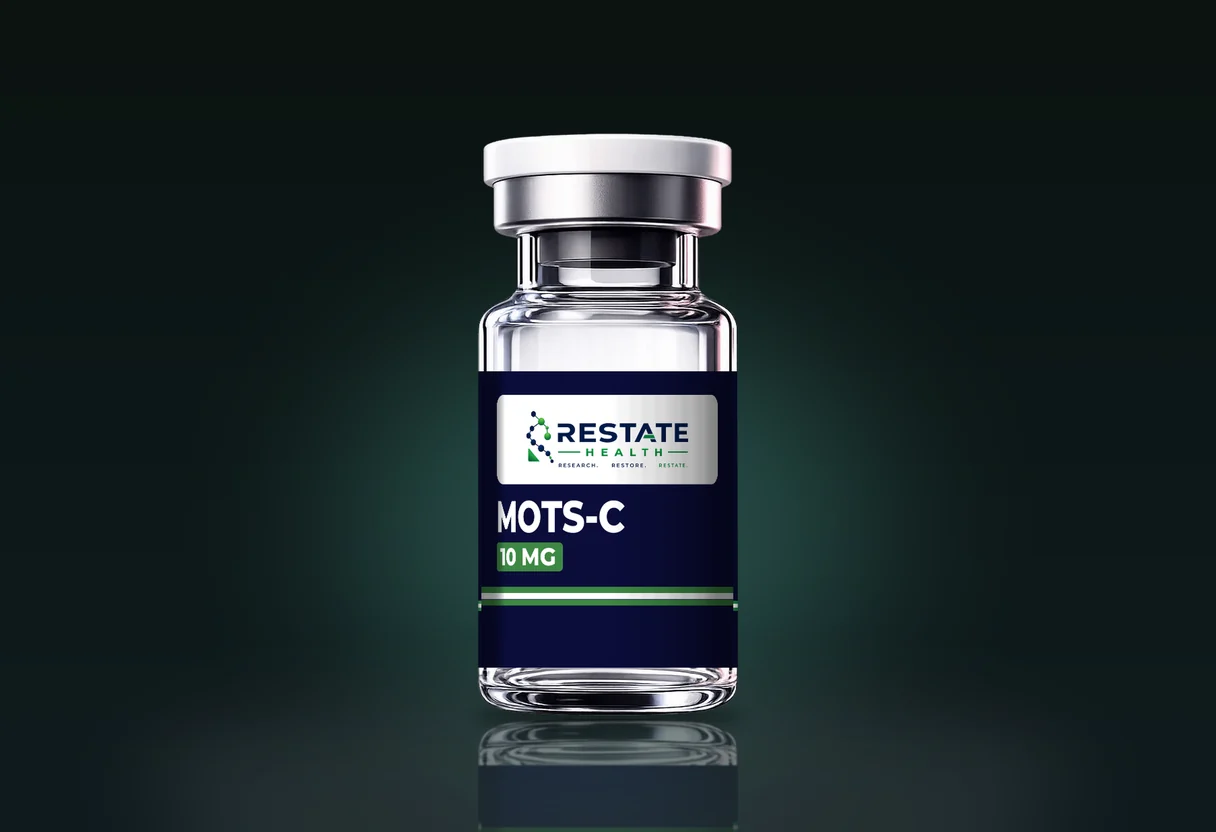
MOTS-c is supplied in two strengths that are four times apart, 10 mg and 40 mg, which is an unusual spread for a single compound in this catalogue. The 40 mg vial is a bulk option, and buying in bulk changes several things at once: the price per milligram, the number of lots and certificates involved, and how much of the material is exposed each time the vial is opened.
This guide covers the sequence and the numbers the certificate must reconcile with, the two strengths and what they cost, what the 40 mg vial changes in practice, and the handling consequences that follow from the residues in the sequence. Mitochondrial peptides explained covers the class and the distinction between this compound, humanin and SS-31; none of that is repeated here.
| MOTS-c | Catalog specification |
|---|---|
| Vial strengths | 10 mg, 40 mg |
| Sequence | Met-Arg-Trp-Gln-Glu-Met-Gly-Tyr-Ile-Phe-Tyr-Pro-Arg-Lys-Leu-Arg |
| Molecular formula | C101H152N28O22S2 |
| Molecular weight | 2174.55 g/mol |
| Amino acid count | 16 |
| CAS number | 1627580-64-6 |
From the Restate Health catalog record. Lot-specific values are on the certificate of analysis.
A 16-residue peptide encoded in the mitochondrial genome
The catalogue record gives the sequence as Met-Arg-Trp-Gln-Glu-Met-Gly-Tyr-Ile-Phe-Tyr-Pro-Arg-Lys-Leu-Arg, with the formula C101H152N28O22S2, a molecular weight of 2174.55 g/mol and CAS number 1627580-64-6. Sixteen standard residues with a free C-terminal acid. The two methionines account for the two sulfurs in the formula.
The peptide was described in 2015 by Lee and colleagues in Cell Metabolism as the product of a short open reading frame within the mitochondrial 12S ribosomal RNA gene. That paper reports experiments in cultured cells, including HEK293 cells, and in mice, and the catalogue record describes the compound as studied for its role in metabolic regulation, insulin sensitivity and energy homeostasis at the cellular level. A 2018 paper from the same group, Kim and colleagues, reports in cell models that the peptide moves to the nucleus under metabolic stress and associates with nuclear gene regulation. Those are the two primary sources for what the compound is; this guide is about buying it.
Two strengths and what they cost
The listed prices at the time of writing, with the two other mitochondrial compounds in the catalogue for scale.
| Item | Strength | Listed price | Price per nominal mg |
|---|---|---|---|
| MOTS-c | 10 mg | $81.20 | $8.12 |
| MOTS-c | 40 mg | $240.80 | $6.02 |
| Four MOTS-c 10 mg vials | 40 mg in four vials | $324.80 | $8.12 |
| SS-31 | 10 mg | $95.20 | $9.52 |
| SS-31 | 30 mg | $336.00 | $11.20 |
| SS-31 | 50 mg | $487.20 | $9.74 |
| Humanin | 10 mg | $212.80 | $21.28 |
Strengths and prices from the Restate Health catalogue records, October 2026. Per-milligram figures divide the listed price by nominal label mass. SS-31 and humanin are different molecules, included for scale and not as substitutes.
The 40 mg vial costs $84 less than four 10 mg vials, a saving of about 26 percent, and $6.02 per nominal milligram against $8.12. That is the case for the bulk vial, and it is a real saving for a laboratory that consumes 40 mg inside the usable window. The next section is the case against it, which is not about price.
What the 40 mg vial changes
- One lot, one certificate. Four 10 mg vials may come from one lot or several, each traceable to its own certificate; a single 40 mg vial is one lot by definition. That is simpler to document and it concentrates the whole purchase behind one set of results. A problem with the lot is a problem with all 40 mg.
- More value behind one stopper. Each entry into a reconstituted vial exchanges air and introduces a small chance of contamination, and a vial that is entered many times over weeks is exposed in a way that four vials opened in sequence are not.
- More freeze-thaw exposure if not aliquoted. A 40 mg vial reconstituted as one volume and returned to cold storage between uses is frozen and thawed as many times as it is used. Freeze-thaw cycles and aliquoting covers why that matters and the fix, which is to divide the reconstituted solution into single-use portions at the first opening so that each portion is thawed once.
The practical rule: the 40 mg vial is the right purchase where consumption is measured, where aliquoting is already part of the laboratory's routine, and where one lot covering the whole quantity is acceptable. Four 10 mg vials are the right purchase where the work is exploratory, where consumption is uncertain, or where separate lots are preferred for the record.
What the certificate must show
Lot against vial, dates running forwards, then identity, purity and content. Four points are specific to this sequence.
- The mass basis. The catalogue figure of 2174.55 g/mol is an average mass; PubChem gives 2173.11 as the monoisotopic mass for the same formula under CID 146675088. The two are about 1.4 daltons apart, which is enough to look like a discrepancy if the basis is not stated. Ask for it, or read it off the method.
- Oxidation neighbours. Two methionines means two sites that oxidise to the sulfoxide, each adding 16 daltons, and the tryptophan at position 3 is a third oxidation-prone residue. On reversed-phase HPLC the oxidised forms elute slightly before the main peak. A purity figure of 99 percent or higher by HPLC, the catalogue specification, should come from a method that resolves those neighbours rather than one that folds them into the main peak.
- Deamidation. The glutamine at position 4 is a deamidation site, adding about one dalton and producing a close-eluting peak. Same comment as above.
- Content. The measured mass of peptide in the vial, which is the figure to divide the price by and to carry into any calculation. At 40 mg, a few percent either side of the label is a real quantity.
For a 16-residue sequence of standard residues the residue-sum check is simple and worth doing once, and the catalogue formula can be reconciled with the sequence by anyone with a residue table. Peptide degradation pathways covers the oxidation and deamidation routes in general and why they produce the near-neighbour peaks a certificate has to resolve.
Handling consequences of the sequence
Three arginines and a lysine against a single glutamate and the C-terminal acid give this peptide a net positive charge at neutral pH. Kristensen and colleagues showed in 2015 that cationic peptides adsorb to glass and to some plastics from dilute solution, and that the loss can be a substantial fraction of the material at low concentration. For a buyer the consequence is that a dilute working solution left in an untreated glass vial or a polystyrene tube may contain less peptide than the arithmetic says, and that low-binding plasticware or a higher stock concentration is the usual answer.
The tryptophan at position 3 absorbs ultraviolet light and is the residue most readily damaged by it, which is why the catalogue's instruction to protect the material from light is not a formality here. The two methionines are the reason a reconstituted solution should be used inside a bounded window rather than held.
The catalogue record specifies storage of the lyophilised powder at -20 °C, protected from light and moisture, with the reconstituted solution refrigerated at 2 to 8 °C.
Two things that vary between suppliers
- The salt form. With four basic residues the counter-ion load per molecule is higher than for a neutral sequence, and trifluoroacetate against acetate makes a measurable difference to the mass of powder for a given mass of peptide. It is rarely on the certificate and always answerable.
- The net peptide content. The measured mass of peptide in the vial rather than the label figure. Net peptide content explained covers how the figure is obtained. On a 40 mg vial the difference between label and content is the largest absolute quantity in this guide.
Two suppliers quoting 99 percent purity for the same 16-residue sequence can still differ on both of these, and the price per milligram on the quote does not reveal either.
What to check on arrival
- Lot number on every vial against the certificate supplied for it, in full. For four 10 mg vials, check whether they share a lot or carry several, and that a certificate exists for each lot present.
- Strength on the vial against the packing list. A 40 mg cake is visibly larger than a 10 mg cake, which makes this the one compound in the set where a glance helps.
- The cake: intact and white is expected; a collapsed or glassy cake is worth recording.
- If the 40 mg vial was bought, that aliquoting supplies are to hand before it is opened, since the decision to divide the solution has to be made at the first opening.
- The certificate downloaded and stored with your records.
In short
MOTS-c is a 16-residue peptide encoded in the mitochondrial 12S rRNA gene, 2174.55 g/mol in the catalogue record, with two methionines, one tryptophan and a net positive charge that together set its handling. It is $81.20 at 10 mg and $240.80 at 40 mg, and the bulk vial saves about 26 percent against four small ones while concentrating the purchase behind one lot and one stopper. Aliquot it at the first opening or buy the small vials. The certificate should state its mass basis, resolve the oxidation and deamidation neighbours, and report content; salt form and content are the two things to ask about.