
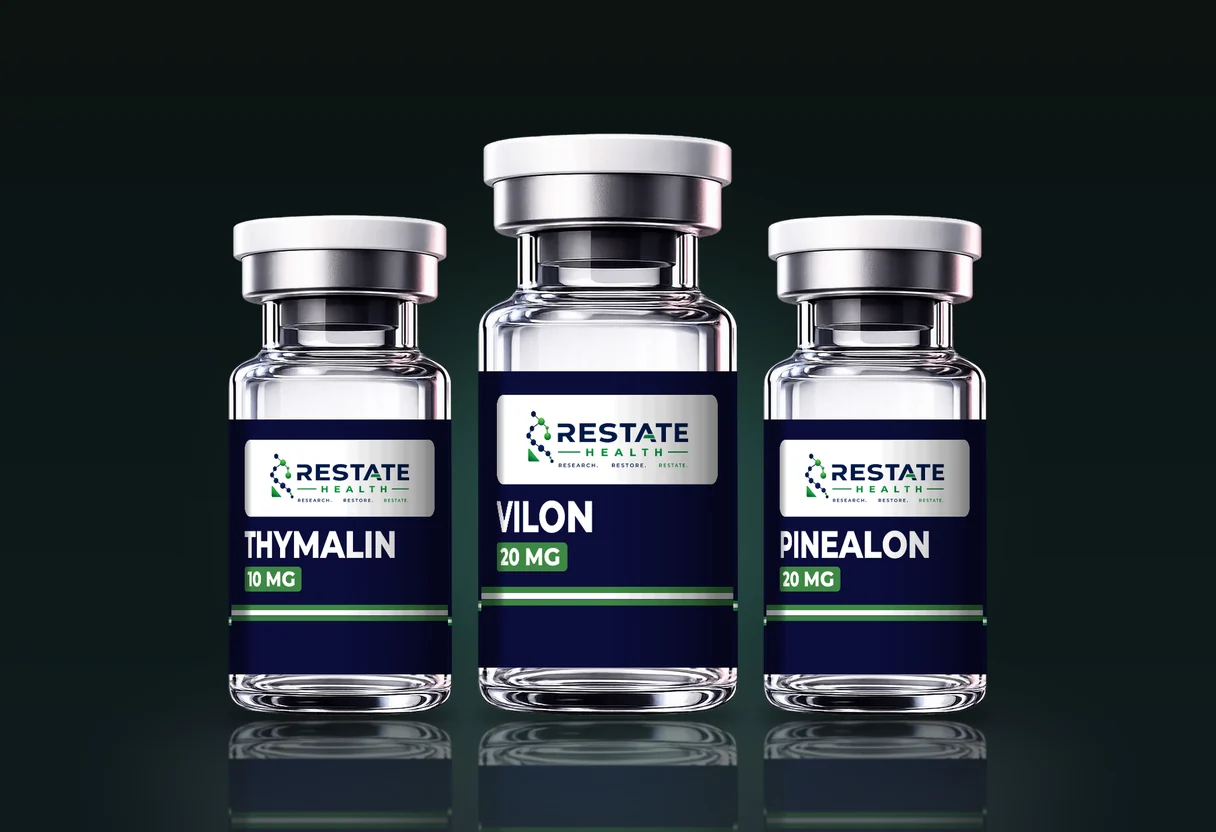
Six of the catalogue's bioregulator entries are short peptides from the series associated with Vladimir Khavinson and the St Petersburg Institute of Bioregulation and Gerontology: Thymalin, Vilon, Pinealon, Prostamax, Testagen and Vesugen. The seventh member stocked here, Epithalon, has its own buying guide and appears below only for comparison.
Five of the six are defined molecules of two to four residues. One is not a molecule at all but a fraction. That split, and the very small masses involved, decide what a certificate can show for each, which is the subject of this guide. For what the class is and how to read its literature, bioregulator peptides explained covers the ground and is not repeated here.
| Compound | Vial strengths | Molecular weight | Amino acids |
|---|---|---|---|
| Thymalin | 10 mg, 20 mg | — | — |
| Vilon | 20 mg | 291.30 g/mol | 2 |
| Pinealon | 10 mg, 20 mg | 418.41 g/mol | 3 |
| Prostamax | 20 mg | 487.50 g/mol | 4 |
| Testagen | 20 mg | 447.44 g/mol | 4 |
| Vesugen | 20 mg | 390.39 g/mol | 3 |
From the Restate Health catalog records. Lot-specific values are on each certificate of analysis.
The series, briefly
The compounds are written in the literature by one-letter code: KE for Vilon, EDR for Pinealon, KED for Vesugen, KEDP for Prostamax, KEDG for Testagen and AEDG for Epithalon. Khavinson and colleagues' 2023 modelling paper lists KE, EDR, KED, KEDP, KEDG and AEDG among 26 ultrashort peptides whose passage through LAT and PEPT family transporters it examined by computational docking, which is a convenient confirmation that the catalogue names and the literature codes refer to the same sequences. The same group's 2021 systematic review in Molecules collects the published work on peptide regulation of gene expression across the series.
Thymalin is the exception. The 2020 paper by Khavinson and colleagues describes it as a polypeptide complex isolated from the thymus, and the catalogue record says the same: a thymus polypeptide complex from calf thymus, a peptide fraction, not a single defined molecule. It has a CAS number (79621-14-0) but no formula, no mass and no sequence, because a fraction has none.
The six in one table
| Catalogue entry | Sequence | Residues | Molecular weight (catalogue) | Strengths | Price from |
|---|---|---|---|---|---|
| Thymalin | Polypeptide complex (calf thymus); no defined sequence | n/a | n/a; CAS 79621-14-0 | 10 mg, 20 mg | $56.00 |
| Vilon | Lys-Glu (KE) | 2 | 291.30 g/mol (C11H21N3O6); PubChem gives 275.30 | 20 mg | $81.20 |
| Pinealon | Glu-Asp-Arg (EDR) | 3 | 418.41 g/mol (C15H26N6O8) | 10 mg, 20 mg | $81.20 |
| Vesugen | Lys-Glu-Asp (KED) | 3 | 390.39 g/mol (C15H26N4O8) | 20 mg | $81.20 |
| Prostamax | Lys-Glu-Asp-Pro (KEDP) | 4 | 487.50 g/mol (C20H33N5O9) | 20 mg | $81.20 |
| Testagen | Lys-Glu-Asp-Gly (KEDG) | 4 | 447.44 g/mol (C17H29N5O9) | 20 mg | $81.20 |
| Epithalon (for comparison) | Ala-Glu-Asp-Gly (AEDG) | 4 | 390.35 g/mol (C14H22N4O9) | 10 mg, 50 mg | $47.60 |
Sequence, residue count, molecular weight, strengths and starting price from the Restate Health catalogue records as they stood on 21 October 2026. Epithalon is included for comparison. The Vilon mass is discussed in its own section below.
Four of the five defined peptides are built by extending Vilon's Lys-Glu one residue at a time: KED, then KEDP or KEDG. Pinealon shares the Glu-Asp pair in a different frame. That is why they are discussed as a series and why their certificates raise the same questions.
On strengths and price the table is nearly flat: four of the six are a single 20 mg vial at $81.20, Thymalin and Pinealon add a 10 mg option, and Pinealon is also listed as a liquid spray at 10 mg in 10 mL, the same tripeptide in solution. At these masses 20 mg is a large number of moles (about 73 micromoles for Vilon at 275.30 g/mol), so size the order against what the work will consume rather than against unit price.
What a certificate can show for a two-to-four-residue peptide
Every mass in the table sits where small organic molecules sit, between about 275 and 490 g/mol, and the analytical consequences follow from that. An intact mass is easy to measure accurately and should reconcile with the catalogue figure to within a fraction of a dalton; molecular weight for buyers covers the average and monoisotopic conventions, and at these sizes the two differ by less than 0.3, so the basis matters less than it does for a 4,000 g/mol peptide.
What an intact mass cannot do is distinguish between peptides of the same composition, and in this series that is not hypothetical. Vesugen (KED) is recorded at 390.39 g/mol and Epithalon (AEDG) at 390.35. Their formulas differ, C15H26N4O8 against C14H22N4O9, so their monoisotopic masses differ too, 390.175 against 390.139 in the PubChem records (CID 87571363 and CID 219042), but only by 0.036. A certificate that reports the mass to one decimal place, 390.4 or 390.2, has not told the two apart. One that reports it to three places on a high-resolution instrument has. For peptides this short, ask what resolution the identity measurement was made at.
Residue order is the other blind spot. KED, EDK and DKE share one formula and one mass, so an intact mass cannot show which order the three residues are in. A fragment spectrum can, but a tripeptide yields only a handful of fragments and a dipeptide fewer still, so the ladder is short and should be read rather than merely claimed. Mass spectrometry and peptide identity covers what each kind of result establishes.
Purity by HPLC is recorded for all six at 99% or better in the catalogue. Short, highly polar peptides elute early on reversed-phase columns, close to where the injection solvent appears, so the method matters: a certificate should name the column, the gradient and the detection wavelength, so that a buyer can judge whether an early-eluting impurity would have been seen at all.
Thymalin and Prostamax: when the record describes a fraction
For Thymalin there is no mass to reconcile. Identity for a fraction is a fingerprint: a chromatographic profile compared with a reference lot, a peptide-content assay by a stated method, and, ideally, a statement of the source tissue and the extraction. A certificate that reports a single intact mass for Thymalin is describing something other than a complex, and the question to put to the supplier is which. The catalogue strength, 10 mg or 20 mg, is a mass of the preparation, not of a defined peptide, and should be read as such.
Prostamax needs a closer read. Its record gives a defined tetrapeptide, Lys-Glu-Asp-Pro, with a formula and a mass of 487.50 g/mol, and PubChem CID 9848296 agrees at 487.5. The same record describes the physical form as a prostate peptide bioregulator complex, not a single defined molecule. Those two descriptions cannot both apply to one vial. Before ordering, ask whether the lot is the synthetic tetrapeptide KEDP, in which case the certificate should carry an intact mass near 487.5 and a fragment spectrum, or a tissue-derived fraction, in which case it should carry a fingerprint profile as Thymalin's should.
The Vilon record: two formulas for one dipeptide
The catalogue record for Vilon lists the formula C11H21N3O6 and a molecular weight of 291.30 g/mol. The dipeptide it names, Lys-Glu, has a different formula. Lysine is C6H14N2O2 and glutamic acid is C5H9NO4; joining them with the loss of one water gives C11H21N3O5, and PubChem CID 7010502, which carries the synonyms Vilon and peptide vilon, lists exactly that formula with a molecular weight of 275.30 and a monoisotopic mass of 275.148.
The 16.00 between the two figures is one oxygen atom. Whatever its origin, the practical instruction is simple: a certificate for Lys-Glu should reconcile with 275.3, and a buyer should ask which figure the supplier's lot document reports before accepting it. A certificate reading 291.3 for a product sold as Lys-Glu is describing a different composition from the one PubChem and the residue arithmetic give.
Salt form: a large share of a small powder
Synthetic peptides are isolated as salts, usually trifluoroacetate from the purification or acetate after exchange, and the counter-ion mass is part of the powder weighed into the vial. TFA and acetate salt forms covers the chemistry. For a 4,000 g/mol peptide the counter-ions are a few percent of the mass. For a dipeptide they can be close to half.
The arithmetic is the number of basic sites times the counter-ion mass. Vilon's Lys-Glu has two, the N-terminal amine and the lysine side chain. If both carry trifluoroacetate (114.02 each), the salt weighs 275.30 plus 228.04, and the peptide is 55% of that. As a di-acetate (60.05 each) it is 70%. Pinealon, Vesugen, Prostamax and Testagen each also have two basic sites, an N-terminal amine plus either an arginine or a lysine side chain. Epithalon has only the N-terminal amine.
| Compound (peptide mass) | Basic sites | Peptide share as full TFA salt | Peptide share as full acetate salt |
|---|---|---|---|
| Vilon (275.30) | 2 | 55% | 70% |
| Pinealon (418.41) | 2 | 65% | 78% |
| Vesugen (390.39) | 2 | 63% | 76% |
| Prostamax (487.50) | 2 | 68% | 80% |
| Testagen (447.44) | 2 | 66% | 79% |
| Epithalon (390.35) | 1 | 77% | 87% |
Illustrative upper bound: every basic site carrying one counter-ion. Peptide masses from the catalogue records (Vilon from PubChem CID 7010502), trifluoroacetate 114.02 and acetate 60.05 g/mol. Real lots carry at most this much; the certificate's net peptide content is the figure to use.
The consequence for buying is that a 20 mg label on a dipeptide may correspond to roughly 11 to 14 mg of peptide depending on salt form, and the only figure that settles it is the net peptide content on the certificate. Net peptide content explained covers why the label and the certificate differ and which one to use.
What the published work describes, and in what model
- Pinealon (EDR): Khavinson and colleagues (2011) report work in cultured cerebellar granule cells, neutrophils and PC12 cells under induced oxidative stress.
- Vilon (KE): Khavinson and colleagues (2002) report work in aged Wistar rats, measuring enzyme activity in layers of the small intestine, with Epithalon studied in the same paper.
- Vesugen (KED): the 2021 paper by Khavinson, Lin'kova and Umnov is a review of gene-expression findings and cites in vitro models.
- Testagen (KEDG): Pateyk and colleagues (2013) report thymus morphology in hypophysectomised chicks, alongside AEDG.
- Prostamax (KEDP): PubMed-indexed reports on KEDP specifically are few; the 2023 modelling paper lists it among the 26 peptides docked against transporters.
- Thymalin: Khavinson and colleagues (2020) report work in cultured human haematopoietic stem cells, measuring surface markers.
Each of those is a laboratory model and most are the originating group's own work, which is the point the class explainer makes about reading this literature. Nothing in a buying guide speaks to outcomes in any organism, and all six are supplied strictly for laboratory research.
Questions to ask before ordering
- For Vilon: does the lot certificate reconcile with 275.3 or with 291.3, and which formula does it state?
- For Vesugen: at what resolution was the identity mass measured, and does the certificate separate 390.175 from 390.139?
- For Prostamax: is the lot the synthetic tetrapeptide or a tissue-derived fraction?
- For Thymalin: what is the identity method for a fraction, and what reference does the profile compare against?
- For all six: which salt form, what is the net peptide content, and does the certificate name the lot on the vial I will receive?
Comparing suppliers on documentation is the method those answers feed into.
In short
Five defined peptides of two to four residues and one fraction, all at small-molecule masses where an intact mass is precise but cannot separate same-composition peptides or confirm residue order. Reconcile Vilon to 275.3 rather than the record's 291.3, ask for the resolution on Vesugen, ask Prostamax which thing it is, ask Thymalin for a fingerprint rather than a mass, and treat the salt form as a third or more of every powder until the net peptide content says otherwise.