
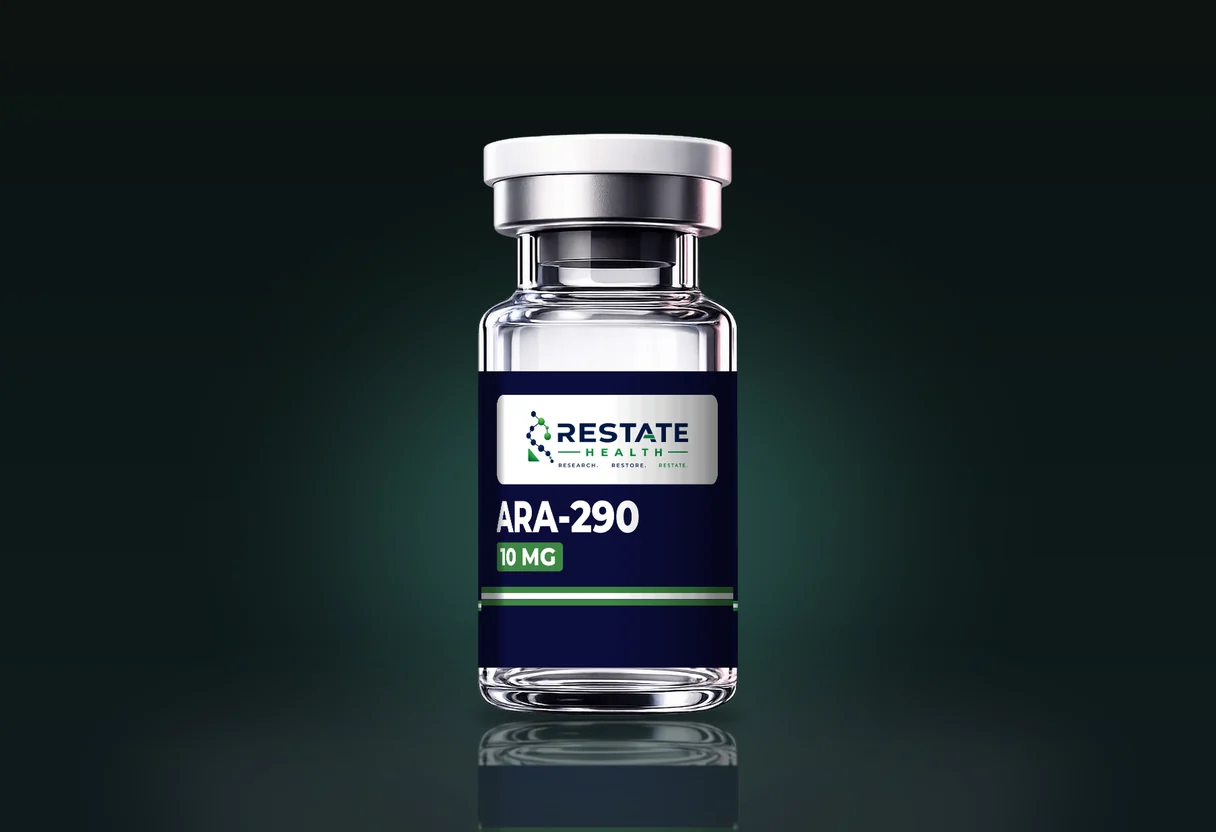
ARA-290, also listed under the name cibinetide, is an 11-residue peptide whose sequence was taken from one face of erythropoietin, the 165-residue protein that regulates red cell production. The 2008 paper by Brines and colleagues in PNAS describes how the peptide was derived and why: to keep one of erythropoietin's activities while leaving its erythropoietic activity behind. ARA-290 is listed in the catalogue at 10 mg and 16 mg, from $84.
This guide covers where the sequence comes from, what the design was meant to avoid, the sequence and mass as recorded, what the two strengths mean in practice, and which checks matter on a certificate for a peptide this short.
Published findings are described by model throughout. The material is supplied for laboratory research only.
| ARA-290 | Catalog specification |
|---|---|
| Vial strengths | 10 mg, 16 mg |
| Sequence | Pyr-Glu-Gln-Leu-Glu-Arg-Ala-Leu-Asn-Ser-Ser |
| Molecular formula | C55H82N18O18 |
| Molecular weight | 1259.34 g/mol |
| Amino acid count | 11 |
| CAS number | 1208243-50-8 |
From the Restate Health catalog record. Lot-specific values are on the certificate of analysis.
From a 165-residue protein to an 11-residue peptide
Erythropoietin is a glycoprotein of four alpha-helices, labelled A to D. In 2004, Leist and colleagues reported in Science that a chemically modified erythropoietin, carbamylated at its lysines, no longer stimulated red cell production in their assays but retained tissue-protective activity in rodent models. In the same year Brines and colleagues reported in PNAS that this second activity runs through a receptor complex distinct from the classical erythropoietin receptor homodimer, pairing an erythropoietin receptor subunit with the common beta receptor, CD131.
The 2008 PNAS paper took the next step. Reasoning that the two activities might use different surfaces of the protein, Brines and colleagues designed peptides from the aqueous face of helix B, the region they identified as facing away from the classical receptor contact. The 11-residue helix B surface peptide is ARA-290. The paper reports activity in cultured cells and in rodent models, and reports the peptide as nonerythropoietic in the assays it describes.
The distinction between a protein and a peptide is worth holding on to here, and peptide vs protein sets it out. Erythropoietin folds, carries carbohydrate and acts through its three-dimensional shape; an 11-mer does none of that on its own. ARA-290 is a linear fragment that presents one surface of the parent, which is exactly what the design intended.
Designed not to bind the classical receptor
The point of the derivation was negative as much as positive. The classical erythropoietin receptor, a homodimer, drives red cell production, and that is the activity the design sets out to exclude. Brines and Cerami's 2012 review in Molecular Medicine describes the alternative heteroreceptor, which they call the innate repair receptor, and places ARA-290 as a ligand for it. The 2015 review by Collino and colleagues covers the same ground with later rodent work.
A representative animal paper is Swartjes and colleagues, 2011, in Anesthesiology, which reports experiments in rats and in mice lacking the common beta receptor; in the knockout animals the peptide's reported effect was absent, which is the kind of result that ties an observation to a receptor. The catalogue record summarises the compound as studied in neuropathic and inflammatory models, without erythropoietin's effect on red cell production. That is a fair reading of the literature as a description of models; it is not a statement about people.
Sequence, pyroglutamate and the two reference figures for mass
The catalogue records the sequence Pyr-Glu-Gln-Leu-Glu-Arg-Ala-Leu-Asn-Ser-Ser, 11 residues, CAS number 1208243-50-8. Pyr is pyroglutamic acid: a glutamate or glutamine whose side chain has cyclised onto the N-terminal amine to form a five-membered lactam. The consequence is that the peptide has no free N-terminal amine. That blocks aminopeptidases, removes one positive charge, and is a common deliberate feature in designed peptides.
There are two reference figures for the mass, and they do not agree. The catalogue record carries the formula C55H82N18O18 and a molecular weight of 1259.34 g/mol. PubChem's entry for cibinetide, CID 91810664, records C51H84N16O21 at 1257.3 g/mol. Summing the residues of the recorded sequence arrives at the PubChem figure, as the table shows.
| Component | Count | Formula contribution | Average mass (Da) |
|---|---|---|---|
| Glu residue | 3 | C15H21N3O9 | 387.35 |
| Gln residue | 1 | C5H8N2O2 | 128.13 |
| Leu residue | 2 | C12H22N2O2 | 226.32 |
| Arg residue | 1 | C6H12N4O | 156.19 |
| Ala residue | 1 | C3H5NO | 71.08 |
| Asn residue | 1 | C4H6N2O2 | 114.10 |
| Ser residue | 2 | C6H10N2O4 | 174.16 |
| Terminal water | 1 | H2O | 18.02 |
| Pyroglutamate cyclisation | -1 | -H2O | -18.02 |
| Sum | C51H84N16O21 | 1257.32 |
Residue formulas and average masses summed for the recorded sequence. Residue values are the standard amino acid less one water; the pyroglutamate correction removes one further water for the lactam. PubChem CID 91810664 records C51H84N16O21 and 1257.3 g/mol.
Where reference figures disagree, the certificate is the arbiter. The observed mass on a lot's certificate should reconcile with one structure or the other, and a supplier should be able to say which. A reported mass near 1257 on the average basis is consistent with the pyroglutamate 11-mer as the sequence is written; a value 18 Da higher would indicate an uncyclised N-terminal glutamate rather than a different peptide.
The two strengths
The catalogue offers ARA-290 at 10 mg and 16 mg, listed from $84. The material is the same; what differs is the fill. For a laboratory the choice turns on how much is consumed per planned run and how many times a vial would be opened, since each opening of a reconstituted vial is a contamination and freeze-thaw event. A larger vial that is opened many times is not obviously better than two smaller ones.
The gravimetric figure on the label is not the peptide figure. ARA-290 carries one arginine and, with the pyroglutamate, no free N-terminal amine, so it has fewer sites for trifluoroacetate counterion than most peptides of its length; but residual water and counterion still make up part of the vial mass. Net peptide content explains how the figure is reported and why it matters for calculating what is actually in the vial.
Certificate checks for an 11-mer
Short peptides are easier to characterise than long ones, and a certificate for an 11-mer should be correspondingly clean. The purity statement in the record is 99 percent or higher by HPLC. HPLC purity explained covers what that number does and does not mean; the specifics for this sequence are below.
| Possible impurity | Mass shift | Visible by intact mass | Visible by HPLC |
|---|---|---|---|
| Uncyclised N-terminal Glu (no pyroglutamate) | +18 Da | Yes | Usually, as a separate peak |
| Deletion of one Ser | -87 Da | Yes | Yes |
| Deletion of one Leu | -113 Da | Yes | Yes |
| Deletion of Arg | -156 Da | Yes | Yes |
| Deamidation of Asn or Gln | +1 Da | Only at high resolution | Sometimes, as a shoulder |
| Trifluoroacetate counterion | None (not covalent) | No | No |
Impurities plausible for the recorded sequence and the mass shift each produces. Shifts are average-mass arithmetic from standard residue masses.
Deletion sequences are the main synthetic impurity class and on a 1257 Da peptide they are easy to resolve: the smallest, a missing serine, is 87 Da away. The one impurity that intact mass struggles with is deamidation, which converts asparagine or glutamine to the corresponding acid with a shift of about one dalton. The sequence has one asparagine, followed by serine, and one glutamine, and Asn-Ser is one of the sequence motifs most prone to deamidation. A high-resolution instrument separates it; a low-resolution intact mass does not.
Beyond mass and purity, the certificate should carry the lot number, the method parameters for the HPLC run, and a date. How to read a peptide COA walks through the document line by line.
Handling notes that follow from structure
The recorded sequence has no cysteine, no methionine and no tryptophan, so the three residues most prone to oxidation are absent and the peptide is comparatively robust in that respect. The vulnerability it does have is deamidation at Asn-Ser, which is driven by pH and temperature in solution. The record's storage line, lyophilised at -20°C protected from light and moisture and refrigerated at 2-8°C once reconstituted, is the appropriate response, and keeping time in solution short matters more here than protecting from light.
The peptide is small and only mildly basic, with one arginine and no free N-terminal amine, so the adsorption problems that affect highly cationic peptides at low concentration are less of a concern.
What to establish before ordering
- Which mass the supplier's certificate reconciles with, since the catalogue record and PubChem carry different formulas for the compound.
- That the N-terminus is reported as pyroglutamate and the observed mass is consistent with it.
- The HPLC method and the purity figure, with attention to any shoulder on the main peak that could be a deamidated form.
- Net peptide content, so the vial strength can be converted into an amount of peptide.
- The lot number on the certificate matching the vial.