
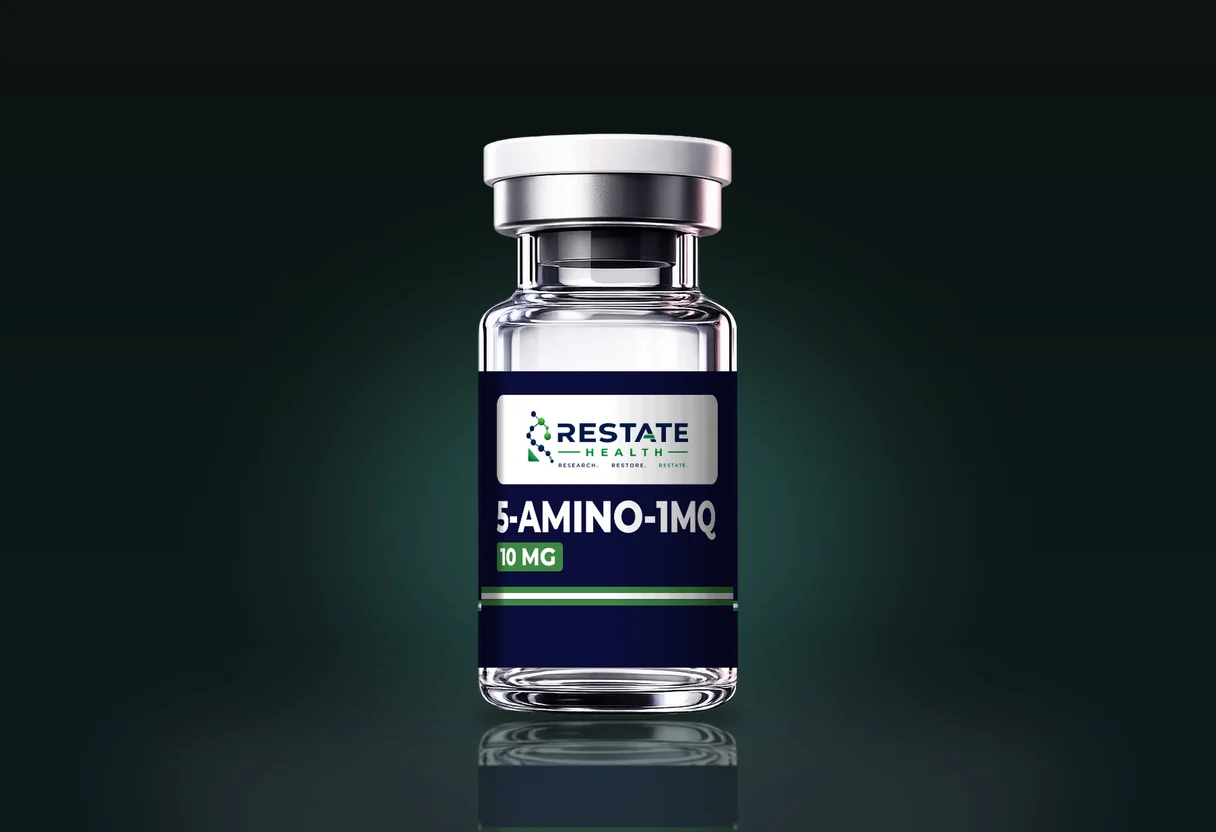
5-Amino-1MQ is listed in a peptide catalogue and is not a peptide. It is 5-amino-1-methylquinolinium, a small aromatic cation built on a single two-ring system, supplied as its iodide salt. The catalogue carries it at 10, 20 and 50 mg under GLP-1 & Metabolic, which is a grouping by research interest rather than by chemistry.
That distinction matters to a buyer because nearly everything a peptide certificate is built to report, a sequence, a residue count, a net peptide content, has no meaning here. What replaces those lines, what the published work on the compound actually describes and in which models, and how the mass on the label relates to the mass of active cation in the vial are the subjects of this guide.
Not everything in a peptide catalog is a peptide covers the whole group of non-peptide items in the catalogue. This guide takes the one compound in depth.
| 5-Amino-1MQ | Catalog specification |
|---|---|
| Vial strengths | 10 mg, 20 mg, 50 mg |
| Molecular formula | C10H11N2+ (supplied as the iodide salt, C10H11IN2) |
| Molecular weight | 159.21 (cation) / 286.11 (iodide salt) g/mol |
From the Restate Health catalog record. Lot-specific values are on the certificate of analysis.
What the molecule is
Quinoline is a benzene ring fused to a pyridine ring. Put a methyl group on the ring nitrogen and that nitrogen carries a permanent positive charge, giving a quinolinium cation. Add an amino group at the 5-position of the ring system and the result is 5-amino-1-methylquinolinium, which the name 5-Amino-1MQ abbreviates: 1MQ for 1-methylquinolinium, 5-amino for where the amine sits.
PubChem files the cation as CID 950107 with the formula C10H11N2+ and a molecular weight of 159.21 g/mol, and the iodide salt as CID 66522933, C10H11IN2, 286.11 g/mol. The catalogue record carries both figures, recorded as C10H11N2+ (supplied as the iodide salt, C10H11IN2) and 159.21 (cation) / 286.11 (iodide salt) g/mol. The two numbers are the same substance counted two ways, and the difference between them, 126.90, is the atomic weight of iodine.
There is no amide bond, no amino acid and no stereocentre in the molecule. A peptide is a chain whose identity is a sequence. This is a rigid ring whose identity is a formula and a substitution pattern. That difference runs through every line of the documentation and is the reason a certificate written on a peptide template fits this compound badly.
NNMT, the enzyme the literature pairs it with
Nicotinamide N-methyltransferase (NNMT) is a cytosolic enzyme that moves a methyl group from S-adenosylmethionine (SAM) onto nicotinamide, producing 1-methylnicotinamide. Nicotinamide is a precursor of NAD+, and SAM is the cell's main methyl donor, so the enzyme sits where two central pools meet. The 2017 review by Pissios in Trends in Endocrinology and Metabolism sets out why that position attracted interest beyond the enzyme's older description as a vitamin B3 clearance route.
The paper that made the enzyme a target was Kraus and colleagues, Nature 2014. Working in mice, they found Nnmt to be the most strongly reciprocally regulated gene in white adipose tissue when comparing adipose-specific Glut4-knockout with adipose-specific Glut4-overexpressing animals. Knocking the gene down with antisense oligonucleotides in white adipose tissue and liver protected mice against diet-induced obesity, and NNMT inhibition in adipocytes increased oxygen consumption. The model is mice and cultured adipocytes throughout.
That result is why small-molecule inhibitors of NNMT were pursued, and why a quinolinium compound ended up in catalogues next to peptides that happen to be studied in the same metabolic context.
What the published work on 5-Amino-1MQ describes
The compound comes from a programme at the University of Texas Medical Branch. Neelakantan and colleagues, Journal of Medicinal Chemistry 2017, screened N-methylated quinolinium, isoquinolinium, pyridinium and benzimidazolium or benzothiazolium analogues against purified NNMT and identified quinoliniums as the useful scaffold, with inhibition in the low micromolar range (IC50 around 1 micromolar) and docking into the nicotinamide-binding site. That is a biochemical study with isolated enzyme.
The follow-up in Biochemical Pharmacology 2018, by the same group, took methylquinolinium scaffolds with primary amine substitutions, which is the structural description of 5-Amino-1MQ, through permeability assays (parallel artificial membrane and Caco-2), selectivity panels against related SAM-dependent methyltransferases and NAD+ salvage enzymes, cultured adipocytes, and diet-induced obese mice on a high-fat diet. In the adipocytes the inhibitors reduced intracellular 1-methylnicotinamide, raised intracellular NAD+ and SAM, and suppressed lipogenesis. In the mice, a potent inhibitor given systemically reduced body weight and white adipose mass, decreased adipocyte size and lowered plasma total cholesterol, without a change in total food intake.
A third paper from the group, Biochemical Pharmacology 2019, reports an NNMT inhibitor in aged mice, where the readouts were muscle stem cell activation and the regenerative capacity of skeletal muscle after injury. Separately, a Sanofi and Jubilant Biosys collaboration (Ruf and colleagues, Bioorganic and Medicinal Chemistry Letters 2018, with Rudolph and Kannt among the authors) describes an unrelated chemotype, a nicotinamide analogue, as an NNMT inhibitor. That matters for a buyer in one way: "NNMT inhibitor" names a class with several structurally different members, not a molecule, so a certificate has to identify the quinolinium specifically.
| Paper | System | What was measured |
|---|---|---|
| Kraus and colleagues, Nature 2014 | Mice; cultured adipocytes | Nnmt expression in white adipose tissue; antisense knockdown and diet-induced obesity; adipocyte oxygen consumption |
| Neelakantan and colleagues, J Med Chem 2017 | Purified NNMT enzyme | IC50 across quinolinium and related scaffolds; docking to the nicotinamide site |
| Neelakantan and colleagues, Biochem Pharmacol 2018 | Membrane assays; cultured adipocytes; diet-induced obese mice | Permeability, selectivity, 1-methylnicotinamide, NAD+, SAM, lipogenesis; body weight, adipose mass, adipocyte size, plasma cholesterol |
| Neelakantan and colleagues, Biochem Pharmacol 2019 | Aged mice | Muscle stem cell activation; regenerative capacity after injury |
| Ruf and colleagues, Bioorg Med Chem Lett 2018 | Enzyme and cells; a different chemotype | Inhibition by a nicotinamide analogue, not a quinolinium |
Compiled from the abstracts of the cited papers. Models and readouts only; none of these studies involves people.
Everything in that table is in cells or in rodents. Nothing in it describes the compound in people, and none of it is a basis for anything other than laboratory work.
What a small-molecule certificate shows that a peptide certificate does not
Purity is still a chromatographic figure, and the catalogue states 99% or above by HPLC. Identity is still a mass. After that the two document types part ways.
| Line | A synthetic peptide | 5-Amino-1MQ |
|---|---|---|
| Identity | Sequence read by fragmentation, or intact mass against a calculated figure | Mass of the cation at 159 (monoisotopic 159.09), formula C10H11N2+; often an NMR spectrum. There is no sequence to read |
| Purity | Reversed-phase HPLC, area percent at 214 or 220 nm | HPLC area percent; an aromatic ring absorbs strongly, so a longer wavelength is usual. 99% or above by HPLC in the record |
| Amino acid count | Stated, 16 | Not applicable. A number here means a peptide template was used |
| Net peptide content | Amino acid analysis or qNMR | Not applicable. Replaced by an assay of the salt, percent by weight, and a water figure |
| Counterion | TFA or acetate, variable, often unstated | Iodide, one per cation, fixed by the formula: 44.4% of the salt mass |
| Residual solvents, water | Reported | Reported |
Certificate lines for a 16-residue peptide and for 5-Amino-1MQ. The iodide share is 126.90 divided by 286.11, from the catalogue molecular weights.
The identity line deserves a sentence. A quinolinium carries its positive charge permanently, so in positive-ion electrospray the spectrometer sees the molecule itself at m/z 159, not a protonated adduct. That is a clean result, and it says nothing about the counterion, which does not appear in a positive-ion spectrum at all. Whether the vial holds the iodide, and how much of the solid is salt rather than water, is settled by the assay and water lines, not by the mass. Mass spectrometry and peptide identity covers what a mass can and cannot establish, and the logic carries over to a small molecule with the sequence step removed.
The purity line also needs one caution. HPLC purity explains that an area percent is a share of detector response. For a strongly absorbing aromatic cation, a non-absorbing impurity, inorganic salt for instance, contributes nothing to the trace and is invisible to the figure. The water and assay lines are where that mass shows up.
Counterion and content: why 10 mg is not 10 mg of cation
For a peptide, the gap between labelled mass and peptide mass is variable and has to be measured; net peptide content covers why. For this compound the largest part of the gap is fixed by stoichiometry. One iodide accompanies every cation, so the cation is 159.21 divided by 286.11, or 55.65%, of the salt mass. The rest is iodine.
| Label strength | Cation present if the label is salt mass | Salt required if the label is cation mass | Micromoles of compound (salt basis) |
|---|---|---|---|
| 10 mg | 5.57 mg | 17.97 mg | 34.95 |
| 20 mg | 11.13 mg | 35.94 mg | 69.90 |
| 50 mg | 27.83 mg | 89.86 mg | 174.76 |
Arithmetic from the catalogue molecular weights, 159.21 g/mol for the cation and 286.11 g/mol for the iodide salt. Water and residual solvent are not included.
The table has two mass columns because a label can be written either way, and the catalogue record does not say which. That is the first question to ask before comparing this item across suppliers, since a quote on cation mass and a quote on salt mass differ by a factor of 1.8 at the same price. Once the basis is known, the micromole column is the figure that carries into any laboratory calculation, because a molar quantity does not depend on which salt the compound came as.
Strengths, and what mass means for a small molecule
The three strengths, 10, 20 and 50 mg, look like a modest ladder. In molar terms it is wider than it looks. At 286.11 g/mol, 10 mg of the salt is about 35 micromoles. The same 10 mg of a 1,815 Da peptide, which is the size of AOD-9604, is about 5.5 micromoles. A 10 mg vial of this compound therefore holds roughly six times as many molecules as a 10 mg vial of a sixteen-residue peptide, and the 50 mg vial holds about 175 micromoles, which is more compound than most of the peptide catalogue offers in any single vial.
The sizing rule is the one that applies to anything bought by mass: choose the strength a single piece of work consumes, since the per-milligram saving on the 50 mg vial is only realised if the material is used. The difference from a peptide is that a sealed aromatic salt is not subject to deamidation, oxidation of methionine or cysteine, or disulfide scrambling, because it has none of those groups. Its storage line in the catalogue, lyophilised at -20°C, protected from light and moisture, with short-term refrigeration of a reconstituted solution, is the same as the peptides', and light is the item to take seriously for an aromatic amine supplied as an iodide: iodide can oxidise to iodine in light and air, and a yellow or brown cast on a solid that was pale is worth recording at receipt.
What to check before ordering
- Whether the strength on the label is the mass of the iodide salt or of the cation. Ask, and record the answer with the lot.
- An identity result that names the cation: a mass at 159 and, ideally, an NMR spectrum. A sequence line, an amino acid count or a net peptide content figure on this certificate means the document was generated from a peptide template and should be read with that in mind.
- An assay figure (percent by weight) and a water figure, which together do for a small molecule what net peptide content does for a peptide.
- The HPLC method and wavelength, since the figure is only comparable between suppliers if the method is.
- That the certificate is for the lot you will receive and not for the product line.
Where this leaves a buyer
A compound with a formula instead of a sequence, a counterion that is nearly half the mass of the solid, and a literature that so far runs through isolated enzyme, cultured adipocytes and mice. The useful habit is to stop reading its certificate as a peptide certificate with gaps, and to read it as a small-molecule certificate that should have an assay, a water figure and a mass at 159. Where those are present and the lot matches, the document has done its job. All material is supplied strictly for laboratory research.