
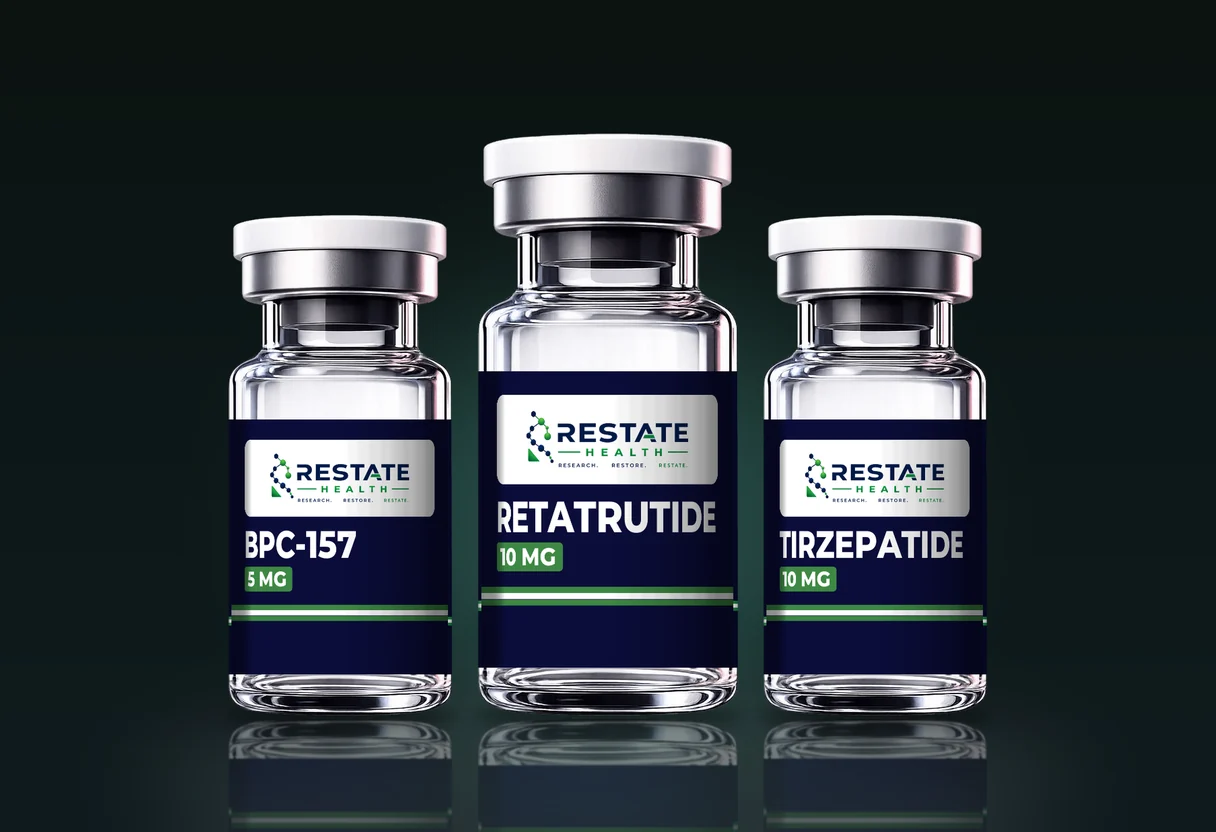
A peptide is a short chain of amino acids joined end to end by a repeating bond. That one sentence covers everything in this catalogue that is genuinely a peptide, from the three residues of KPV to the 39 of LY3437943 and LY3298176, and it is the sentence a buyer needs behind every other figure on a certificate. BPC-157, with 15 residues of ordinary amino acids and no modifications, is the cleanest example to think with.
The library already has guides on nomenclature, synthesis, certificates and the peptide-protein boundary. What it lacked was the page those guides assume: what the molecule is, how big it is, where it comes from, and what the powder in the vial actually consists of. This is that page.
Nothing here concerns effects. It concerns chemistry, naming and documentation, which are the things a supplier of research material can speak to and the things a buyer can check.
Amino acids, the building blocks
An amino acid is a small molecule with an amino group (NH2) at one end, a carboxylic acid group (COOH) at the other, and a variable side chain in between. Twenty of them are encoded by the genetic code and these are the standard set. Glycine has the smallest side chain, a single hydrogen. Tryptophan has the largest, a two-ring system. Lysine and arginine carry a positive charge at neutral pH; aspartic acid and glutamic acid carry a negative one.
The side chain is what distinguishes one amino acid from another, and it is why the order of amino acids in a chain matters. Two peptides with the same 15 amino acids in a different order are different molecules with the same formula and the same mass. Peptide nomenclature and sequence notation covers how that order is written down.
Beyond the standard twenty, synthetic peptides routinely include residues that no gene encodes. The α-aminoisobutyric acid (Aib) in LY3437943 and LY3298176 is one. Such residues are introduced deliberately during synthesis, usually to resist enzymatic cleavage or to hold a shape, and they are the first reason a catalogue sequence may not be a plain string of twenty letters.
The peptide bond
The carboxyl group of one amino acid and the amino group of the next react to form an amide bond, with a molecule of water released. Chemists call this specific amide a peptide bond. Each bond removes 18.015 Da from the sum of the two free amino acids, so the mass of a peptide is always less than the mass of the amino acids that went into it.
Linus Pauling, Robert Corey and Herman Branson established in 1951 that this bond is rigid and planar, which is why peptide chains fold into the regular helices and sheets they described. The 1983 IUPAC-IUB recommendations define a peptide formally as any compound of two or more amino acids joined by such bonds, and define the residue, which is what remains of each amino acid once the water has gone.
The chain therefore has a direction. One end still carries a free amino group and is called the N-terminus; the other still carries a free carboxyl group and is called the C-terminus. Sequences are written N to C by convention, left to right.
Dipeptide to protein: the two-to-fifty convention
Two residues make a dipeptide, three a tripeptide, and so on. Below about ten residues the chain is an oligopeptide; above that it is a polypeptide. The widely used working convention is that a peptide has from two to around fifty residues and a protein has more, with roughly 5,000 to 10,000 Da as the mass equivalent of that boundary. Reviews of peptide drug discovery, including Muttenthaler and colleagues in 2021 and Henninot, Collins and Nuss in 2018, use that convention while noting it is a convention and not a chemical discontinuity.
The boundary blurs because what actually separates a protein from a peptide is behaviour, not length. Proteins fold into stable three-dimensional structures that persist in solution; short peptides mostly do not. Insulin, with 51 residues in two chains, is usually called a protein. The 39-residue incretin analogues in this catalogue are called peptides. Peptide vs protein walks through the cases where the label is contested and why a buyer should care.
Natural, synthetic and modified
Many catalogue peptides are sequences that occur in a living organism, or fragments of such sequences. BPC-157 is described in the 1993 paper by Sikirić and colleagues as a fragment of a protein found in gastric juice. LL-37 is a fragment of a human protein. KPV is the last three residues of a longer hormone. In each case the molecule in the vial is made by chemical synthesis; it is the sequence, not the material, that is natural.
Other catalogue peptides are designed. NN9535, LY3298176 and LY3437943 are analogues of natural incretin hormones with substituted residues and a fatty-acid chain added to a lysine side chain. Willard and colleagues in 2020 describe LY3298176 as a 39-residue molecule engineered to act at two receptors with deliberately unequal affinity. The point for a buyer is that the word analogue means the natural sequence has been changed, and the certificate must therefore confirm the changed molecule rather than the parent.
Almost all research peptides are made by solid-phase synthesis, the method Merrifield published in 1963, in which the chain is built one residue at a time on an insoluble resin. Solid-phase peptide synthesis explained covers the process and, more usefully for a buyer, the impurities that each step can leave behind.
How peptides are named
A catalogue name is one of three kinds. A trivial name, such as BPC-157, is a label from the discovering group or a sponsor's code and carries no structural information. A descriptive name, such as pentadecapeptide, states the length. A systematic name writes the sequence out in three-letter or one-letter code, N to C, with any modifications marked. The 1983 IUPAC-IUB recommendations govern that last form.
A CAS Registry Number identifies one specific substance and is the most useful single identifier on a catalogue page, because two suppliers using different trivial names for the same molecule will quote the same CAS number, and two different molecules sold under the same name will not. The three peptides below show how the three kinds of name line up.
| Peptide | Residues | Molecular formula | Molecular weight | CAS number | Class |
|---|---|---|---|---|---|
| BPC-157 | 15 | C62H98N16O22 | 1419.55 g/mol | 137525-51-0 | Unmodified linear pentadecapeptide of standard amino acids, sequence Gly-Glu-Pro-Pro-Pro-Gly-Lys-Pro-Ala-Asp-Asp-Ala-Gly-Leu-Val |
| RS-RTA-3 | 39 | C256H392N64O79 | 4731.2 g/mol | 2381089-83-2 | Designed analogue with Aib and α-methyl-leucine residues and a C20 diacid on a lysine side chain; C-terminal serinamide |
| RS-TRZ-2 | 39 | C225H348N48O68 | 4813.45 g/mol | 2023788-19-2 | Designed analogue with Aib residues and a C20 diacid on lysine 20; C-terminal amide |
Three catalogue peptides compared by residue count, mass and class. Formula, mass, residue count and CAS number are from the Restate Health catalogue records; the class descriptions summarise the catalogue sequence lines.
Two things in that table are worth noticing. The two 39-residue molecules differ by about 82 g/mol, because residue count fixes the number of backbone bonds but not what hangs off them. And the catalogue states LY3437943's and LY3298176's full sequences as per the certificate rather than in letters, which is normal for modified molecules: the letter code cannot carry a lipid chain, so the certificate's structural confirmation does the work instead.
What lyophilised powder in a vial is
After synthesis and purification the peptide is in solution. Lyophilisation freezes that solution and removes the water under vacuum, leaving a dry solid that stores far better than the liquid. The white powder or cake in a research vial is that solid.
It is not pure peptide by mass. It is peptide plus the counterion the purification left attached (commonly trifluoroacetate or acetate), plus residual water, plus whatever small amount of salt came through. A vial labelled 10 mg contains about 10 mg of that solid. How much of it is peptide is a separate measurement, and the catalogue's own guide to reading a certificate explains where to find it.
The catalogue storage lines say the same thing for every lyophilised product: keep it frozen, protect it from light and moisture, and reconstitute it only when it is to be used. That is because the dry solid is stable and the solution is not. The peptide bond itself hydrolyses slowly in water, side chains oxidise and deamidate, and chains aggregate, none of which happens at any useful rate in a sealed, cold, dry vial.
What a buyer gets with it
- A vial, sealed, labelled with the product name, the nominal strength and a lot number. The lot number is the thread that ties the physical vial to its paperwork.
- A certificate of analysis for that lot. At minimum it should state an identity result (mass spectrometry), a purity result (HPLC, as a percentage of detector response), an appearance line, and the dates of testing. Better certificates add net peptide content, residual moisture, counterion and endotoxin.
- A catalogue record giving sequence or structural description, molecular formula, molecular weight, CAS number and storage conditions. This is what the certificate's identity result should reconcile with.
- A research-use-only statement. The material is supplied for laboratory work and is not for human or veterinary use.
A buyer who understands the chemistry above can check all of that in a few minutes: the formula on the certificate should match the catalogue, the observed mass should reconcile with the molecular weight on a stated basis, the sequence or structural description should name the modifications, and the lot on the paper should match the lot on the glass.
Why the chemistry matters at the ordering stage
Length tells you how many places synthesis can go wrong, which is why longer peptides cost more per milligram and are supplied at the same purity only with more purification. Modifications tell you that identity needs more than a single mass to confirm, because a side chain on the wrong lysine has the same formula. Charge, from the lysines and arginines in the sequence, tells you how much counterion to expect and therefore how far gross weight will sit from peptide content. Everything a certificate reports is downstream of the structure, and a buyer who reads the structure first reads the certificate better.