
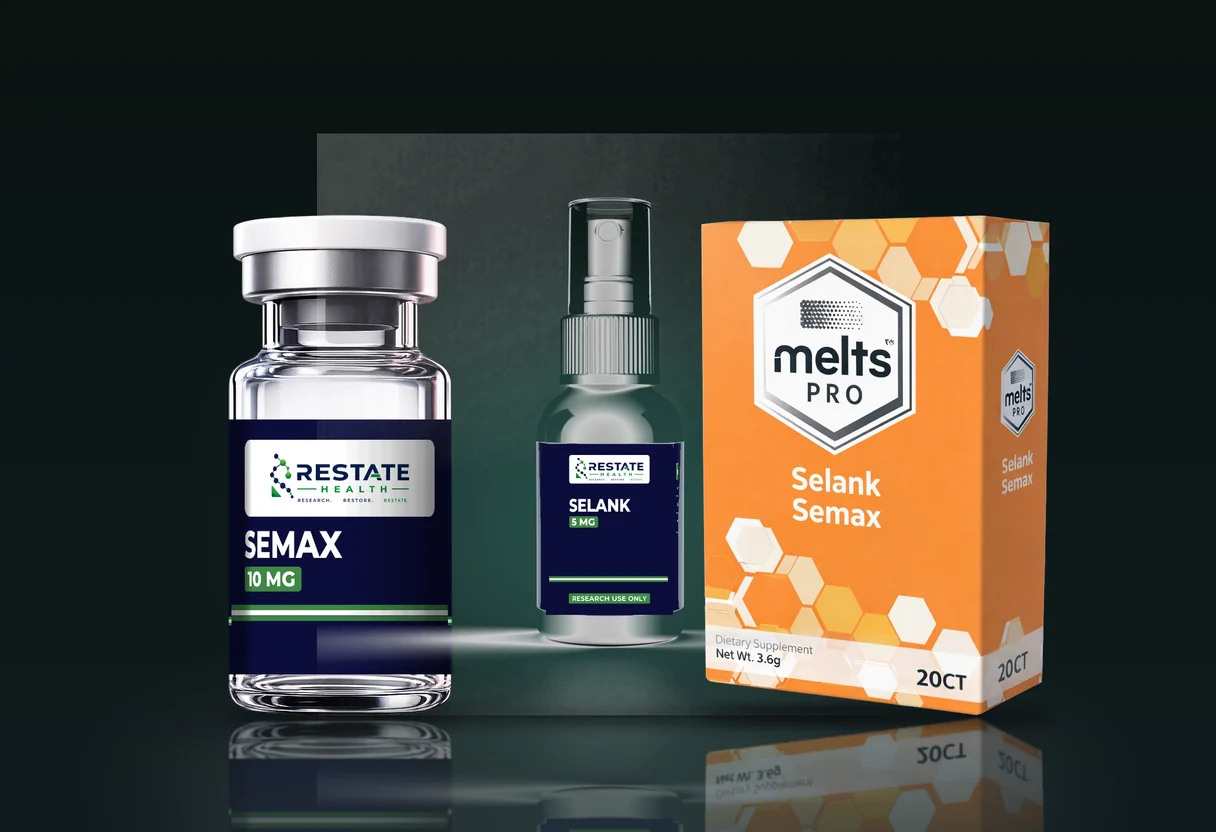
Semax and Selank are two heptapeptides from the same Russian research tradition, and between them they account for seven entries in this catalogue: two single vials, a blended vial, three liquid sprays and a dissolving-film strip. The chemistry across the seven is two molecules and one modified variant. The presentations are what multiply.
This guide lays the seven out in one table, works through what the N-acetyl and amide modifications on the spray variant of Semax do to the expected mass, and sets out what a certificate has to state for each form. It does not cover what either peptide does in any model; nootropic peptides: Semax and Selank explained covers the compounds and the published work.
Two heptapeptides, written out
Semax is Met-Glu-His-Phe-Pro-Gly-Pro, formula C37H51N9O10S, molecular weight 813.93 g/mol, CAS 80714-61-0. Selank is Thr-Lys-Pro-Arg-Pro-Gly-Pro, formula C33H57N11O9, molecular weight 751.89 g/mol, CAS 129954-34-3. PubChem records CID 9811102 and CID 11765600 carry the same formulas, with monoisotopic masses of 813.35 and 751.43.
Two features of the sequences matter for formats. Both end in Pro-Gly-Pro, which is part of why the two are so often stocked together. Only Semax carries a methionine, and methionine is the residue most readily oxidised in solution, so a Semax solution has a degradation route a Selank solution lacks, and a certificate for any Semax liquid should carry a related-substances figure rather than purity alone.
The seven entries in one table
| Catalogue entry | Form | Amount stated | Price from | What the certificate should state |
|---|---|---|---|---|
| Semax | Lyophilised vial | 10 mg or 30 mg | $56.00 | Identity against 813.93, HPLC purity, net peptide content |
| Selank | Lyophilised vial | 10 mg | $56.00 | Identity against 751.89, HPLC purity, net peptide content |
| Semax / Selank | Lyophilised vial, blend | 5 mg / 5 mg | $112.00 | Two identities, two content figures, one purity trace with both peaks assigned |
| NA-Semax Amidate Liquid Spray | Lyophilised powder for spray-format reconstitution | 10 mg | $78.40 | Identity against the modified mass (about 855), not 813.93; HPLC purity; content |
| Selank Liquid Spray | Lyophilised powder for spray-format reconstitution | 5 mg | $78.40 | Identity against 751.89, HPLC purity, content |
| Selank + Semax Liquid Spray | Atomised solution, 10 mL metered bottle | 10 mg combined | $90.00 | Assay in mg/mL for each peptide, the split between them, preservative if present |
| Melts Pro Selank + Semax Dissolving Strips | Dissolving film | 20 strips | $109.20 | Content per strip for each peptide and a uniformity result across strips |
Catalogue entries as they stood on 21 October 2026. Forms, amounts and prices are from the records; the last column is what a buyer should expect the certificate for that form to state.
N-acetyl Semax amidate: what the acetyl and the amide change
The spray variant of Semax is sold as N-acetyl Semax amidate. The name describes two end modifications to the same seven residues: an acetyl group on the N-terminal amine and an amide in place of the free acid at the C-terminus. Each changes the formula by a fixed amount, so the expected mass is arithmetic.
- Acetylation adds C2H2O at the N-terminus: +42.04 on an average basis, +42.01 monoisotopic.
- Amidation replaces the C-terminal OH with NH2: -0.98 on either basis.
- Starting from 813.93 for Semax, the acetylated amide comes to about 854.99 g/mol, with the formula C39H54N10O10S.
PubChem carries a record under the name N-acetyl semax amidate, CID 172638603, with exactly that formula and a molecular weight of 855.0, so the arithmetic and the database agree. The catalogue record for the spray, however, lists the parent Semax figures: CAS 80714-61-0, C37H51N9O10S and 813.93 g/mol. A buyer should therefore ask which molecule the lot certificate reports. A mass reconciling with about 855 is the modified peptide the name promises. A mass of 813.9 means the unit holds unmodified Semax and the label is wrong, or the certificate is for the wrong material. Either way the two documents have to agree before the lot is accepted.
The modifications are not cosmetic. Magri and colleagues (2016) showed in solution that acetylating the N-terminus of Semax changes how the peptide coordinates copper(II), because the free terminal amine is one of the donor groups in the unmodified complex. Blocking both termini is also a standard route to resistance against exopeptidases, which need a free end to work from; Werle and Bernkop-Schnurch's 2006 review sets out N- and C-terminal modification as one of the general strategies. So the variant is a different molecule with a different mass and different chemistry, and it should be documented as one.
Vials: what the certificate should state
For a single heptapeptide the certificate is short and should be exact. Identity by mass spectrometry, with the observed mass against 813.93 or 751.89 on an average basis (813.35 or 751.43 monoisotopic) and the basis stated. Purity by HPLC with the method named, since short peptides elute early and a poor method can hide an impurity under the solvent front. Net peptide content in milligrams, which is the number the reconstitution calculation uses rather than the label.
The blended vial adds a requirement rather than a complication: two identities and two content figures on one document, and a purity trace in which both peaks are assigned. Buying the Semax / Selank blend works through that certificate line by line, including the molecular-weight check from the two sequences.
Liquid sprays: three entries, two different things
The three spray entries are not the same kind of product. The NA-Semax Amidate and Selank sprays are recorded as lyophilised powder supplied for spray-format reconstitution: the peptide arrives dry, with the bottle, and the solution is made at the bench. Their certificates are vial certificates, their storage is vial storage at -20 °C, and the solution clock starts when the buyer adds water.
The Selank + Semax Liquid Spray is different. The record states an atomised solution, 10 mL in a metered bottle, 10 mg combined of the two peptides, third-party tested by lot. That is a solution made at the factory, so its clock started there, and three questions follow that the record does not answer: how the 10 mg divides between Selank and Semax, what the assay of each is in mg/mL, and whether the solution carries a preservative. The certificate should answer all three. Nasal sprays and liquid formats explained covers why concentration replaces mass on a liquid certificate and what the preservative is doing. Illum's 2003 review of the nasal route counts peptides among the challenging molecules for it, which is a reminder that a finished solution is formulation work and not merely peptide in water.
For the Semax-containing solution specifically, the methionine matters. Manning and colleagues (2010) list methionine oxidation among the principal chemical degradation routes in aqueous formulations, so a certificate for a Semax solution should report related substances, and a buyer should expect that figure to change over the product's life in a way a lyophilised cake's does not.
Dissolving strips: what uniformity replaces
The Melts Pro entry is Selank and Semax in a dissolving film, 20 strips, no reconstitution. The record states the count and the two compounds but not the amount of either per strip, and that amount is the first thing to ask for. In a film the peptide is distributed through a polymer matrix and cut into units, so the specification that matters is content per unit and how little it varies between units.
Hoffmann, Breitenbach and Breitkreutz's 2011 review of orodispersible films discusses the characterisation and quality-control methods for a format that at the time had no pharmacopoeial monograph, and Borges and colleagues' 2015 review covers the galenical development and quality attributes of oral films from the polymer matrix outward. For a pre-measured unit, uniformity of content across units is the attribute that carries the specification. A strip certificate should therefore state a content figure per strip for each peptide and a uniformity result across a sample of strips, and a document that reports only the identity and purity of the peptide before it went into the film has not tested the product as sold. Dissolvable strips explained covers what the film is and what the certificate should carry.
Choosing a presentation
- Work that needs a chosen or varying concentration favours the single vials, which also carry the lowest price per milligram of peptide: $56.00 for 10 mg of either compound.
- Work that needs both peptides at a fixed 1:1 ratio can take the blended vial (5 mg / 5 mg) and still choose the concentration.
- The two reconstitution sprays are vials with a bottle. They cost more than the vial for the same or less peptide ($78.40 for 10 mg of the Semax variant, $78.40 for 5 mg of Selank), and the premium buys the device and, for Semax, the modified molecule.
- The factory solution and the strips are the ready formats. Each fixes the amount per unit and moves the testing burden to the supplier, and each is worth buying only with a certificate that tests the product as sold.
Questions to ask before ordering
- For the NA-Semax Amidate spray: which mass does the lot certificate report, about 855 or 813.9?
- For the combined solution: how much of the 10 mg is Selank and how much is Semax, and what is each in mg/mL?
- For the strips: how much of each peptide per strip, and what was the uniformity result?
- For every Semax liquid: what is the related-substances figure, and at what age of the product was it measured?
- For all seven: does the certificate name the lot printed on the unit you will receive?
In short
Two molecules, one modified variant, seven entries. The vials are documented by mass, purity and net content. The reconstitution sprays are vials in disguise. The factory solution and the strips are finished products and need certificates that test them as finished products: mg/mL and the split for the solution, content per strip and uniformity for the film. And the Semax spray variant should reconcile with about 855 g/mol, not 813.93, if it is what its name says.