
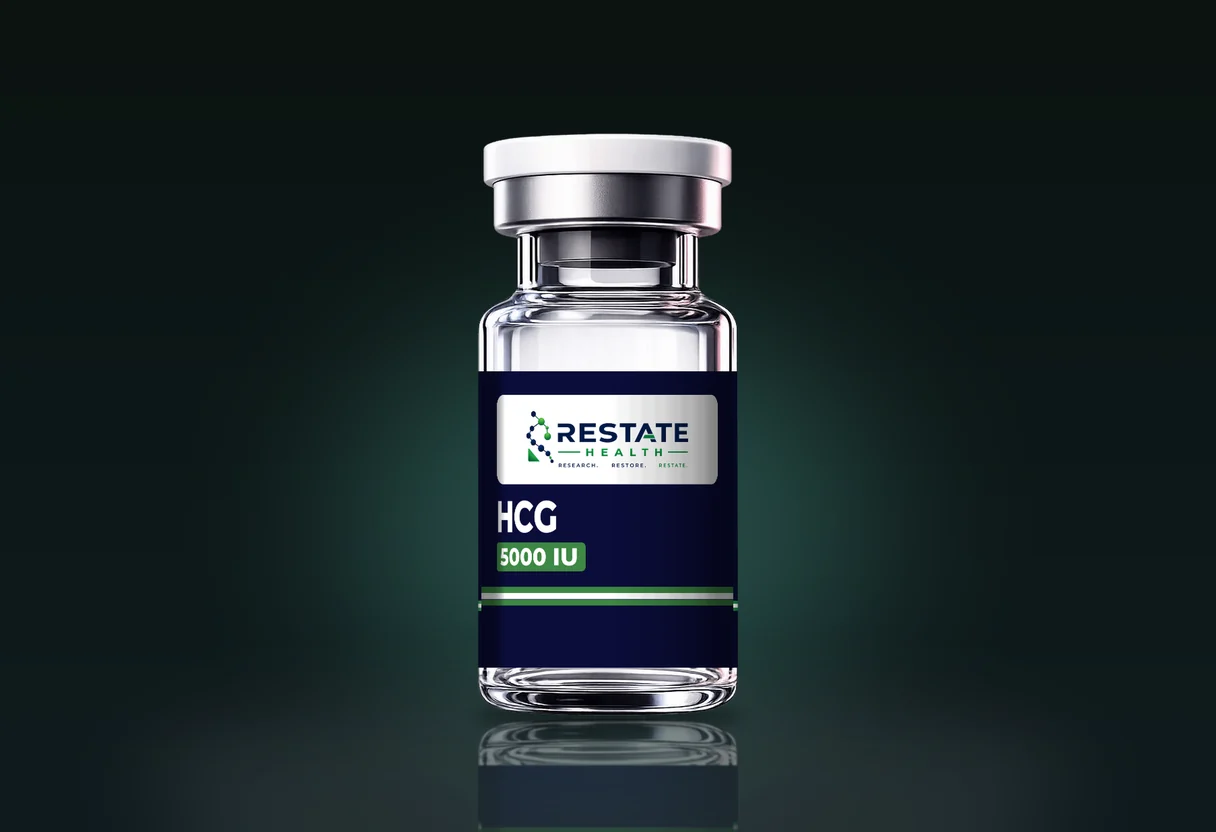
Almost everything in this catalogue is labelled in milligrams. HCG is labelled in international units, at 5000 IU and 10000 IU, and a buyer used to reading a mass on a label will reasonably ask what an IU is, how many milligrams it corresponds to, and why the supplier does not simply say. The short answer is that HCG is not a synthetic peptide, the unit is defined by a reference preparation rather than by a weight, and the conversion between the two depends on which molecular forms are in the vial and which assay is used to measure them.
This guide explains that answer in order: what the molecule is, where the unit comes from, why a fixed mass per unit cannot be stated, and what a certificate for an IU-labelled product can show. It stays with the chemistry and the documentation. The catalogue record describes the material as studied in laboratory models of gonadal signalling and LH-receptor pathways, and that is as far as any statement about activity goes here.
| HCG | Catalog specification |
|---|---|
| Vial strengths | 5000 IU, 10000 IU |
| Sequence | Heterodimeric glycoprotein — two non-covalently associated chains, not a single peptide sequence. Glycosylation is heterogeneous, so no single molecular formula applies. |
| Molecular weight | ~36.7 kDa |
| Amino acid count | 237 in the mature heterodimer (α-chain 92, β-chain 145) |
| CAS number | 9002-61-3 |
From the Restate Health catalog record. Lot-specific values are on the certificate of analysis.
A glycoprotein, not a peptide
The catalogue record gives human chorionic gonadotropin as a heterodimeric glycoprotein of two non-covalently associated chains, 237 residues in the mature heterodimer (an α-chain of 92 and a β-chain of 145), with a molecular weight of about 36.7 kDa and no single molecular formula, because the carbohydrate attached to the protein is heterogeneous. CAS 9002-61-3. That record alone separates it from every single-chain synthetic peptide alongside it, and peptide versus protein sets out why the distinction matters for documentation.
The 1994 crystal structure (Lapthorn and colleagues, Nature) showed that each of the two subunits folds to the same topology, with three disulphide bonds forming a cystine knot, a motif shared with some protein growth factors, and that the heterodimer is held together by a segment of the β-subunit that wraps around the α-subunit and is pinned by the disulphide between Cys 26 and Cys 110, which the authors likened to a seat belt. None of that is reproduced by a solid-phase synthesis of a sequence; the material is isolated or expressed, folded and glycosylated, and its mass depends on how much carbohydrate it carries.
The 2006 review by Stenman and colleagues describes the isoforms that result: intact hCG, hCG with a cut in the β-chain backbone ("nicked"), free α and β subunits, a β-core fragment, and forms differing in glycosylation. Those are the forms a quantification has to cope with, and they are why the unit was defined the way it was.
Where the international unit comes from
An international unit for a biological is defined by a reference preparation whose activity is fixed by agreement, with ampoules of the preparation distributed so that laboratories can calibrate their own assays against it. For hCG the World Health Organization has established a succession of International Standards and Reference Preparations, with value assignment work carried out through collaborative studies and the standards held and distributed by the National Institute for Biological Standards and Control in the United Kingdom. The WHO Expert Committee on Biological Standardization is the body that formally establishes such reference materials, through studies involving many laboratories.
The 1980 paper by Storring, Gaines-Das and Bangham reports potency estimates for the International Reference Preparation of hCG for immunoassay across several bioassay and protein-binding assay systems, together with reference preparations for the α and β subunits. The point of that exercise, and of every one since, is that the unit is a measure of what the preparation does in an assay, not of what it weighs.
Why no fixed mass equals one IU
Three facts combine. The mass of a given number of molecules depends on their glycosylation, which varies between preparations. A bioassay responds to the fraction of the material that is intact and active, and an immunoassay responds to whichever forms its antibodies recognise, so two preparations of equal protein mass can read differently in units. And the reference preparation itself has contained more than one form: Birken and colleagues (2003) note that the 3rd International Standard, coded 75/537, contained nicked hCG and free subunits, whereas the reference reagent they prepared for intact hCG, coded 99/688, contained no nicked form and negligible free subunit.
That is why the 2003 and 2005 work took a different route for the isoform reagents. Birken and colleagues purified six hCG-related molecules and assigned concentrations by amino acid analysis, in substance concentration (mol/L) rather than in units; Bristow and colleagues (2005) report the WHO establishment of those six as First International Reference Reagents, value-assigned in substance concentration. For a buyer, the lesson is that there are two legitimate ways to state how much hCG is in a vial, by activity in IU against a standard or by amount of substance from amino acid analysis, and neither converts to the other by a constant factor without knowing which forms are present.
Sturgeon and colleagues (2009) made the practical consequence measurable: diagnostic immunoassays for hCG recognised the 1st WHO International Reference Reagents for the hCG-related isoforms to different degrees. A unit figure therefore carries its assay with it. A certificate that reports IU without naming the standard and the assay has reported half a number.
What a label in IU tells you, and what it does not
A label reading 5000 IU is a statement about assayed activity of the lot, relative to a stated standard, at the time of testing. It does not state the mass of protein in the vial, the proportion of intact heterodimer, or the carbohydrate content. Where a supplier also prints a mass, it is a preparation-specific conversion that applies to that lot, not a property of hCG. The two figures should both be present on the certificate if either is to be checked, and the content figure in particular needs the same care that net peptide content describes for synthetic peptides: the mass of solid in a lyophilised vial includes excipients and water, and for a protein the excipient share is often larger than for a short peptide.
The two strengths in the catalogue, 5000 IU and 10000 IU, are therefore the same material at two assayed quantities, and the comparison between them is on the certificate's content line, not on the label.
What the certificate for an IU-labelled product can show
| Question | What the certificate can show | What it cannot show |
|---|---|---|
| How much is in the vial? | Assayed activity in IU, with the standard it was measured against and the assay type (bioassay or immunoassay) named | A universal mass per IU; any mass printed is specific to this preparation |
| Is it hCG? | Identity by a method appropriate to a 36.7 kDa glycoprotein: immunoassay, electrophoresis, or intact mass with a glycoform envelope | A single sharp mass of the kind a synthetic peptide gives; glycosylation spreads the signal |
| How pure is it? | Purity by HPLC, size-exclusion or electrophoresis, with the method stated; proportion of intact dimer versus free subunits where measured | A purity figure comparable to a 99% peptide line; the forms being separated are different |
| Which forms are present? | Nicked hCG, free α, free β and β-core fragment, if the laboratory has an assay that distinguishes them | Anything about form from an IU figure alone |
| Is it this lot? | The lot number, matching the vial | Anything, if the lot number is absent or does not match |
| Other panels | Endotoxin, residual moisture, appearance of the cake, where tested | Results the document does not carry |
What a buyer may want to know about an IU-labelled HCG lot, against what a certificate can actually report. The right-hand column is this guide's reading of standard documentation practice.
The identity line deserves a second look. For a synthetic peptide, molecular weight is a precise expected number that an observed mass should reconcile with. For hCG the catalogue gives an approximate figure, about 36.7 kDa, because the heterogeneous carbohydrate produces a distribution of masses rather than one. An identity method that reports a single mass to two decimal places for this material should prompt a question about what was actually measured.
Where HCG sits among the reproductive peptides
The catalogue groups HCG with gonadorelin, kisspeptin-10 and oxytocin, all of which are short synthetic peptides with exact formulas and masses. Gonadotropic and reproductive peptides explained sets the four side by side and makes the point that HCG is the one member of the group whose characterisation problem is a protein's rather than a peptide's. This guide is the longer account of why its label reads the way it does.
Handling, from the record
The catalogue record gives the physical form as lyophilised powder. The general rules for a lyophilised protein follow from its being a folded, glycosylated heterodimer rather than a short chain: the dimer can dissociate, the β-chain can be nicked, and the cake should be dissolved gently rather than shaken. Reconstituted protein solutions are commonly held cold and used within a defined period, and the specific conditions belong on the certificate or the supplier's handling note rather than in a general guide.
What to ask before ordering
- Which standard the IU figure was assigned against, and by which type of assay.
- Whether the certificate also reports a protein content by mass, and by what method.
- Which identity method was used, and whether the result is a glycoform distribution or a single value.
- Whether the proportion of intact heterodimer is reported, or only total immunoreactivity.
- The lot number on the certificate, to be matched against the vial on arrival.
Five questions, one email, and the answers settle whether the IU on the label is a number that can be checked. All material is supplied for laboratory research use only.