
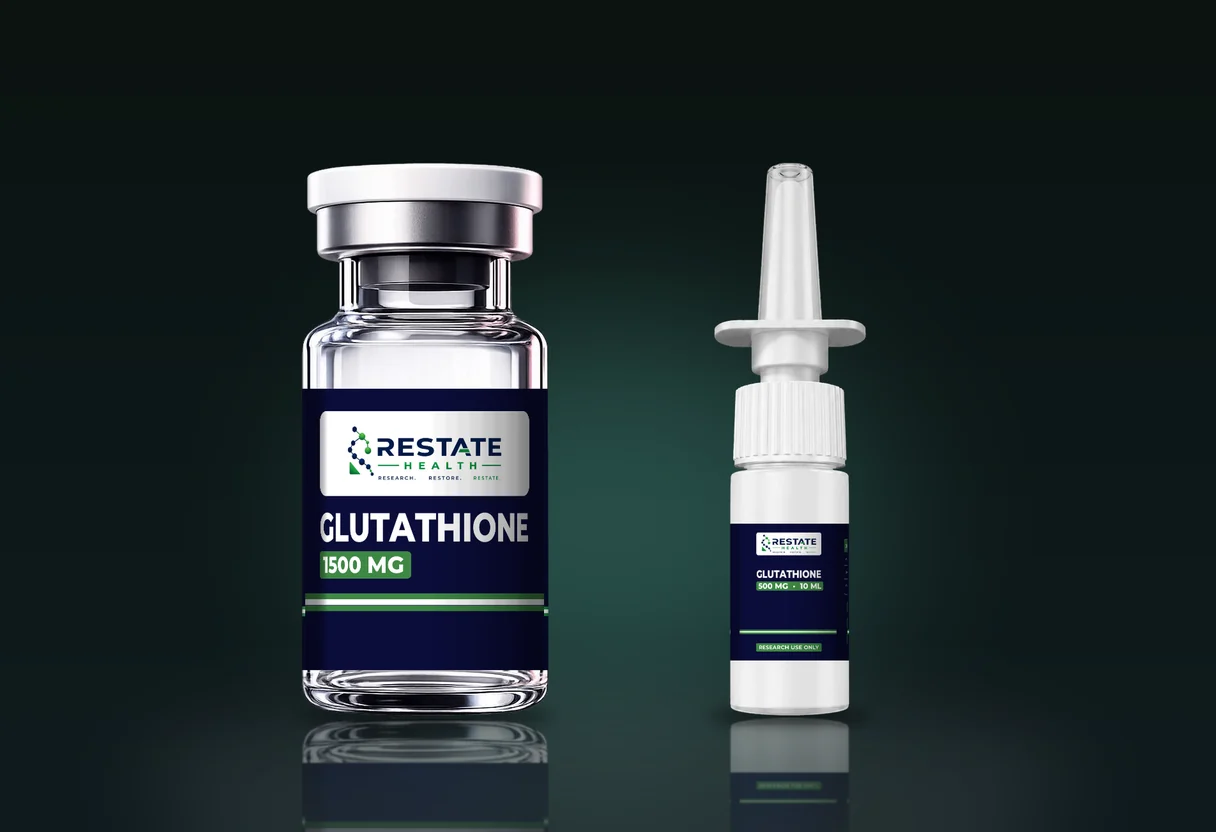
The catalogue lists glutathione three times: Glutathione as a 1500 mg lyophilised vial from $168, L-Glutathione as a 600 mg lyophilised vial from $140, and Glutathione Liquid Spray as 500 mg in a 10 mL metered solution from $65.12. All three records carry the same identifiers: CAS 70-18-8, formula C10H17N3O6S, molecular weight 307.32 g/mol, three amino acids.
It is one molecule in three presentations, and the chemistry that matters to a buyer is the same in all three. Glutathione is a tripeptide joined by an unusual bond, and it carries a free thiol that oxidises to a disulfide dimer. The first fact is why it sits apart from the rest of a peptide catalogue; the second is what a certificate, a solution format and a storage decision all have to deal with.
| Compound | Vial strengths | Molecular weight | Amino acids |
|---|---|---|---|
| Glutathione | 1500 mg | 307.32 g/mol | 3 |
| L-Glutathione | 600 mg | 307.32 g/mol | 3 |
| Glutathione Liquid Spray | 500 mg · 10 mL | 307.32 g/mol | 3 |
From the Restate Health catalog records. Lot-specific values are on each certificate of analysis.
A tripeptide with a gamma bond
Glutathione is gamma-L-glutamyl-L-cysteinyl-glycine, which the catalogue sequence line writes out with the note that the Glu-Cys link is an atypical gamma-peptide bond. PubChem CID 124886 gives the same formula and a molecular weight of 307.33, a rounding difference from the record's 307.32.
In an ordinary peptide, each residue's alpha-carboxyl group is joined to the alpha-amino group of the next. Glutamate has a second carboxyl group on its side chain, the gamma-carboxyl, and in glutathione it is this side-chain carboxyl that forms the amide bond to cysteine. The glutamate's alpha-carboxyl is left free. That one change has two consequences that Meister and Anderson set out in their 1983 review.
- It is not made on a ribosome. Ribosomes form alpha bonds only. Glutathione is assembled by two ATP-dependent enzymes, glutamate-cysteine ligase and glutathione synthetase, which Lu's 2013 review covers in detail.
- It is not a substrate for ordinary peptidases, which recognise alpha bonds. The gamma bond is cleaved by gamma-glutamyl transpeptidase, an enzyme on the outer surface of cells that Hanigan's 2014 review describes as the only one in that position able to do so.
For a buyer the point is classification. Glutathione is a peptide by composition, three amino acids joined by amide bonds, and it is a metabolite rather than a synthesised sequence in the sense that the rest of the catalogue uses the word. Not everything in a peptide catalogue is a peptide covers where the line falls; glutathione sits on the peptide side of it, with an asterisk.
Reduced glutathione oxidises to a disulfide dimer
The cysteine in the middle of the molecule carries a free thiol, and the catalogue sequence line calls it the redox-active moiety. Two glutathione molecules can be oxidised at that thiol to form one disulfide-linked dimer, glutathione disulfide. The reduced form is abbreviated GSH and the dimer GSSG. PubChem CID 65359 records GSSG as C20H32N6O12S2 at 612.6 g/mol, which is two glutathiones less two hydrogens.
The conversion runs on dissolved oxygen, is catalysed by traces of copper and iron, and accelerates as pH rises, because the thiolate anion is the form that reacts. Pompella and colleagues' 2003 review describes the GSH to GSSG pair as the cell's principal redox buffer; the same reaction that makes the molecule interesting in a cell is the one that degrades it in a bottle.
The analytical literature is blunt about how fast this happens during handling. Giustarini and colleagues' 2013 protocol blocks the thiol with N-ethylmaleimide at the moment of sampling precisely because GSH oxidises during the minutes between collection and measurement and GSSG is otherwise overstated. Rahman, Kode and Biswas' 2006 recycling assay quantifies GSH and GSSG separately for the same reason. What those two protocols establish for a buyer is that "glutathione content" is not one number.
What that means for the certificate
A certificate for glutathione should report reduced glutathione, and it should say so. Three lines carry that.
- Assay of GSH, by HPLC against a reference standard, as milligrams of reduced glutathione per vial or per millilitre. The label figure is a nominal mass; the certificate figure is what was measured.
- GSSG as a named impurity, with its own figure. Reversed-phase HPLC separates the monomer from the dimer, so a purity method that does not report GSSG has either not resolved it or has folded it into the main figure. Both are worth asking about.
- A method statement that covers sample handling, since the protocols above show that the measurement itself can oxidise the sample.
Identity is simpler than for a long peptide. At 307.32 g/mol the molecule is small enough that retention time against a reference standard and a single observed mass settle it, and there is no sequence to read by fragmentation in the way a longer chain would need.
The three formats compared
Two of the three listings are the same thing at different amounts. The spray is a solution, which is a different object with a different clock.
| Listing | Form | Amount | Concentration | What the certificate should state |
|---|---|---|---|---|
| Glutathione | Lyophilised powder | 1500 mg | Set at reconstitution | GSH assay in mg per vial; GSSG as a named impurity; water content |
| L-Glutathione | Lyophilised powder | 600 mg | Set at reconstitution | The same lines; the record is identical apart from amount and name |
| Glutathione Liquid Spray | Aqueous solution, metered pump | 500 mg in 10 mL (0.1 mL per actuation, about 100 actuations) | 50 mg/mL as supplied | GSH assay in mg/mL at release; GSSG at release; pH; the carrier; a statement of how long the figures hold once opened |
The three catalogue listings on 21 October 2026, from the product records. Concentration for the spray is 500 mg in 10 mL; the actuation figures are from the record's description.
On the name: all naturally occurring glutathione is built from L-amino acids, so the L- prefix on the 600 mg listing adds nothing the 1500 mg record does not already state. The two records are the same molecule with the same identifiers. The choice between them is amount, and amount should follow consumption, because a 1500 mg vial once reconstituted is a large volume of solution that starts oxidising on the day it is made.
On the spray record: its specification block is the molecule's, shared with the two vials, including the physical form line that reads lyophilised powder. That line describes the input material. The format details, the 10 mL volume, the pump and the solution, are in the record's description, and a buyer reading the specification alone would miss that this listing is already in solution.
What the solution format changes
A lyophilised cake has almost no water in it, and the oxidation above needs dissolved oxygen in water. The dry vial is therefore the slow format: the record's instruction to protect from moisture is the whole story, and the clock starts at reconstitution. Nasal sprays and liquid formats covers what changes in general when material is supplied already dissolved; for glutathione the specific change is that the GSH to GSSG conversion is running from the day of manufacture.
That makes the release certificate for a solution a snapshot. The GSH figure on it was true on the test date, and what a buyer needs alongside it is the carrier's composition and pH, whether a chelator or antioxidant is present, and any stability data the supplier holds for the opened and unopened bottle. The 50 mg/mL concentration is fixed by the fill; the share of it that is still reduced is not.
Storage, and what the two records say
The vial records say: store lyophilised at -20°C, protect from light and moisture, reconstitute with bacteriostatic water, and keep reconstituted material refrigerated. For glutathione the reasons are specific. Moisture lets the oxidation start in the cake. Cold slows it in solution. Keeping the solution's pH from drifting upward keeps the thiol in its less reactive protonated form. And every entry into a reconstituted vial brings fresh oxygen with it, so a 1500 mg vial drawn from many times is the worst case and aliquoting is the defence.
How peptides degrade covers oxidation alongside the other routes. Glutathione is unusual in that the oxidation route is nearly the only one that matters: there is no methionine or tryptophan to oxidise elsewhere, the gamma bond resists hydrolysis by the enzymes that would attack an ordinary peptide, and a molecule of three residues does not aggregate the way a long chain does.
Price per gram, for what it is worth
At the record prices the 1500 mg vial is $168, or about $0.11 per nominal milligram; the 600 mg vial is $140, about $0.23; and the spray is $65.12 for 500 mg, about $0.13. Those are nominal figures. The number worth dividing by is the certificate's GSH assay, and for the spray it is the GSH assay on the date the bottle is used rather than the date it was released.
What this guide does not cover
Effects. The glutathione literature is large and is where any question about what the molecule does belongs; the reviews cited here are about its chemistry and its synthesis. All three listings are supplied for laboratory research only. What documentation can settle is narrower: that the vial or bottle holds the molecule the records describe, how much of it is still in the reduced form, and how fast that figure is changing.