
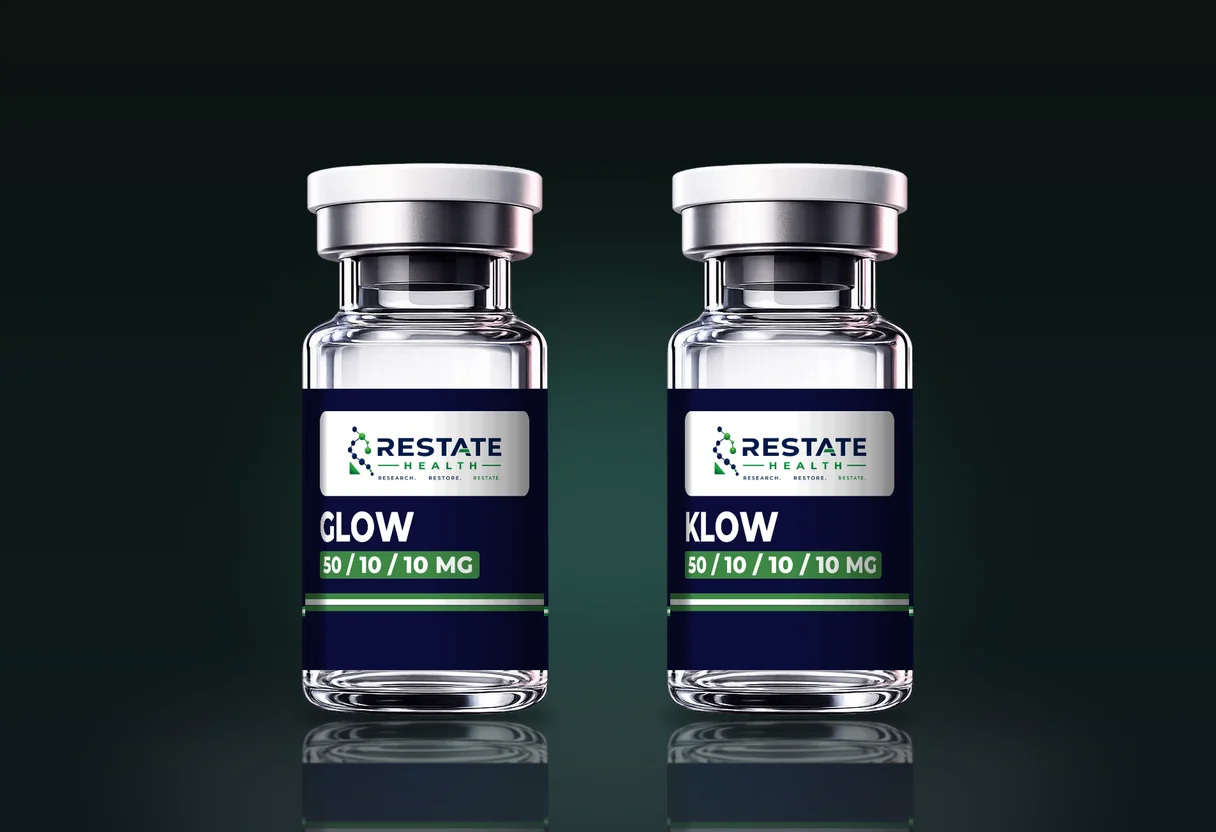
GLOW is recorded in the catalogue as a blend of GHK-Cu, BPC-157 and TB-500 at 50 / 10 / 10 mg, listed from $137.20. KLOW is recorded as GHK-Cu, BPC-157, TB-500 and KPV at 50 / 10 / 10 / 10 mg, listed from $224. The two share three components; KLOW adds a fourth, the tripeptide KPV, at 10 mg.
Both are built around a copper complex, and that is what makes them different from other blends in the catalogue. The copper changes the colour of the powder, changes what a heavy-metals test will find, and adds a line to the certificate that no other blend needs. This guide covers composition from the records, the copper, what a three- or four-component certificate has to show, and the price per component against the singles.
| Compound | Vial strengths | Molecular weight | Amino acids |
|---|---|---|---|
| GLOW | 50 / 10 / 10 mg | — | — |
| KLOW | 50 / 10 / 10 / 10 mg | — | — |
From the Restate Health catalog records. Lot-specific values are on each certificate of analysis.
Composition, as the records state it
The blend records themselves carry only the blend name, the strengths, the price and a synonyms line naming the components. The compound identifiers come from the single-vial records, which is where a buyer should read them.
- GHK-Cu: Gly-His-Lys as a copper(II) complex, formula C14H22CuN6O4, molecular weight recorded as ~403.93 g/mol for the complex, CAS 89030-95-5. The PubChem record under that CAS number (CID 71587328, prezatide copper) lists the complex ion at 402.92; the free tripeptide without copper is CID 73587 at 340.38.
- BPC-157: 15 residues, C62H98N16O22, 1419.55 g/mol, CAS 137525-51-0.
- TB-500: 7 residues, Ac-Leu-Lys-Lys-Thr-Glu-Thr-Gln-OH, C38H68N10O14, 889.02 g/mol, CAS 885340-08-9.
- KPV: Lys-Pro-Val, C16H30N4O4, 342.43 g/mol, CAS 67727-97-3, recorded with the synonym α-MSH(11-13). PubChem CID 125672 carries the same formula.
One reading note on KLOW. The record's description lists the components as GHK-Cu, BPC-157, TB-500 and KPV, and the strengths as 50 / 10 / 10 / 10 mg; its synonyms line lists them in a different order, KPV first. The 50 mg figure belongs to GHK-Cu, which matches GLOW and matches the 50 mg GHK-Cu single. The certificate is where the four figures are tied to the four names, and it should do that explicitly.
The copper is the component that behaves differently
GHK-Cu is not a peptide with copper in the vial alongside it. It is a copper(II) complex in which the tripeptide binds the metal ion, a structure Hureau and colleagues solved by X-ray crystallography and in solution in 2011. Pickart's 1980 paper in Nature, which first proposed that the plasma tripeptide works by delivering copper to cells, is where the pairing comes from. GHK-Cu, the copper tripeptide covers the complex in detail.
Copper(II) complexes of peptides are coloured, blue to violet, because of electronic transitions within the copper ion that the uncomplexed peptide does not have. The free tripeptide is a colourless solid. In GLOW, 50 mg of the 70 mg of nominal peptide is GHK-Cu, and in KLOW 50 of 80 mg, so the lyophilised cake and the reconstituted solution should both carry the complex's colour. A white cake in either vial is a question to ask before anything else is done with it.
Copper content, and why ICH Q3D is the wrong limit for it
Copper is about 15.7% of the mass of the complex, from the atomic mass of copper (63.55) against the recorded 403.93 g/mol. A 50 mg portion of GHK-Cu therefore carries roughly 7.9 mg of copper. That is a plain stoichiometric figure, and a certificate assay of GHK-Cu content implies it.
ICH Q3D(R2), the guideline on elemental impurities, classes copper as a Class 3 element and sets its permitted daily exposures in micrograms. Those limits exist for copper that arrives as a contaminant. In GLOW and KLOW the copper is part of the molecule, three to four orders of magnitude above anything Q3D would call an impurity, and applying the impurity limit to it would fail every vial by design. The guideline's limits still apply to everything else: lead, cadmium, mercury and arsenic as Class 1 elements, and any copper present that is not complexed to the peptide.
That has a practical consequence for the heavy-metals test. An ICP-MS screen of a GLOW or KLOW vial will read very high copper, and a laboratory that has not been told to expect it will flag the result. Heavy metals and residual solvents covers the test itself; for these two blends the test request has to say that copper is stoichiometric and the reportable elements are the others.
What a three- or four-component certificate has to show
Everything a two-component certificate needs, with one more line for the copper. Blends and single vials sets out the general cost of a blend in documentation; these are the specifics.
- Identity, three or four times. Observed masses reconciling with 1419.55 (BPC-157), 889.02 (TB-500) and, for KLOW, 342.43 g/mol (KPV), with the mass basis stated. For GHK-Cu the certificate should say whether the observed mass is the intact complex near 403 or the free tripeptide near 340, because the complex can lose its copper in a spectrometer source and either observation can be correct.
- Content, three or four figures in milligrams, each by HPLC against a standard for that component. One total is not a result.
- Purity, per component from the bulk lots, or a blend chromatogram with every main peak named and reported separately. Three or four main peaks and a single ≥99% is the least informative certificate a buyer can be handed.
- Copper, as an assay of the complex or as total copper by ICP, reconciled with the GHK-Cu content figure. A copper figure far below about 15.7% of the stated GHK-Cu mass means the vial holds free tripeptide rather than the complex.
- Elemental impurities other than copper, with copper named as expected so the laboratory does not report it as a failure.
The two tripeptides raise a method point. GHK-Cu and KPV are both three residues and both small, 403.93 and 342.43 g/mol, and a certificate that reports them should show two resolved peaks rather than one. For KLOW especially, a chromatogram that does not separate the two small components has not measured either.
Price per component against the singles
The catalogue records list the four singles from the following prices: GHK-Cu from $47.60 at 50 mg, BPC-157 from $56 at 5 mg, TB-500 from $98 at 5 mg and KPV at $64.40 for 10 mg. The two blends list from $137.20 and $224. The BPC-157 and TB-500 from prices belong to 5 mg vials, half the amount in either blend, so the singles column below is not like-for-like and says so.
| Item | Composition (nominal) | Price from | Note |
|---|---|---|---|
| GLOW | GHK-Cu 50 mg, BPC-157 10 mg, TB-500 10 mg (70 mg) | $137.20 | $1.96 per nominal mg |
| KLOW | GHK-Cu 50 mg, BPC-157 10 mg, TB-500 10 mg, KPV 10 mg (80 mg) | $224.00 | $2.80 per nominal mg |
| KLOW minus GLOW | 10 mg KPV | $86.80 | The KPV single is $64.40 for 10 mg |
| Singles for GLOW at the from prices | GHK-Cu 50 mg + BPC-157 5 mg + TB-500 5 mg (60 mg) | $201.60 | Half the BPC-157 and TB-500 of the blend |
| Wolverine blend | BPC-157 10 mg + TB-500 10 mg (20 mg) | $193.20 | GLOW contains this pair plus 50 mg GHK-Cu |
Catalogue record prices on 21 October 2026. BPC-157 and TB-500 single prices are the "from" prices and belong to the 5 mg strength; the 10 mg single prices are on the product pages.
Three things fall out of the table. The increment from GLOW to KLOW, $86.80, costs more than the KPV single at $64.40, so a buyer who wants KPV alongside GLOW pays a premium for having it in the same vial. GLOW at the record price is less than the Wolverine blend of the same BPC-157 and TB-500 pair without the copper peptide. And the singles column, even at the smallest strengths, costs more than GLOW while delivering less BPC-157 and TB-500.
None of that changes the documentation question. The per-milligram figures are nominal mass, and a blend whose certificate gives one total content cannot be priced per component at all. Prices on the product pages supersede the record figures quoted here.
When the singles are the better buy
- When the copper is unwanted for part of the work. GHK-Cu in the vial means copper in every aliquot of the solution, which is a decision the blend makes for the buyer.
- When a different ratio is needed. The blends fix GHK-Cu at five times the mass of each other peptide. By moles the gap is larger still, because GHK-Cu is the smallest molecule of the three in GLOW.
- When lots must trace separately, when re-test dates must run separately, or when the components are consumed at different rates. Once reconstituted a blend is one solution with one clock.
- When KPV is wanted on its own terms. Its literature is its own: Hiltz and Lipton reported in 1989 that the C-terminal tripeptide of alpha-MSH retained the parent peptide's activity in the inflammation models they used, and Dalmasso and colleagues in 2008 described its uptake by the transporter PepT1 in cultured intestinal epithelial cells and in mouse models. That literature is about KPV, not about a four-component vial.
Storage as the records state it
The four single records carry the same storage line: lyophilised at -20°C, protected from light and moisture, with the reconstituted solution refrigerated at 2-8°C. The blends inherit it. One point is specific to the copper: the free thiol of a cysteine would be a concern alongside a redox-active metal, and none of the four components here carries a cysteine, so that particular interaction does not arise in these two vials.
What this guide does not cover
Effects. The GHK-Cu literature begins with Pickart's 1980 plasma tripeptide and includes Maquart and colleagues' 1988 report on collagen synthesis in cultured fibroblasts and the 2018 review by Pickart and Margolina of gene-expression data. The BPC-157, TB-500 and KPV literatures are separate again. None of them describes a blend, and nothing here speaks to outcomes in any organism. GLOW and KLOW are supplied for laboratory research only; what documentation can settle is which molecules are in the vial, how much of each, and whether the copper is where the record says it is.