
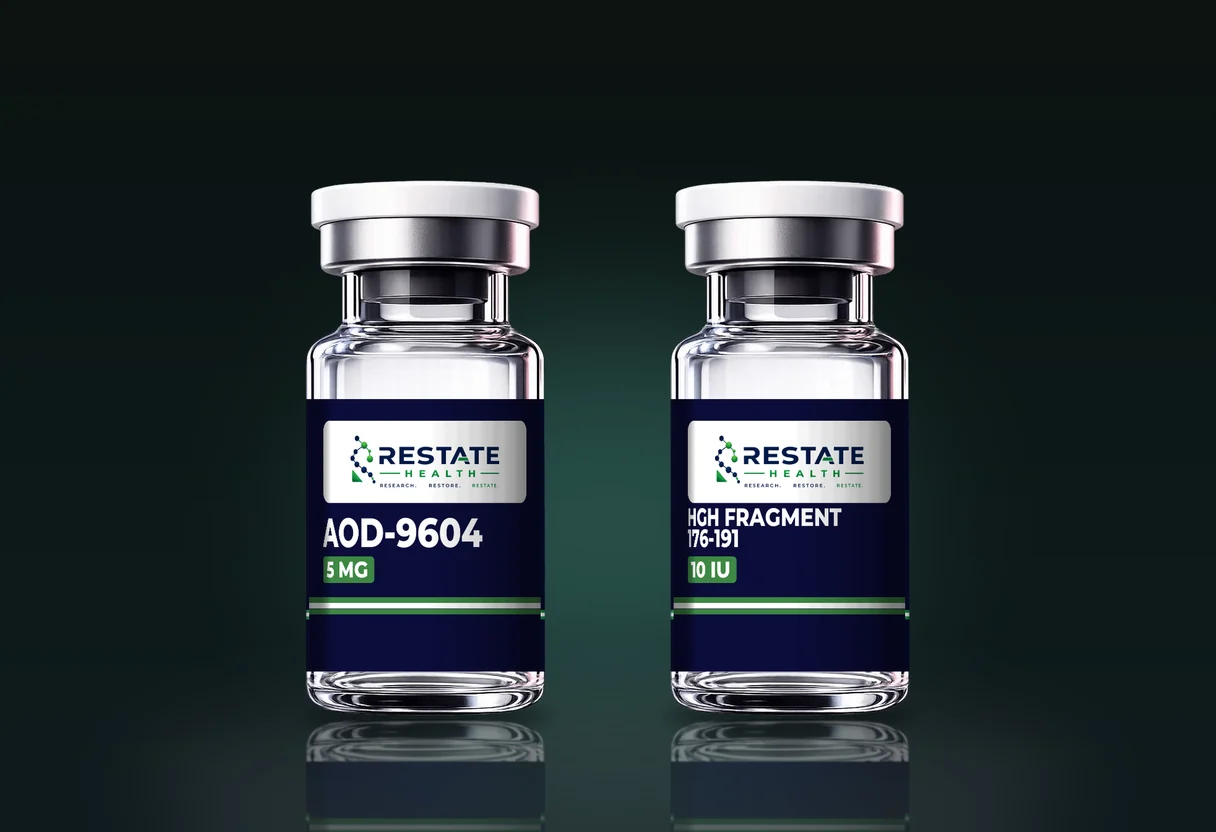
AOD-9604 and HGH Fragment 176-191 are both described as C-terminal fragments of human growth hormone, the 191-residue protein. Both run to sixteen residues, both are listed near the growth-hormone secretagogues without being secretagogues, and they are commonly spoken of as the same thing. They are not quite the same thing, and the catalogue records show exactly where they part.
This guide sets the two side by side: the residue that differs, the disulfide bridge, the two formulae and what their difference means, the published work and the animals it was done in, and the "10 IU" on the fragment label, which is a labelling convention borrowed from the whole hormone rather than a unit anyone has assigned to the fragment.
| Compound | Vial strengths | Molecular weight | Amino acids |
|---|---|---|---|
| AOD-9604 | 5 mg, 10 mg | 1815.08 g/mol | 16 |
| HGH Fragment 176-191 | 10 IU | 1817.12 g/mol | 16 |
From the Restate Health catalog records. Lot-specific values are on each certificate of analysis.
Where the fragments come from
Mature human growth hormone is a single chain of 191 residues, recorded in UniProt as P01241 after removal of a 26-residue signal peptide. Its last sixteen residues, positions 176 to 191, read Phe-Leu-Arg-Ile-Val-Gln-Cys-Arg-Ser-Val-Glu-Gly-Ser-Cys-Gly-Phe. Positions 177 to 191 are the same stretch without the leading phenylalanine. The two cysteines in it, Cys182 and Cys189 in hormone numbering, are joined by a disulfide in the intact protein, so the C-terminal region of growth hormone carries a small loop closed by that bond.
The idea that this region could be studied on its own as a synthetic peptide goes back to Frank Ng's group at Monash University. Wu and Ng, in 1993, synthesised hGH 177-191 and reported antilipogenic activity in rat adipose tissue, with no significant lipolytic effect measured as glycerol release from epididymal fat pads. Natera, Jiang and Ng, in 1994, gave the same 177-191 peptide to obese mice over an extended period and measured cumulative body weight gain and adipose tissue mass. Those are the first two papers on the fragment and both are rodent studies.
AOD-9604: 177-191 with a tyrosine added
The catalogue records AOD-9604 as Tyr-Leu-Arg-Ile-Val-Gln-Cys-Arg-Ser-Val-Glu-Gly-Ser-Cys-Gly-Phe, with a disulfide between Cys7 and Cys15, sixteen residues, formula C78H123N23O23S2 and molecular weight 1815.08 g/mol, CAS 221231-10-3, synonym "hGH fragment 176-191 analogue". Read against the hormone, that is residues 177 to 191 with a tyrosine added at the N-terminus where the native sequence has phenylalanine at position 176. Tyrosine and phenylalanine differ by one hydroxyl group, so the two sixteen-residue sequences differ by exactly one oxygen atom, 15.999 Da.
PubChem files the compound as CID 71300630 under the same CAS number, with the same formula, a molecular weight of 1815.1 g/mol and a monoisotopic mass of 1813.86. The catalogue figure and the database figure agree. The Cys7-Cys15 bridge in the fragment's own numbering is the Cys182-Cys189 bond of the hormone carried over into the fragment.
In the literature the compound appears under its code: Ng and colleagues, Hormone Research 2000, call it a synthetic lipolytic domain of hGH, and Heffernan and colleagues, Endocrinology 2001, a lipolytic fragment synthesised from the C-terminus. AOD stands for anti-obesity drug in the Monash papers' usage, which is a project label from the 1990s and not a description of anything a buyer should expect from a vial.
The two catalogue records side by side
| AOD-9604 | HGH Fragment 176-191 | |
|---|---|---|
| Residues | 16 | 16 |
| Sequence in the record | Tyr-Leu-Arg-Ile-Val-Gln-Cys-Arg-Ser-Val-Glu-Gly-Ser-Cys-Gly-Phe | Not recorded |
| N-terminal residue | Tyr (native position 176 is Phe) | Not stated; native 176 is Phe |
| Disulfide | Cys7-Cys15, stated | Not stated |
| Molecular formula | C78H123N23O23S2 | C78H125N23O23S2 |
| Molecular weight | 1815.08 g/mol | 1817.12 g/mol |
| CAS number | 221231-10-3 | 66004-57-7 |
| Strengths | 5 mg, 10 mg | 10 IU |
| Synonyms | hGH fragment 176-191 analogue | hGH fragment 176-191; somatropin fragment |
From the two catalogue records. The native residues are from UniProt P01241, the mature chain of human growth hormone.
Two rows carry the whole comparison: the formulae and the strengths. The rest of this guide takes each in turn.
Reading the two formulae
C78H123N23O23S2 and C78H125N23O23S2 have the same carbon, nitrogen, oxygen and sulfur counts and differ by two hydrogens, 2.016 Da, which is the 2.04 g/mol gap between 1815.08 and 1817.12. Two hydrogens on an otherwise identical composition is exactly the difference between a pair of cysteines joined by a disulfide and the same pair as free thiols. So the fragment record's formula describes the same atoms as AOD-9604, including the 23 oxygens that go with a tyrosine, in the reduced rather than the bridged form.
The native sequence, with phenylalanine at 176, has one oxygen fewer. PubChem's record under CAS 66004-57-7, the number in the fragment's catalogue entry, is CID 16131230 with the formula C78H123N23O22S2 and a molecular weight of 1799.1 g/mol: the native fragment, oxidised. That gives three candidate molecules behind the label "176-191", and an intact mass separates all three.
| Candidate | N-terminal residue | Cysteines | Formula | Molecular weight | Source |
|---|---|---|---|---|---|
| Native hGH 176-191 | Phe | Disulfide | C78H123N23O22S2 | 1799.1 g/mol | PubChem CID 16131230 (CAS 66004-57-7) |
| AOD-9604 | Tyr | Disulfide | C78H123N23O23S2 | 1815.1 g/mol | PubChem CID 71300630 (CAS 221231-10-3); catalogue 1815.08 |
| Fragment as recorded | Not stated; formula implies Tyr | Formula implies free thiols | C78H125N23O23S2 | 1817.12 g/mol | Catalogue record |
Average molecular weights. The first two are PubChem records; the third is the catalogue record for the fragment. The gaps are one oxygen (16 Da) and two hydrogens (2 Da).
For a buyer the table turns into two questions for the supplier: what is the N-terminal residue, and is the disulfide formed. An observed mass near 1799 is the native fragment. Near 1815 with a tyrosine in the sequence, the vial is chemically AOD-9604 under another name. Near 1817, the sequence has a tyrosine and the two cysteines are free, which is a different handling situation, since free thiols oxidise in solution and can form bridges between molecules rather than within one. Molecular weight for buyers covers why a correct mass can look wrong by a couple of daltons, and this pair is the clearest example in the catalogue of why the basis matters.
The disulfide on a certificate
A Cys7-Cys15 bridge closes residues 7 to 15 into a loop. On a certificate it shows as a mass 2 Da below the reduced figure, and as a single main peak on reversed-phase HPLC, since the bridged and the open forms have different retention. What a certificate rarely shows is a free-thiol assay, so the mass is usually the only evidence of the bridge. In solution, an open form can pair its cysteines with a neighbouring molecule's and give a dimer at roughly twice the mass, around 3,630, which is a peak worth asking about if a re-test trace shows one.
The guide to mass spectrometry and peptide identity sets out why a single intact mass is weaker evidence for a short sequence than it looks. Here it is strong evidence for a narrow question, which of the three candidate molecules is present, and weak evidence for the broader one of whether every residue is in the right place.
"10 IU" is a labelling convention, not a unit assigned to the fragment
The International Unit for growth hormone is defined by a WHO International Standard. Bristow and Jespersen, Biologicals 2001, describe the second International Standard for somatropin, the preparation coded 98/574: lyophilised ampoules containing 1.95 mg of somatropin and somatropin-related proteins each, calibrated in a sixteen-laboratory collaborative study, with a specific activity defined as 3.0 IU per mg of somatropin. Bristow's 1999 review in Hormone Research gives the same figure as the internationally agreed specific activity. The unit belongs to the 191-residue protein and is tied to the assays run on that protein.
No International Standard exists for a sixteen-residue fragment and no unitage has been assigned to one. The 3.0 IU per mg figure cannot be carried across: dividing 10 IU by 3.0 gives 3.33 mg of growth hormone, a number that describes nothing about this vial. "10 IU" on a fragment label is a convention borrowed from the hormone market, and a buyer should treat it as a product name rather than a quantity.
| Label | What defines it | Applies to the fragment? |
|---|---|---|
| IU, for somatropin | WHO International Standard 98/574, 3.0 IU per mg of the 191-residue protein | No; the unit is defined for the whole hormone |
| 10 IU, on the fragment | Vendor convention; no standard, no assigned specific activity | Only as a name |
| 5 mg, 10 mg, on AOD-9604 | Mass of lyophilised solid | Yes; the certificate then reports how much of that mass is peptide |
The IU figure is from Bristow and Jespersen (2001). The catalogue strengths are from the two records.
The practical step is to ask for the quantity in milligrams and for the certificate's measured content. A certificate quantifies a peptide by mass, through amino acid analysis or a comparable method, and that figure is what carries into any calculation; net peptide content covers why it is lower than the mass of solid in the vial. If a supplier cannot state the milligrams behind a "10 IU" label, the quantity in the vial is unknown, and two "10 IU" quotes cannot be compared on price.
What the published work describes, and in which animals
| Paper | Compound | System | What was measured |
|---|---|---|---|
| Wu and Ng, 1993 | hGH 177-191 | Rat adipose tissue, epididymal fat pads | Lipogenesis; glycerol release as an index of lipolysis |
| Natera, Jiang and Ng, 1994 | hGH 177-191 | Obese mice, chronic administration | Cumulative body weight gain; adipose tissue mass |
| Ng and colleagues, 2000 | AOD9604 | Obese Zucker rats, oral, 19 days | Body weight gain; adipose lipolytic activity; insulin sensitivity by euglycaemic clamp |
| Heffernan and colleagues, 2001 | hGH and AOD9604 | Obese mice and beta3-adrenergic receptor knockout mice, 14 days | Body weight and fat; beta3-adrenergic receptor expression in fat cells; energy expenditure and fat oxidation |
Compiled from the abstracts of the cited papers. Models and endpoints only. All four are rodent studies from the Monash group, published between 1993 and 2001.
Two features of that literature matter to a buyer. It is small, and it comes almost entirely from one laboratory over eight years. And it describes two different peptides, the native 177-191 sequence in the 1993 and 1994 papers and the tyrosine-extended AOD9604 in the 2000 and 2001 papers, which is one more reason to know which of the three candidate molecules a given vial contains before reading any of it across. None of the four studies describes the compounds in people, and nothing here speaks to what they do.
What to check before ordering
- For the fragment: which sequence the supplier means. Ask for the N-terminal residue and compare the observed mass against 1799, 1815 and 1817.
- Whether the disulfide is formed, read from the mass and from a single main HPLC peak.
- The quantity in milligrams behind any IU figure, and the certificate's measured peptide content.
- That the certificate names the lot on the vial, and that the CAS number on it matches the molecule the mass indicates: 221231-10-3 for AOD-9604, 66004-57-7 for the native fragment.
- The salt form, which the record does not state and which changes the mass of solid without changing the peptide.
Both items are supplied strictly for laboratory research. The point of the comparison is not that one is preferable, but that a buyer should know which of three closely related molecules is in the vial before paying for it or citing a paper about it.