
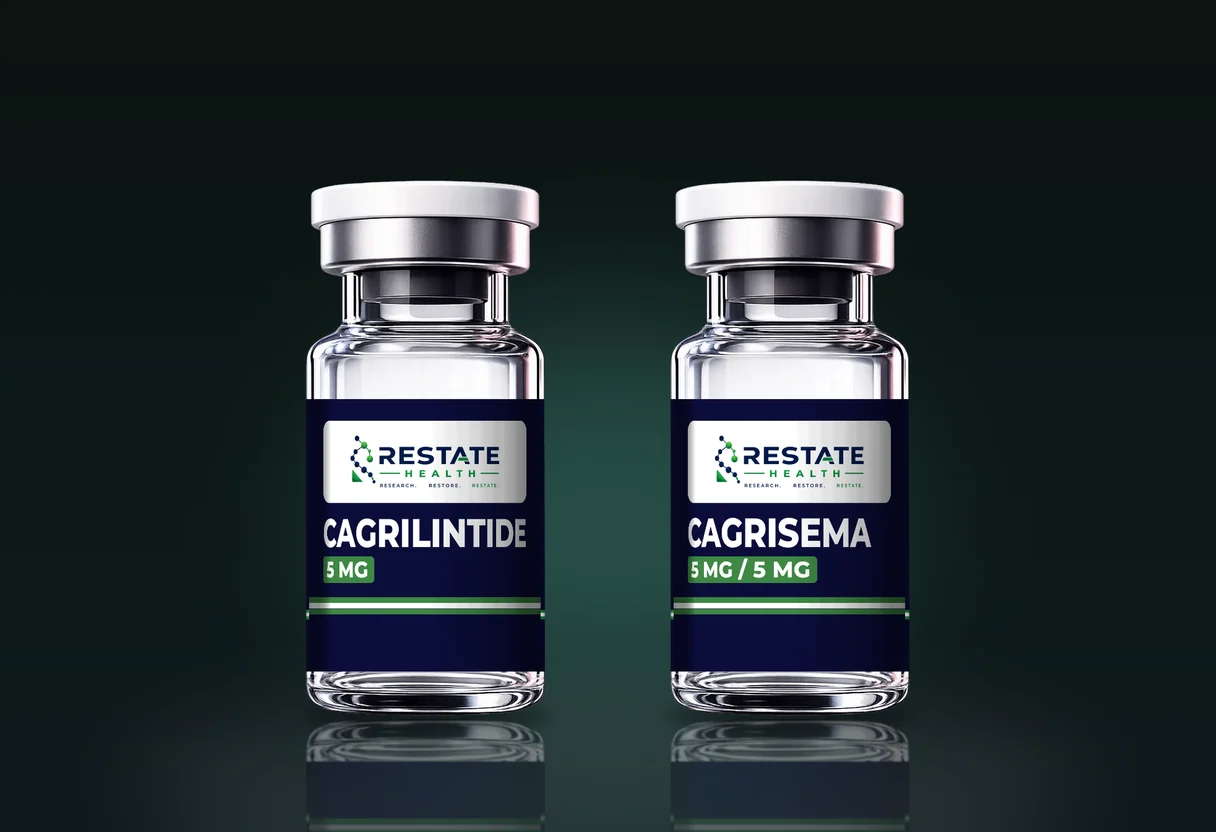
AM833 is a long-acting analogue of amylin, the 37-residue pancreatic hormone co-secreted with insulin. The catalogue lists it in 5 mg and 10 mg vials. AM833/NN9535 is the same peptide co-formulated with NN9535, listed as a single 5 mg / 5 mg vial and described in the record as a AM833 + NN9535 blend.
The first compound raises the questions any acylated peptide raises. The second raises one more, which is the subject of the second half of this guide: a vial with two peptides in it needs a certificate with two of everything. Both are supplied strictly for laboratory research.
Amylin, and why an analogue was needed
Amylin was identified in 1987 as the peptide making up the amyloid fibrils found in human insulinomas and in the pancreatic islets of diabetic cats, and shown to be a 37-residue peptide also present in normal islet cells (Westermark and colleagues, PNAS 1987). Its sequence has cysteines at positions 2 and 7, which form a disulfide, and the native hormone's strong tendency to aggregate into fibrils is what makes it impractical as a research material in solution.
Kruse and colleagues at Novo Nordisk published the development of AM833 in 2021, describing it as a stable, lipidated, long-acting amylin analogue and setting out the structure-activity work that led to it (J Med Chem 2021). Its earlier development code was AM833, and Fletcher and colleagues compared AM833 pharmacologically with six other agonists at calcitonin-family receptors in cell-based assays the same year (J Pharmacol Exp Ther 2021). Amylin receptors are calcitonin receptors paired with receptor activity-modifying proteins, which is why the comparison was made across that family.
The structure, as far as the catalogue record goes
The record gives AM833 37 amino acids, the same count as amylin, with the formula C194H312N54O59S2, a molecular weight of 4409.07 g/mol and CAS number 1415456-99-3. PubChem holds the same formula at CID 171397054 with a monoisotopic mass of 4406.25. The two sulfur atoms in the formula are what two cysteine residues contribute, consistent with the analogue keeping amylin's disulfide.
The record does not name the acyl chain or where it is attached, and this guide does not supply those details from anywhere else. What the primary paper establishes is that the analogue is lipidated: a fatty-acid group has been attached to the peptide so that it binds albumin and stays in circulation longer. GLP-1 and incretin peptides covers the same design principle across the incretin class, where it is the rule rather than the exception.
NN9535's record is more explicit and makes a useful comparison. It gives a 31-residue GLP-1 receptor agonist analogue with Aib at position 2 and Lys26 conjugated to γGlu-(AEEA)2-C18 diacid, with a C-terminal carboxylate, formula C187H291N45O59 and molecular weight 4113.58 g/mol. Lau and colleagues' 2015 paper describes the design of that lipidation (J Med Chem 2015). So in NN9535 the fatty acid is an eighteen-carbon diacid, attached to one named lysine through a linker made of a glutamate and two short spacers. That is what acylation looks like when a record spells it out.
What acylation changes for a buyer
- Mass. The fatty acid and its linker are inside the catalogue formula and molecular weight. An observed mass that reconciles with 4409.07 (average) or 4406.25 (monoisotopic) is consistent with the whole acylated molecule, and a mass worked out from a bare 37-residue chain would not match it.
- Solubility. An acyl chain makes the molecule more hydrophobic than its residue composition suggests, and acylated peptides are among the slowest in a catalogue to dissolve. The record lists AM833 as soluble in bacteriostatic water, with the COA to be consulted for specific solvent recommendations.
- Position. An intact mass cannot show which residue carries the chain. Two molecules with the same parts attached at different positions have the same formula. Only a fragment pattern, or the supplier's synthesis record, settles that.
- Purity. Acylated peptides tend to tail on reversed-phase HPLC and to show late-eluting aggregates. The record lists ≥99% by HPLC; the chromatogram, if supplied, shows whether the peak behind that number is clean.
AM833, NN9535 and AM833/NN9535 side by side
| RS-AMR1 | RS-SEM-1 | AM833/NN9535 | |
|---|---|---|---|
| Class | Long-acting amylin analogue | GLP-1 receptor agonist analogue | Co-formulation of both |
| Strengths listed | 5 mg, 10 mg | 5, 10, 20, 30 and 50 mg | 5 mg / 5 mg in one vial |
| Amino acid count | 37 | 31 | 37 and 31, two separate peptides |
| Molecular formula | C194H312N54O59S2 | C187H291N45O59 | Two formulas, not one |
| Molecular weight (g/mol) | 4409.07 | 4113.58 | Two masses, 295.49 g/mol apart |
| CAS number | 1415456-99-3 | 910463-68-2 | Two CAS numbers |
| Acylation named in the record | Not named; described as lipidated in the primary paper | Lys26, γGlu-(AEEA)2-C18 diacid | Both apply |
| Lot-matched certificate must carry | One identity, one purity, one content | One identity, one purity, one content | Two identities, two purities, two contents |
Figures for AM833 and NN9535 are the catalogue records. The AM833/NN9535 record carries only a strength, a synonym and an about line; its component figures are those of the two single-peptide records.
AM833/NN9535: one vial, two contents
The catalogue lists AM833/NN9535 as a research blend of AM833 with NN9535, 5 mg of each in one vial, studied for the combined effect of amylin and incretin signalling on metabolic endpoints. That is a co-formulation: two distinct peptides, lyophilised together. It is not a fusion peptide and not a single molecule, and its certificate cannot be read like one.
Peptide blends vs single vials sets out the general case. For this blend specifically, a certificate that has done its job shows the following, and a buyer should look for each item by name.
- Two identity results. One ion or fragment set reconciling with AM833 at 4409.07 g/mol, and a separate one reconciling with NN9535 at 4113.58 g/mol. The two are 295 Da apart, so a single intact-mass spectrum resolves both; the certificate should still report them as two findings, not one.
- Two purity figures, or a stated method for one. On reversed-phase HPLC the two peptides elute as two main peaks. A single purity figure for the vial is ambiguous: it may be the share of both main peaks together, in which case related impurities of either peptide are what is left; or it may be one peptide's figure applied to both. A certificate should say which, and the better practice is one figure per peptide.
- Two content figures. 5 mg / 5 mg is the label. The certificate should report the measured mass of each peptide, by amino acid analysis or another content method, because the two were dispensed separately before lyophilisation and can be off in opposite directions.
- A ratio check. 5 mg and 5 mg is a 1:1 ratio by mass, not by moles. Dividing by the two molecular weights gives 1.134 micromoles of AM833 to 1.216 micromoles of NN9535, about 7% more NN9535 molecules than AM833. A certificate does not need to state that, but a buyer planning work in molar terms does need to work it out.
- One lot number, on the vial and on the certificate, and one set of dates. The blend is one lot even though it has two components.
A certificate that gives one mass, one purity and one content for AM833/NN9535 has described half the vial. Mass spectrometry and peptide identity covers why reading two identities from one spectrum is routine for an analytical laboratory, which is to say there is no technical reason for a supplier not to report both.
What the clinical literature studied
Both compounds have been through clinical trials, and the limit of this guide is to say what was studied and nothing about what was found. Lau and colleagues reported a phase 2 trial of once-weekly AM833 in people with overweight and obesity in 2021 (Lancet 2021). Enebo and colleagues reported a phase 1b trial in which several levels of AM833 were given together with NN9535 (Lancet 2021). Frias and colleagues reported a phase 2 trial of AM833 given together with NN9535 in type 2 diabetes in 2023 (Lancet 2023).
Those papers are cited so that a reader can see what the co-formulation is and why the two peptides are paired in a research catalogue. They say nothing about the material in any vial, and the material in the catalogue is not the product used in those trials. It is research-grade peptide supplied with a certificate, and the certificate is the document that describes it.
Handling the pair
AM833's record gives storage of the lyophilised powder at -20°C, protected from light and moisture, with reconstitution in bacteriostatic water and the reconstituted solution refrigerated at 2-8°C. NN9535's record gives the same storage and reconstitution, with the reconstituted material refrigerated and used per laboratory protocol. The AM833/NN9535 record carries no handling line of its own, so the stricter of the two component records is the sensible default, and the lot's certificate should be consulted.
Two acylated peptides in one cake dissolve no faster than one. Allow time rather than agitation; shaking drives air into the solution, and the air-water interface is where peptides unfold and aggregate. Once in solution, the usual single-use portioning applies.
In short
AM833 is a 37-residue, disulfide-containing, acylated amylin analogue whose catalogue formula and mass include the acyl group even though the record does not name it. AM833/NN9535 is that peptide plus NN9535 in one vial, and its certificate has to carry two identities, two purities and two contents to describe what is inside. Check for all six lines before comparing one supplier's blend with another's.