
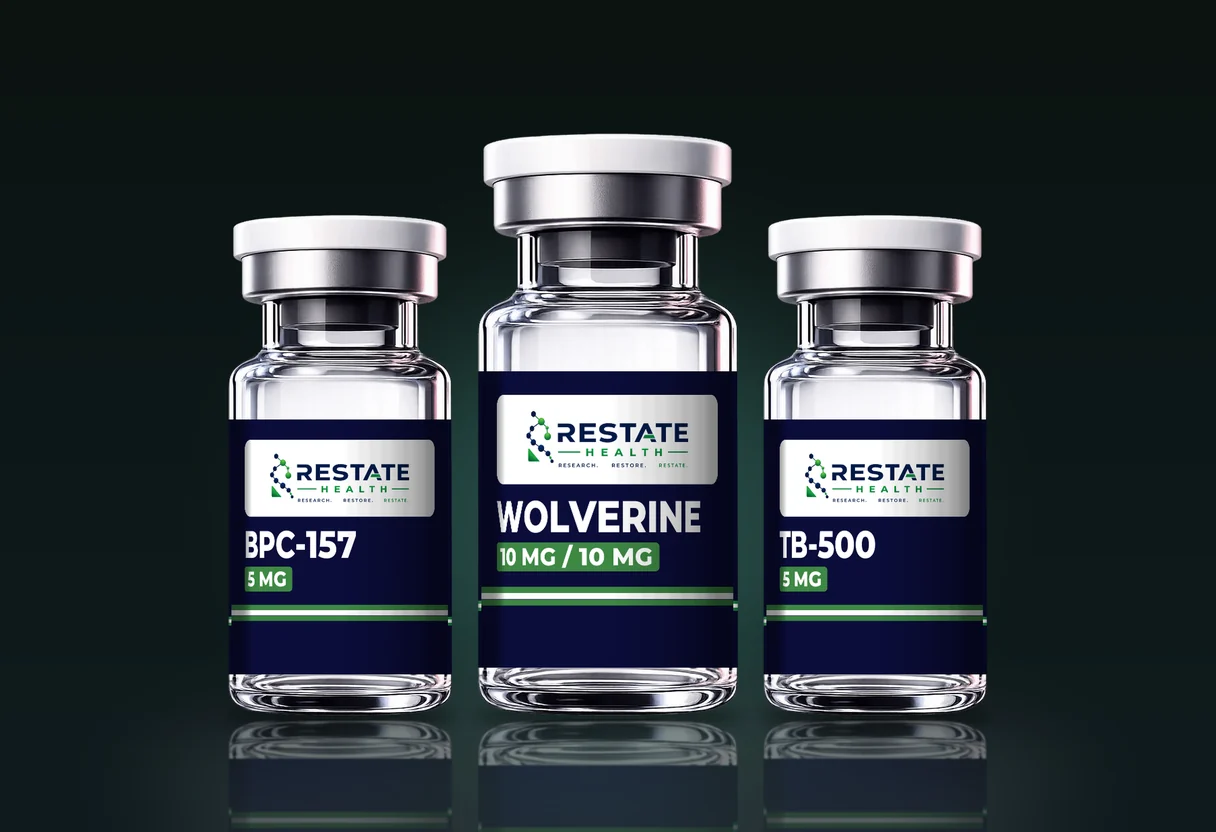
Wolverine is recorded in the catalogue as a blend of 10 mg of BPC-157 and 10 mg of TB-500, lyophilised together in a single vial at a listed price from $193.20. Two peptides, one lot number, one certificate. That last fact is where buying a blend differs from buying the two singles, and it is what this guide is about.
It is a different product from the BPC-157 and TB-500 FRAG blend, which is a separate catalogue entry pairing BPC-157 with the TB-500 FRAG listing at 50 mg / 50 mg and 100 mg / 100 mg. That blend has its own guide. Nothing below about Wolverine's strengths, price or certificate transfers to it.
Three things are covered here: what the catalogue record says is in the vial, what a certificate for two peptides has to carry before it has documented either of them, and the arithmetic of the blend against BPC-157 and TB-500 bought as singles.
| Wolverine | BPC-157 | TB-500 |
|---|---|---|
| Sequence | Gly-Glu-Pro-Pro-Pro-Gly-Lys-Pro-Ala-Asp-Asp-Ala-Gly-Leu-Val | Ac-Leu-Lys-Lys-Thr-Glu-Thr-Gln-OH |
| Molecular formula | C62H98N16O22 | C38H68N10O14 |
| Molecular weight | 1419.55 g/mol | 889.02 g/mol |
| Amino acid count | 15 | 7 |
| CAS number | 137525-51-0 | 885340-08-9 |
Vial strengths: 10 mg / 10 mg. From the Restate Health catalog record. Lot-specific values are on the certificate of analysis.
What the catalogue record says is in the vial
The blend record carries both compounds' identifiers side by side, and they match the single-vial records exactly.
- BPC-157: 15 residues, Gly-Glu-Pro-Pro-Pro-Gly-Lys-Pro-Ala-Asp-Asp-Ala-Gly-Leu-Val, formula C62H98N16O22, molecular weight 1419.55 g/mol, CAS 137525-51-0. PubChem CID 9941957 carries the same formula.
- TB-500: 7 residues, Ac-Leu-Lys-Lys-Thr-Glu-Thr-Gln-OH, formula C38H68N10O14, molecular weight 889.02 g/mol, CAS 885340-08-9. The PubChem record filed under that CAS number (CID 62707662) carries the same formula.
TB-500 is not the whole of thymosin beta-4. It is the acetylated seven-residue segment that contains the LKKTET motif, the stretch Van Troys and colleagues mapped as the actin-binding site of thymosin beta-4 by mutational analysis in 1996. Safer and colleagues had shown in 1991 that thymosin beta-4 and the actin-sequestering peptide Fx isolated from platelets were the same molecule, and the 2005 review by Goldstein, Hannappel and Kleinman covers the parent protein. A certificate mass that reconciles with 889.02 g/mol confirms the fragment; a much larger mass would mean the vial holds something other than what the record describes.
The two components differ in mass by about 530 daltons and differ in length, acetylation and charge. Two peptides this different would be expected to separate cleanly on a reversed-phase gradient and to appear as two distinct masses in a spectrometer. The certificate should show that both of those things happened.
One lot number for two syntheses
A blend is made from two bulk peptides, each with its own synthesis lot, combined in solution and then filled and lyophilised. The lot number on the Wolverine vial identifies that third step. The two upstream lots exist, and a supplier may or may not disclose them. Whether they do is the first question to ask, because every later question about one component's purity depends on being able to point at the material it came from.
The vial also carries one re-test date, and it has to be set by whichever component is the less stable in the shared cake. Re-test dates and expiry dates covers how that date is set; for a blend the point is that the date belongs to the pair, not to either peptide.
What a two-component certificate must carry
Identity, content and purity are the three lines that matter on any certificate. For a blend each of them has to be answered twice, and the purity line has to say what its denominator is.
- Identity: two. A mass spectrum showing two observed masses, one reconciling with 1419.55 and one with 889.02 g/mol, with the certificate stating whether those are average or monoisotopic values. A single observed mass has identified one of the two peptides.
- Content: two figures, each in milligrams of peptide per vial, each measured by HPLC against a reference standard for that peptide. A single figure of 20 mg cannot show the ratio, and the ratio is the product.
- Purity: either one figure per component, or a combined chromatogram with both main peaks named. The two are not equivalent, and the next section says which is acceptable.
The analytical principle behind all three lines is specificity: the method has to be shown to tell each analyte apart from the other component and from the impurities of both. ICH Q2(R2), the current guideline on validation of analytical procedures, sets that requirement out, and a blend certificate that does not state its method has not shown it was met.
One purity per component, or a combined chromatogram
There are three ways a supplier can report purity for a blend, and only two of them tell a buyer anything.
The complete answer is a purity figure for each component from the bulk lot before blending, because each of those chromatograms has one main peak and every other peak is an impurity of that peptide. This needs the two upstream certificates, or their figures transcribed onto the blend certificate with the upstream lot numbers named.
The acceptable answer, where upstream figures are not released, is a chromatogram of the blend itself with both main peaks identified by retention time and each main peak reported as its own share of total area. That shows how much of the vial is neither peptide. What it cannot show is which component an impurity belongs to, or whether a degradation product of one peptide sits under the other's main peak. It is a real result with a known limit.
The unacceptable answer is a single figure with no method statement. The catalogue record for the blend reads "≥99% by HPLC", and a certificate that repeats that line has to say whether 99% is the sum of two main peaks over total area, the lower of two per-component figures, or something else. Without that, the line is a label rather than a measurement.
| Certificate line | Single vial | Wolverine blend | Not acceptable for the blend |
|---|---|---|---|
| Identity | One observed mass, reconciled with the record | Two observed masses, reconciled with 1419.55 and 889.02 g/mol | One mass; or a mass with no statement of average versus monoisotopic |
| Content | One figure in mg of peptide | Two figures, one per peptide, by HPLC against a standard for each | A single total such as 20 mg |
| Purity | Main peak over total area | Per-component figures from the bulk lots, or a blend chromatogram with both main peaks named and reported separately | A single ≥99% with no method statement or denominator |
| Lot | The synthesis lot | The blend lot, ideally with both upstream lots named | A certificate for the product line rather than the lot |
| Re-test date | Set for one peptide | One date, set by the less stable component | Two dates on one vial, or none |
What each certificate line has to show for a single vial and for the two-component Wolverine blend, against the catalogue record values.
The arithmetic against the two singles
The catalogue record lists Wolverine from $193.20 for 10 mg plus 10 mg. The single records list BPC-157 from $56 and TB-500 from $98, and in both cases the "from" price belongs to the smallest listed strength, which is 5 mg for each. That makes a like-for-like figure impossible from the record alone, and the table says so rather than inventing one.
| Item | Nominal peptide | Price from | Nominal price per mg |
|---|---|---|---|
| Wolverine blend | 10 mg BPC-157 + 10 mg TB-500 (20 mg) | $193.20 | $9.66 |
| BPC-157 single, smallest strength | 5 mg | $56.00 | $11.20 |
| TB-500 single, smallest strength | 5 mg | $98.00 | $19.60 |
| Both singles at the from prices | 5 mg + 5 mg (10 mg) | $154.00 | $15.40 |
| Both singles scaled to the blend's mass | 10 mg + 10 mg (20 mg) | Read the 10 mg prices from the product pages | Depends on those prices |
Catalogue record prices on 21 October 2026. The single-vial figures are the "from" prices and belong to the 5 mg strength; the 10 mg single prices are on the product pages and change the last row.
Two things follow. At the from prices the blend buys twice the nominal peptide for about 25% more money, which is a real difference and also not the whole comparison, because larger single vials are normally cheaper per milligram than the smallest strength. The comparison that matters is the one made against the 10 mg single prices on the day of ordering.
The second is that every figure above is nominal mass. The certificate content figures, not the label, are what the price should be divided by, and for a blend there are two of them. A blend whose certificate states one total content cannot be priced per milligram of either peptide at all.
When a laboratory would rather have singles
- Separate lots. Two singles carry two lot numbers, each traceable to its own synthesis and its own certificate with one main peak. If a result ever has to be traced to the material, that chain is shorter and clearer than one blend lot with two upstream lots behind it.
- Separate re-test dates. Each single ages on its own schedule. The blend's single date is set by the less stable component, so the more stable peptide is retired early.
- Separate storage clocks. Once reconstituted, a blend vial is one solution, and both peptides share every entry, every freeze-thaw cycle and every day of age. A laboratory that consumes one of the two faster than the other ages the slower one for nothing. With singles, each vial's clock runs only as fast as it is used.
- A different ratio. The blend is fixed at 10 mg to 10 mg by mass. By moles that is not one to one: 10 mg of TB-500 at 889.02 g/mol is about 11.25 micromoles, and 10 mg of BPC-157 at 1419.55 g/mol is about 7.04 micromoles, so the vial holds roughly 1.6 TB-500 molecules for every BPC-157 molecule. Work that needs any other ratio needs singles.
The blend earns its place where the fixed ratio is the one wanted, both components are consumed at the same rate, and one vial, one reconstitution and one set of entries is worth the documentation cost. Blends and single vials sets out that cost in general terms; this guide is the Wolverine-specific version of it.
Storage as the record states it
The blend record and both single records carry the same storage line: store lyophilised at -20°C, protect from light and moisture, reconstitute with bacteriostatic water and refrigerate the reconstituted solution at 2-8°C. Nothing about the blend changes that. What changes is that the reconstituted vial is one solution, so the aliquoting and entry-count habits that protect a single vial protect both peptides at once, or neither.
What to check before ordering and on arrival
- That the certificate offered is for the lot you will receive, and that it names both peptides.
- Two identity masses, with the mass basis stated.
- Two content figures in milligrams, not one total.
- A purity statement that says what was measured and over what denominator, per the section above.
- Whether the two upstream lot numbers are available on request.
- On arrival, the lot on the vial read in full against the certificate, and the cake inspected before the vial is put away.
What this guide does not cover
Effects. The two components have separate literatures: BPC-157 was described by Sikirić and colleagues in 1993 as a gastric juice peptide studied in rat models, and the thymosin beta-4 literature is about an actin-sequestering protein. Neither literature is about a blend, and nothing in a buying guide speaks to outcomes in any organism. Wolverine is supplied for laboratory research only. What documentation can settle is which two molecules are in the vial, how much of each, how pure each is, and whether the lot in front of you is the one described.