
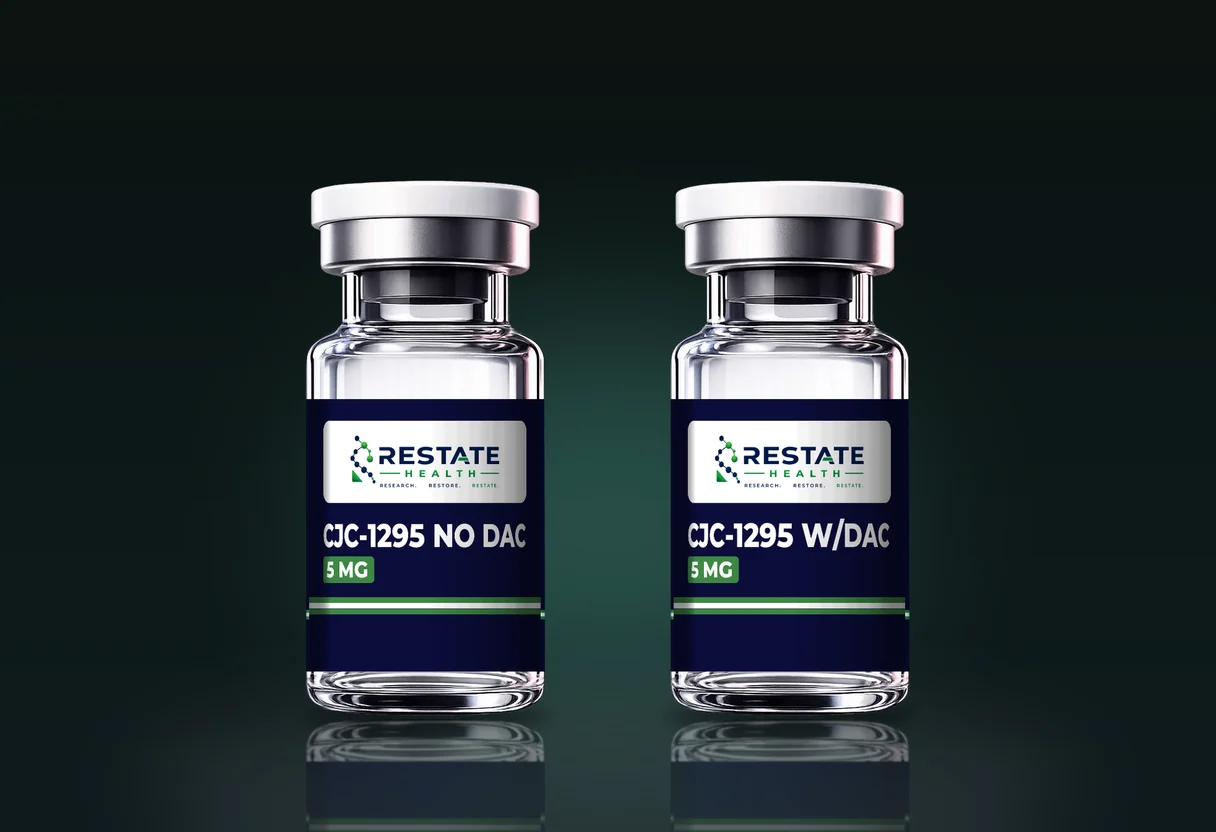
Two catalogue entries carry the name CJC-1295. CJC-1295 No DAC is a 29-residue analogue of growth-hormone-releasing hormone with four substitutions and nothing else. CJC-1295 w/DAC is the same 29 residues with a Drug Affinity Complex attached, a short linker that ends in a maleimide and reacts with serum albumin. The two are different molecules, and the catalogue records give them different formulas and different masses.
The name does not reliably tell a buyer which one they are looking at. Across the market the shared label has been applied loosely in both directions. The intact mass on a certificate of analysis does tell them apart, because the two differ by 279 g/mol and no amount of relabelling changes that. This guide sets out what the difference is, where it came from, and how to read the certificate for it.
| Compound | Vial strengths | Molecular weight | Amino acids |
|---|---|---|---|
| CJC-1295 No DAC | 5 mg, 10 mg | 3367.93 g/mol | 29 |
| CJC-1295 w/DAC | 5 mg, 10 mg | 3647.25 g/mol | 29 |
From the Restate Health catalog records. Lot-specific values are on each certificate of analysis.
What the name CJC-1295 was coined for
The designation comes from a 2005 paper in Endocrinology by Jetté and colleagues, who were building albumin-binding conjugates of human GRF(1-29). They identified one of them as a long-lasting analogue and named it CJC-1295. The molecule they named was the albumin-binding one, in other words the form now sold as "with DAC". The paper reports receptor activation on anterior pituitary cells and work in rats.
The phrase "without DAC" is a market coinage for the underlying peptide with the linker left off. That peptide has its own older name, modified GRF(1-29) or Mod GRF(1-29), and the catalogue record lists both synonyms. Where a paper or a supplier writes CJC-1295 without qualification, the strict reading is the DAC form, but in practice the word is used for either, which is why the certificate rather than the label is the authority.
The four substitutions in the peptide both forms share
The parent sequence is GRF(1-29) amide, the 29-residue fragment of growth-hormone-releasing hormone that is sold as sermorelin. The 2005 paper describes four changes to it, each with a stabilising purpose. Read against the sermorelin sequence in the catalogue record, they fall at positions 2, 8, 15 and 27.
| Position | In GRF(1-29) | In modified GRF(1-29) | Why |
|---|---|---|---|
| 2 | L-Ala | D-Ala | Resists cleavage after residue 2 by dipeptidyl peptidase IV, the enzyme that inactivates GHRH in plasma |
| 8 | Asn | Gln | Removes an asparagine that deamidates readily |
| 15 | Gly | Ala | Favours the helical conformation the receptor recognises |
| 27 | Met | Leu | Removes the methionine that oxidises on storage |
Positions read from the sermorelin sequence in the catalogue record (Tyr-Ala-Asp-Ala-Ile-Phe-Thr-Asn-Ser-Tyr-Arg-Lys-Val-Leu-Gly-Gln-Leu-Ser-Ala-Arg-Lys-Leu-Leu-Gln-Asp-Ile-Met-Ser-Arg-NH2). The purpose column follows the account in Jetté and colleagues (2005).
Three of the four changes show up in the formula. Asn to Gln and Gly to Ala each add CH2, and Met to Leu removes the sulfur. Against sermorelin's C149H246N44O42S at 3357.93 g/mol, the no-DAC record gives C152H252N44O42 at 3367.93 g/mol: three carbons and six hydrogens gained, one sulfur lost, ten grams per mole heavier. The fourth change, L-Ala to D-Ala, has no mass at all, since an enantiomer has the same formula as its mirror image. A certificate cannot see it, which is a general limitation of mass-based identity covered in mass spectrometry and peptide identity.
What the Drug Affinity Complex is
The DAC is a lysine added at the C-terminus whose side-chain amine carries a 3-maleimidopropionyl group. Maleimides react selectively with free thiols, and serum albumin has a single free cysteine, Cys34. In the 2005 paper the conjugate forms a covalent bond to that cysteine, so the peptide travels with albumin and is cleared on albumin's timescale rather than its own. The design intention was persistence in circulation, and the 2006 study by Teichman and colleagues in healthy adults is the human pharmacokinetic work the "long-acting" description rests on.
The arithmetic confirms the structure. The DAC record's formula, C165H269N47O46, exceeds the no-DAC formula by C13H17N3O4. A lysine residue contributes C6H12N2O and a 3-maleimidopropionyl group, as an acyl addition, contributes C7H5NO3; together they are exactly C13H17N3O4, and the mass difference in the records, 3647.25 less 3367.93, is 279.32 g/mol. Both records give an amino acid count of 29, which is consistent with the linker lysine being counted as part of the complex rather than as a thirtieth residue of the GRF sequence.
One consequence worth knowing before the vial is opened: a maleimide is thiol-reactive by design, so any solution containing free thiols (dithiothreitol, mercaptoethanol, glutathione, cysteine) will react with the DAC form. That is plain chemistry rather than a published finding, and it is the reason the two forms should not be assumed interchangeable in a protocol.
The two records side by side
| CJC-1295 No DAC | CJC-1295 w/DAC | |
|---|---|---|
| Synonyms as recorded | Mod-GRF(1-29); CJC-1295 without DAC | CJC-1295 with Drug Affinity Complex; DAC:GRF |
| Amino acid count | 29 | 29 |
| Molecular formula | C152H252N44O42 | C165H269N47O46 |
| Molecular weight | 3367.93 g/mol | 3647.25 g/mol |
| CAS number | 863288-34-0 | Not listed |
| Strengths | 5 mg, 10 mg | 5 mg, 10 mg |
| From | $112 | $182 |
| Difference | +C13H17N3O4, +279.32 g/mol (one lysine with a 3-maleimidopropionyl group) |
Figures from the two catalogue records. The DAC record lists no CAS number, so the certificate for that product should be read on name, formula and mass. Prices are the lowest listed strength at the time of writing.
The PubChem record that carries the name CJC-1295 (CID 91971820) gives the formula C165H269N47O46 and a molecular weight of 3647.2, which matches the DAC record and confirms which molecule the name was registered for.
Which one is in my vial: reading the certificate
Three lines on the certificate settle it. First the intact mass. An observed mass that reconciles with 3367.93 is the no-DAC peptide; one that reconciles with 3647.25 is the DAC form. The gap is 279 g/mol, around eight percent of the molecule, and no mass spectrometer in routine use will confuse them. Check whether the figure is reported as average or monoisotopic before comparing: PubChem lists the monoisotopic mass of the DAC form as 3645.02, roughly two daltons below the average figure.
Second, the formula or the named compound on the identity line. A certificate that says "CJC-1295" and reports a mass near 3368 is describing modified GRF(1-29) under the loose name, and the mass wins. Third, the chromatogram, if one is supplied. The DAC form, with its hydrophobic maleimide and extra lysine, will not elute where the bare peptide does on a reversed-phase column, so two certificates from the same laboratory should show two different retention times.
What the certificate cannot show is the D-alanine at position 2, for the mass reason given above, nor whether the maleimide ring is intact or has hydrolysed in storage, unless a method sensitive to that change is listed. Those are questions for the supplier, and how to verify a certificate of analysis covers how to ask them.
What the published work describes
The two catalogue records frame the difference in the terms the literature uses. The no-DAC entry describes a short-acting analogue studied for pulsatile growth hormone signalling; the DAC entry describes an albumin-bound analogue studied for sustained growth hormone and IGF-1 signalling. The 2005 paper reports the receptor and rat work for the conjugates; the 2006 paper reports the pharmacokinetics in healthy adults. Both are cited below as what was studied.
The broader class, and where these two sit among the GHRH analogues and the ghrelin-receptor hexapeptides they are often paired with, is set out in growth hormone secretagogues explained. The pairing question matters for buying: several blends in the market combine a GRF analogue with a hexapeptide, and the GRF component may be either form. Buying growth hormone axis blends covers how to find out which, and the answer is the same as for a single vial. Ask for the certificate and read the mass.
A second mass the DAC form can show
The maleimide ring is the reactive part of the DAC and it is also the fragile part. In water, and faster as the pH rises above neutral, a maleimide ring opens by hydrolysis to the corresponding maleamic acid. The ring-opened form has taken up one molecule of water, so it is eighteen daltons heavier than the intact conjugate, and it no longer reacts with thiols. That is general bioconjugation chemistry rather than a finding specific to this peptide, and it has a direct reading on a certificate.
A mass spectrum of the DAC form that shows a satellite at +18 against the main peak, or a chromatogram with a second peak eluting just ahead of the product, is consistent with partial hydrolysis of the maleimide. The lyophilised solid is where the ring is most stable, because the water that the reaction needs has been removed; the clock starts at reconstitution. For a buyer the practical consequences are to keep the material dry until it is used, to prefer a certificate issued on the lot as supplied rather than on a solution, and to ask the supplier whether the identity method would have resolved the hydrolysed form from the intact one. A certificate that reports a single mass at 3647 has established the intact conjugate; one that reports a single mass at 3665 has established something else.
Buying notes
- Both forms are supplied at 5 mg and 10 mg. The DAC form is priced higher, which follows from the extra synthetic step of adding the linker and the additional purification it needs.
- On a first order from any supplier, the 5 mg vial and its certificate are the test. The certificate should name the lot, report an intact mass, and that mass should reconcile with the form ordered.
- Record which form was received, by mass, not by label. A later reader of the records cannot recover that from the name.
- If the material is going into any solution that contains a thiol reagent, the DAC form will react with it. Plan the protocol around the molecule rather than the name.
In short
CJC-1295 without DAC is modified GRF(1-29): four substitutions on the sermorelin sequence, 3367.93 g/mol. CJC-1295 with DAC is that peptide plus a lysine carrying a maleimide, 3647.25 g/mol, and the maleimide is what binds albumin. The label is used loosely across the market; the 279 g/mol gap on the certificate is not.