
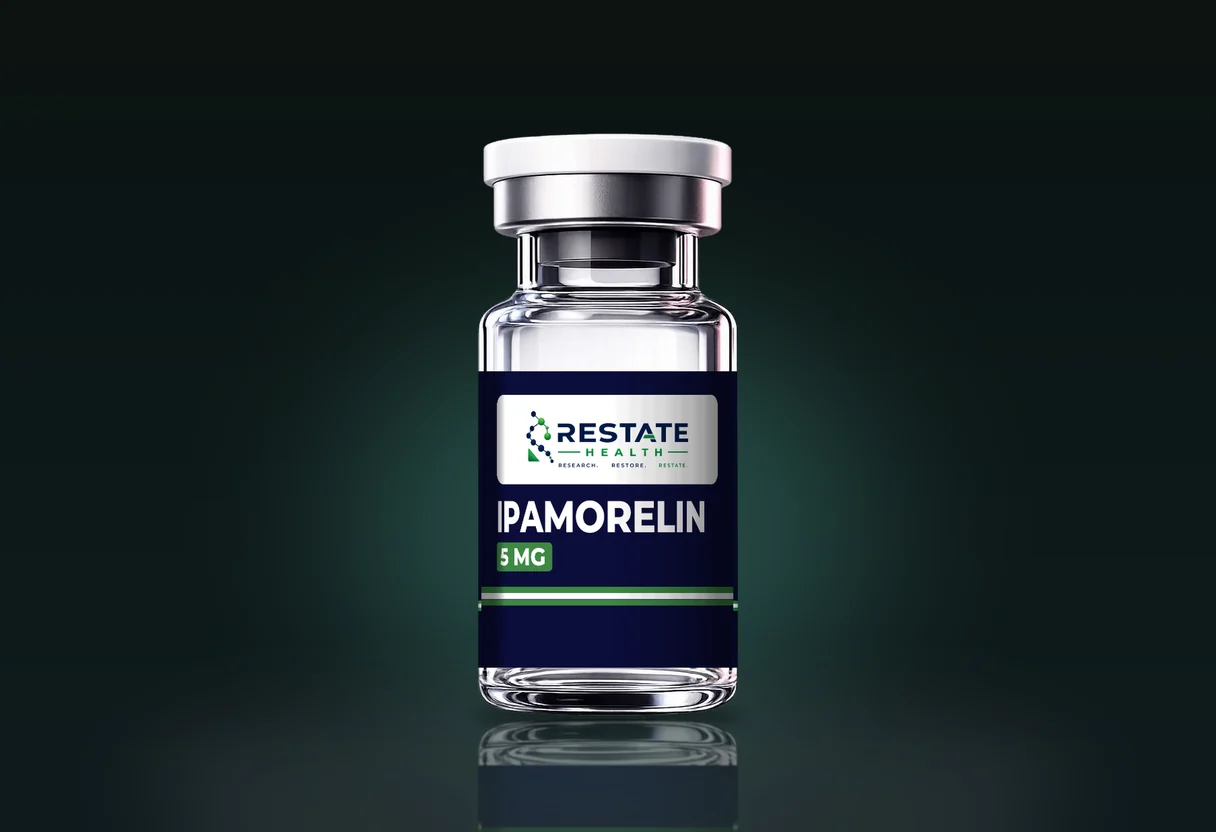
Ipamorelin is the smallest molecule in the growth-hormone-axis part of the catalogue and one of the least expensive, and it appears twice: alone at 5 mg and 10 mg, and as half of the CJC / Ipamorelin blend. A buyer therefore has two decisions, not one: which strength, and whether to buy it alone at all.
This guide covers the sequence and why its unusual residues change what a certificate can show, the prices per milligram across the single and the blend, and the documentation difference between one vial containing one peptide and one vial containing two.
| Ipamorelin | Catalog specification |
|---|---|
| Vial strengths | 5 mg, 10 mg |
| Sequence | Aib-His-D-2-Nal-D-Phe-Lys-NH2 |
| Molecular formula | C38H49N9O5 |
| Molecular weight | 711.85 g/mol |
| Amino acid count | 5 |
| CAS number | 170851-70-4 |
From the Restate Health catalog record. Lot-specific values are on the certificate of analysis.
A pentapeptide with three non-standard residues
The catalogue record gives the sequence as Aib-His-D-2-Nal-D-Phe-Lys-NH2, with the formula C38H49N9O5, a molecular weight of 711.85 g/mol and CAS number 170851-70-4. Five residues. Only two of them, histidine and lysine, are standard L-amino acids.
- Aib is α-aminoisobutyric acid, an achiral residue with two methyl groups on the α-carbon. PubChem records it as C4H9NO2 at 103.12 g/mol under CID 6119.
- D-2-Nal is 3-(2-naphthyl)-D-alanine, a phenylalanine-like residue with a naphthalene ring in place of the benzene ring, in the D-configuration. PubChem records it as C13H13NO2 at 215.25 g/mol under CID 2733661.
- D-Phe is the D-isomer of phenylalanine, identical in formula and mass to the standard residue.
The C-terminus is an amide. Ipamorelin was described in 1998 by Raun and colleagues in the European Journal of Endocrinology, who characterised it in rat pituitary cell cultures and in rats and swine as a growth hormone secretagogue acting without the release of other pituitary hormones that earlier compounds in the series had produced in those models. The receptor the class acts on was cloned by Howard and colleagues in 1996, and its natural ligand, ghrelin, was identified by Kojima and colleagues in 1999. Growth hormone secretagogues explained covers the class; this guide stays with the vial.
Strengths and prices, single and blend
The catalogue lists ipamorelin alone at 5 mg and 10 mg, the CJC / Ipamorelin blend at 5 mg / 5 mg and 10 mg / 10 mg, and CJC-1295 (no DAC) alone at 5 mg and 10 mg. The listed prices at the time of writing are below, with per-milligram figures worked out from nominal label mass.
| Item | Strength | Listed price | Price per nominal mg |
|---|---|---|---|
| Ipamorelin | 5 mg | $47.60 | $9.52 |
| Ipamorelin | 10 mg | $64.40 | $6.44 |
| CJC / Ipamorelin blend | 5 mg / 5 mg | $103.60 | $10.36 |
| CJC / Ipamorelin blend | 10 mg / 10 mg | $198.80 | $9.94 |
| CJC-1295 (no DAC) | 5 mg | $112.00 | $22.40 |
| CJC-1295 (no DAC) | 10 mg | $182.00 | $18.20 |
| Both singles at 5 mg | 5 mg + 5 mg | $159.60 | $15.96 |
| Both singles at 10 mg | 10 mg + 10 mg | $246.40 | $12.32 |
Strengths and prices from the Restate Health catalogue records, October 2026. Blend rows divide the listed price by the total nominal mass of both peptides. Certificate content, not label mass, is the figure to use once a lot is in hand.
Two things stand out. For ipamorelin alone the 10 mg vial is markedly cheaper per milligram, $6.44 against $9.52, so the usual sizing argument applies and the question is only whether a 10 mg vial is finished before the material ages. For the blend, the listed price is below the two singles bought separately at the same nominal masses, by $56 at the 5 mg level and by $47.60 at the 10 mg level.
The price difference is not the whole comparison, because the blend and the pair of singles are different products in ways that matter to documentation, which the next section covers.
Single vial or the blend
A blend is two peptides lyophilised together in one vial, under one lot number, with one certificate. That certificate has to establish two identities and report two contents, and buying growth-hormone-axis blends covers what a blend certificate has to show in detail.
The structural consequence is that the ratio is fixed by the supplier. The catalogue blend is 1:1 by nominal mass at both strengths. By molar quantity it is nothing like 1:1, because the catalogue record gives CJC-1295 (no DAC) a molecular weight of 3367.93 g/mol against 711.85 for ipamorelin: equal masses mean roughly 4.7 times as many ipamorelin molecules as CJC-1295 molecules. Whether that is what a piece of work needs is a question only the buyer can answer, and buying the two singles leaves the ratio open.
The documentary consequence is that one lot number now covers two molecules, so a problem with either one is a problem with the vial. Two singles carry two lots and two certificates, and a question about one does not touch the other. Peptide blends versus single vials sets out the trade-off in general; for this pair the specific points are the fixed mass ratio and the single certificate.
The practical rule most buyers settle on: the blend where the fixed ratio is the ratio wanted and convenience matters; the singles where the ratio is a variable, or where the two components are consumed at different rates and one would otherwise be discarded.
What the certificate must show
Lot number against the vial, dates running forwards, then identity, purity and content. For a molecule this small the identity line has a feature the longer peptides do not share: the average and monoisotopic masses are close. PubChem gives 711.39 as the monoisotopic mass for C38H49N9O5 under CID 9831659, against the catalogue's 711.85 average, so an observed mass of 711.4 or 712.9 for the protonated molecule is consistent with the compound whichever basis the laboratory used. The two conventions are the average and the monoisotopic mass, and the certificate should say which it reports.
The residue-sum check that works for ordinary peptides needs two extra numbers here, because Aib and 2-Nal are not in a table of the twenty standard residues. A residue is the free amino acid less one water. From the PubChem figures above, the Aib residue is 103.12 minus 18.02, or 85.11, and the 2-Nal residue is 215.25 minus 18.02, or 197.23. With standard average residue masses for histidine (137.14), phenylalanine (147.18) and lysine (128.17), the five residues sum to 694.83. Add one water for the chain ends (18.02) and subtract 0.98 for the amide in place of the free acid, and the result is 711.87, which agrees with the catalogue figure of 711.85 to within rounding. A buyer can do that on paper, and it is a check that the certificate's stated mass is the right target.
What mass spectrometry cannot show is chirality. D-2-Nal and D-Phe have the same formula and mass as their L-forms, so a certificate that reports an intact mass has confirmed the composition and not the stereochemistry. Where a certificate states the D-configuration as a tested result, the method should be a chiral one, usually amino acid analysis after hydrolysis on a chiral column. Where it states it as the specification, that is a claim about the synthesis rather than a measurement, and it is reasonable to ask which. Mass spectrometry and peptide identity covers what each method can establish.
Routine identification of ipamorelin by liquid chromatography and mass spectrometry is well established: Thomas and colleagues published a method in 2011 that detects it alongside other secretagogues of the class at trace levels in urine for doping control. A testing laboratory asked for a specific identity method for this compound has published precedent to work from.
Two things that vary between suppliers
- The salt form. Trifluoroacetate or acetate, rarely printed on the certificate, always answerable. For a molecule of 711.85 g/mol with a free N-terminal amine and basic histidine and lysine side chains, the counter-ion is a larger fraction of the powder mass than it is for a long peptide, which makes the question more important here rather than less.
- The net peptide content. The measured mass of peptide in the vial, which is what the label mass approximates. It is the number to divide the price by once a lot is in hand, and the number every later calculation uses.
A supplier who can answer both quickly, from the document, has told you more than the price list did.
Storage and what to check on arrival
The catalogue record specifies the lyophilised powder at -20 °C, protected from light and moisture, with the reconstituted solution at 2 to 8 °C. The naphthalene ring of 2-Nal absorbs in the ultraviolet, so protection from light is not a formality for this compound. The sequence contains no methionine, cysteine or tryptophan, so the commonest oxidation routes do not apply; the asparagine and glutamine deamidation routes do not apply either, since neither residue is present.
- Lot number on every vial against its certificate, reading the full string.
- For the blend, that the certificate reports both identities and both contents under the one lot.
- Strength on the vial against the packing list; 5 mg and 10 mg vials of a 711.85 g/mol peptide look identical and hold very little visible powder.
- The certificate stored with your own records.
In short
Ipamorelin is a five-residue amide with three non-standard residues, 711.85 g/mol in the catalogue record. Alone it is $47.60 at 5 mg and $64.40 at 10 mg, and the larger vial is cheaper per milligram. The blend with CJC-1295 lists below the two singles but fixes a 1:1 mass ratio, which is about 4.7:1 by molecules, under one lot and one certificate. The certificate can confirm composition by mass and purity by HPLC; it can only confirm stereochemistry by a chiral method, and it is fair to ask which it used.